Topic 3.10 Notes – Social Movements and Equal Protection
Civil Rights and Equal Protection
Civil rights mean protection against discrimination and equal treatment under the law. That is different from civil liberties, which protect you from government interference in freedoms like speech or religion.
The main constitutional base is the Fourteenth Amendment. It says states cannot deny any person due process or equal protection. That phrase matters because it protects persons, not only citizens.
- Due process clause protects life, liberty, and property from unfair government action.
- Equal protection clause lets people challenge laws that treat groups differently without a good reason.
The Fourteenth Amendment mainly restrains state and local governments. Public schools, state laws, police departments, and city governments all fall under it.
The federal government is covered too, but through the Fifth Amendment’s due process clause. The chart below is a helpful reminder that equal protection is tied to the Fourteenth Amendment’s limits on the states, and that the Fifth Amendment is the path the Court uses for similar limits on the federal government.
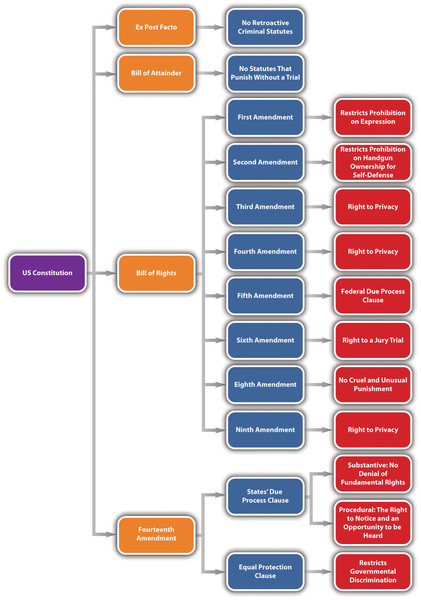
Constitutional roots of due process and equal protection
One limit trips students up a lot. The Constitution usually targets state action, not purely private discrimination. That is why acts of Congress matter so much.
- Title II, Title VII, and Title IX reach discrimination in places the Constitution by itself often cannot.
- Equal protection does not mean every person must be treated identically. Government can classify people if it has enough justification.
Standards of review
| Classification | Standard | Government must show |
|---|---|---|
| Race, national origin | Strict scrutiny | compelling interest and narrow tailoring |
| Sex | Intermediate scrutiny | important interest and substantial relation |
| Most others | Rational basis | legitimate interest and rational relation |
How Social Movements Use Constitutional Rights
A social movement is a sustained collective effort to create political, legal, or social change. The Constitution gives movements a language of rights and a target for action.
Common methods include:
- Protests and marches to create public pressure
- Boycotts and civil disobedience to disrupt unjust systems
- Litigation to challenge laws in court
- Lobbying to push lawmakers
- Voter registration and elections to change who holds power
- Public education and coalition building to expand support
Constitutional rights help movements in several ways:
- They provide a standard for calling laws unjust.
- They give a legal basis for court challenges.
- They give movements legitimacy by tying demands to American ideals.
- They point activists toward institutions they can pressure, like courts, Congress, presidents, states, and even the amendment process.
The pattern usually looks like this:
- Identify unequal treatment.
- Organize and mobilize.
- Litigate and pressure institutions.
- Win rulings or legislation.
- Fight over enforcement.
- Face resistance or counter-movements.
A court win matters, but it does not automatically create equality in daily life.
The Civil Rights Movement
The civil rights movement aimed to end Jim Crow segregation and racial discrimination.
Brown v. Board of Education
In Brown v. Board of Education (1954), the Supreme Court ruled that racial segregation in public schools violated equal protection. The key line was that “separate educational facilities are inherently unequal.”
That overturned separate-but-equal in public education and showed how equal protection could directly fuel social change. The fight to enforce school desegregation brought fierce resistance, as seen in Little Rock a few years later.
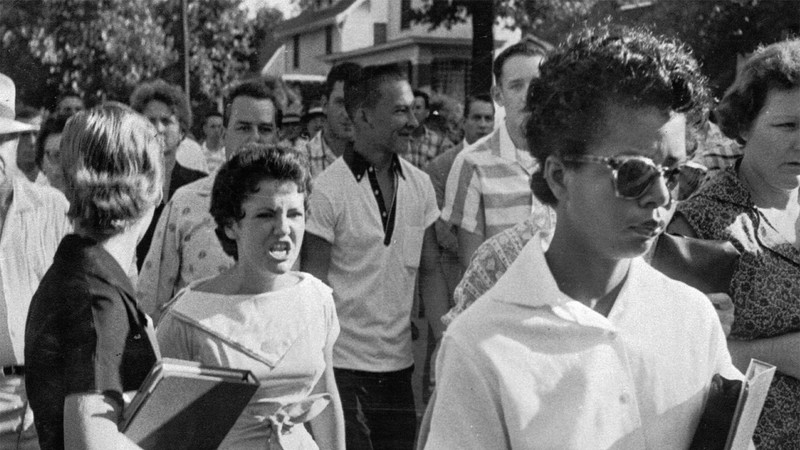
Elizabeth Eckford during the Little Rock school desegregation crisis, 1957
Letter from a Birmingham Jail
In 1963, Martin Luther King Jr. defended nonviolent direct action. He argued that waiting for justice usually means justice never comes.
His four steps were:
- Fact finding
- Negotiation
- Self-purification
- Direct action
King said just laws respect human dignity. Unjust laws degrade people or are imposed unequally. Civil disobedience should be open, nonviolent, and willing to accept punishment. That argument gave moral and political support to protest as a tool for constitutional change.
Major legislation
- Title II of the Civil Rights Act of 1964 bans discrimination in public accommodations like hotels and restaurants.
- Title VII of the Civil Rights Act of 1964 bans employment discrimination based on race, color, religion, sex, and national origin.
Women’s Rights and LGBTQ Rights
The women’s rights movement pushed for equality in work, education, politics, and reproductive autonomy.
- National Organization for Women, founded in 1966, used lobbying, litigation, protest, and public education.
- It also backed the Equal Rights Amendment, which was proposed but never ratified.
Reed v. Reed
In Reed v. Reed (1971), the Court struck down a law that automatically preferred men over women as estate administrators. It was the first Supreme Court case invalidating a sex-based classification under equal protection.
Title IX
Title IX (1972) bans sex discrimination in federally funded education programs. You usually see it linked to athletics, but it covers educational opportunities more broadly.
LGBTQ rights
LGBTQ advocacy uses both equal protection and due process/liberty arguments.
- Romer v. Evans (1996) struck down a Colorado amendment targeting protections for gay and lesbian people.
- Obergefell v. Hodges (2015) protected same-sex marriage under due process and equal protection.
- Bostock v. Clayton County (2020) held that Title VII protects gay and transgender employees.
That last case is statutory, not a pure equal protection ruling. That distinction matters on tests.
Pro-Life and Pro-Choice as Competing Constitutional Movements
These movements show that the Constitution can inspire opposing sides.
- Pro-choice arguments stress privacy, liberty, bodily autonomy, and women’s equality. They were historically tied to Roe v. Wade (1973).
- Pro-life arguments stress protection of prenatal life and government power to restrict abortion. One constitutional route was the proposed Hatch Amendment (1981), which failed.
In Dobbs v. Jackson Women’s Health Organization (2022), the Court overturned Roe and returned abortion policy mainly to legislatures. That pushed conflict into elections, state laws, Congress, courts, and amendment efforts.
Key Takeaways
Civil Rights
Protections against discrimination and guarantees of equal treatment under the law, based on characteristics such as race, national origin, religion, and sex
Social Movement
Sustained collective activity seeking political, legal, or social change through methods such as protest, litigation, lobbying, and elections
Fourteenth Amendment
Constitutional amendment that bars states from denying any person due process or equal protection and authorizes Congress to enforce those guarantees
Equal Protection Clause
Fourteenth Amendment provision barring states from denying any person equal protection of the laws; the main basis for challenging unjustified government classifications
Due Process Clauses of the Fifth and Fourteenth Amendments
The Fifth Amendment restrains the federal government and the Fourteenth restrains the states; both protect life, liberty, and property, and Fifth Amendment due process also imposes equality principles on the federal government
State-Action Requirement
The Fourteenth Amendment directly restricts state and local government discrimination, not purely private conduct, which is generally reached through legislation
Strict Scrutiny
Review applied to racial and national-origin classifications, requiring a narrowly tailored means of serving a compelling governmental interest
Intermediate Scrutiny
Review applied to sex classifications, requiring them to be substantially related to an important governmental interest
Rational Basis Review
Review under which most classifications survive if they are rationally related to a legitimate governmental interest
Civil Rights Movement
Movement of the 1950s and 1960s that sought to end racial segregation and discrimination through equal-protection litigation, nonviolent action, voter registration, and lobbying
Brown v. Board of Education
1954 unanimous ruling that state-mandated racial segregation in public schools violated equal protection because separate educational facilities are inherently unequal
Letter from a Birmingham Jail
Martin Luther King Jr.’s 1963 defense of nonviolent direct action and open civil disobedience against unjust laws rather than waiting indefinitely for justice
Women’s Rights Movement
Movement seeking to eliminate sex discrimination in law, politics, education, and employment and to advance reproductive autonomy and equal opportunity
National Organization for Women (NOW)
Women’s rights organization founded in 1966 that uses lobbying, litigation, demonstrations, and public education to secure and enforce sex equality
Equal Rights Amendment (ERA)
Proposed amendment that would prohibit denial of equal rights on account of sex; Congress proposed it in 1972, but it was not ratified by the required number of states by the deadline
Reed v. Reed
1971 unanimous ruling that struck down an automatic preference for men as estate administrators, the first invalidation of a sex classification under equal protection
LGBTQ Rights Advocacy
Movement using equality and liberty claims to challenge government disadvantages based on sexual orientation or gender identity
Pro-Life and Pro-Choice Movements
Competing abortion-policy movements: pro-life advocacy emphasizes protecting prenatal life, while pro-choice advocacy emphasizes liberty, privacy, bodily autonomy, and women’s equality
Title II of the Civil Rights Act of 1964
Federal law prohibiting racial and certain other discrimination in public accommodations affecting interstate commerce
Title VII of the Civil Rights Act of 1964
Federal law prohibiting covered employers from discriminating because of race, color, religion, sex, or national origin, including discrimination for being gay or transgender
Title IX of the Education Amendments of 1972
Federal law prohibiting sex discrimination in education programs or activities receiving federal financial assistance
Notes
Civil Rights
Protections against discrimination and guarantees of equal treatment under the law, based on characteristics such as race, national origin, religion, and sex
Social Movement
Sustained collective activity seeking political, legal, or social change through methods such as protest, litigation, lobbying, and elections
Fourteenth Amendment
Constitutional amendment that bars states from denying any person due process or equal protection and authorizes Congress to enforce those guarantees
Equal Protection Clause
Fourteenth Amendment provision barring states from denying any person equal protection of the laws; the main basis for challenging unjustified government classifications
Due Process Clauses of the Fifth and Fourteenth Amendments
The Fifth Amendment restrains the federal government and the Fourteenth restrains the states; both protect life, liberty, and property, and Fifth Amendment due process also imposes equality principles on the federal government
State-Action Requirement
The Fourteenth Amendment directly restricts state and local government discrimination, not purely private conduct, which is generally reached through legislation
Strict Scrutiny
Review applied to racial and national-origin classifications, requiring a narrowly tailored means of serving a compelling governmental interest
Intermediate Scrutiny
Review applied to sex classifications, requiring them to be substantially related to an important governmental interest
Rational Basis Review
Review under which most classifications survive if they are rationally related to a legitimate governmental interest
Civil Rights Movement
Movement of the 1950s and 1960s that sought to end racial segregation and discrimination through equal-protection litigation, nonviolent action, voter registration, and lobbying
Brown v. Board of Education
1954 unanimous ruling that state-mandated racial segregation in public schools violated equal protection because separate educational facilities are inherently unequal
Letter from a Birmingham Jail
Martin Luther King Jr.’s 1963 defense of nonviolent direct action and open civil disobedience against unjust laws rather than waiting indefinitely for justice
Women’s Rights Movement
Movement seeking to eliminate sex discrimination in law, politics, education, and employment and to advance reproductive autonomy and equal opportunity
National Organization for Women (NOW)
Women’s rights organization founded in 1966 that uses lobbying, litigation, demonstrations, and public education to secure and enforce sex equality
Equal Rights Amendment (ERA)
Proposed amendment that would prohibit denial of equal rights on account of sex; Congress proposed it in 1972, but it was not ratified by the required number of states by the deadline
Reed v. Reed
1971 unanimous ruling that struck down an automatic preference for men as estate administrators, the first invalidation of a sex classification under equal protection
LGBTQ Rights Advocacy
Movement using equality and liberty claims to challenge government disadvantages based on sexual orientation or gender identity
Pro-Life and Pro-Choice Movements
Competing abortion-policy movements: pro-life advocacy emphasizes protecting prenatal life, while pro-choice advocacy emphasizes liberty, privacy, bodily autonomy, and women’s equality
Title II of the Civil Rights Act of 1964
Federal law prohibiting racial and certain other discrimination in public accommodations affecting interstate commerce
Title VII of the Civil Rights Act of 1964
Federal law prohibiting covered employers from discriminating because of race, color, religion, sex, or national origin, including discrimination for being gay or transgender
Title IX of the Education Amendments of 1972
Federal law prohibiting sex discrimination in education programs or activities receiving federal financial assistance
