Topic 1.4 Notes – Challenges of the Articles of Confederation
What the Articles of Confederation Were
The Articles of Confederation were the first national government of the United States. They were ratified in 1781 and replaced by the Constitution in 1789. The key idea was a confederation, which means a loose alliance of states that keep most power for themselves.
Article II said each state kept its “sovereignty, freedom, and independence” unless a power was expressly given to Congress. Article III called the Union a “firm league of friendship.” That tells you what the framers wanted. The national government would help the states cooperate, not rule over them.
That fear of central power came straight from colonial experience under Britain and royal authority. So the government under the Articles was intentionally limited, not missing.
It still had real successes:
- It helped manage the final phase of the Revolutionary War.
- It negotiated the Treaty of Paris of 1783, which officially ended the war.
- It passed the Northwest Ordinance of 1787, which set rules for governing western territories.
The problem was simple. Congress had national responsibilities, but it lacked the independent power to actually make states obey.
How the Government Was Structured
The structure shows exactly how much the states wanted to protect themselves.
- Unicameral Congress meant one legislative house only. There was no House and Senate split.
- Each state got one vote, no matter its population. That treated states as equal political units, not people as equal individuals.
- There was no executive branch, so there was no president to carry out laws or enforce policy.
- There was no national court system, so there was no permanent judiciary to interpret national law consistently.
- Major laws needed 9 of 13 states.
- Amending the Articles required unanimous approval from all 13 states, which made change extremely hard.
Congress sat at the center of that setup, but the states remained the key political units.
This matched many early state constitutions, which often weakened governors and strengthened legislatures because Americans distrusted executives.
The Major Weaknesses of the Articles
Once you see the structure, the weaknesses make sense.
- No centralized military power. Congress could ask states for troops and money, but it depended on them to cooperate.
- No direct taxing power. Congress could send requisitions asking states for money, but states could ignore or delay payment.
- No enforcement machinery. Without an executive, Congress could pass decisions but had little way to carry them out.
- No national judiciary. Interstate disputes and national obligations were harder to settle consistently.
- No power to regulate interstate commerce. States could place tariffs and trade barriers on each other.
- No exclusive control over money. States issued their own currencies, which made trade and debt payment confusing and unstable.
Why These Weaknesses Became a Crisis
These weren’t separate problems. They piled on each other.
No taxes meant little revenue. Little revenue meant weak military power and unpaid debts. No executive and no courts meant weak enforcement. State control over trade and currency meant the economy stayed fragmented.
Shays’ Rebellion
The clearest example came in 1786 to 1787 in Massachusetts. Daniel Shays led indebted farmers who shut down courts to stop debt collection and foreclosures. Rebels even tried to seize the federal arsenal at Springfield.
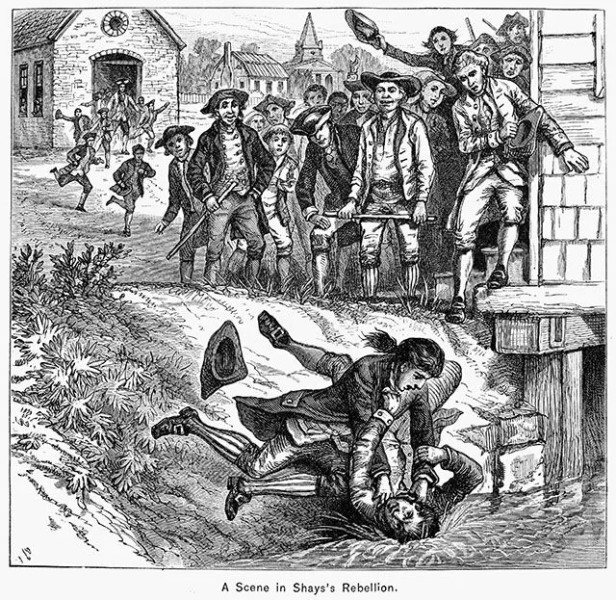
Shays’ Rebellion
Congress could not easily raise money or troops to respond. Massachusetts had to rely on its own militia, with some private funding. That made Shays’ Rebellion a symbol of how weak the Articles were, especially in military and fiscal power.
The larger pattern included unpaid Revolutionary War debts, weak public credit, trouble enforcing treaties, and difficulty dealing with foreign nations because Congress could not control state behavior.
How the Failures Led to Greater Federal Power
By the mid-1780s, many leaders thought national problems needed national solutions. The debate became whether powers kept by the states should be transferred to the national government.
Supporters of a stronger national government wanted real federal power over:
- taxation
- military affairs
- commerce
- courts
- enforcement
- money
Critics feared that a stronger national government would become tyrannical, like Britain had been.
The Annapolis Convention in 1786 started as a meeting about trade problems, but it helped push for a broader convention. The Constitutional Convention in 1787 was officially called to revise the Articles, but delegates ended up writing a whole new Constitution.
Memorize this chain because AP Gov loves cause and effect here:
state sovereignty under the Articles → weak national institutions → inability to solve national problems → push for a stronger federal government
Key Takeaways
Articles of Confederation
The first U.S. national framework, in force from 1781 to 1789, that created a loose union while leaving most governing authority with the states
Confederation
A loose association in which member states retain most governing authority and the common government depends heavily on their cooperation
State Sovereignty Under the Articles of Confederation
Article II preserved each state’s sovereignty, freedom, independence, and every power not expressly delegated to the United States
Congress Under the Articles of Confederation
A unicameral national legislature in which each state had one vote regardless of population
Congressional Voting Under the Articles of Confederation
Important congressional decisions required approval from nine of the thirteen states
Amending the Articles of Confederation
An amendment required congressional approval and confirmation by every state legislature
Lack of Centralized Military Power
Congress depended on states to provide troops and money and had little power to compel them, leaving it unable to maintain or deploy a reliable national force
Shays’ Rebellion
A 1786–1787 uprising of indebted western Massachusetts farmers; the Confederation government could not quickly fund and deploy a sufficient force, so Massachusetts suppressed it with a state militia
Requisitions Under the Articles of Confederation
Congressional requests for states to contribute specified sums because Congress could not levy taxes directly on individuals
Absence of an Executive Branch Under the Articles of Confederation
There was no independent chief executive responsible for carrying national laws into effect, so congressional decisions depended heavily on state implementation
Absence of a National Court System Under the Articles of Confederation
There was no standing national judiciary with general authority to interpret and enforce national law consistently across the states
Inability to Regulate Interstate Commerce
Congress could not impose uniform rules on trade among states, allowing conflicting duties, restrictions, and retaliatory policies to fragment the national market
Lack of Exclusive National Control Over Money
Congress had monetary authority, but states also issued money, preventing a uniform and stable national monetary system
Collective-Action Problem Under the Articles of Confederation
All states benefited from national defense, stable commerce, and public credit, but each had incentives to withhold resources and protect its own autonomy
Annapolis Convention
A 1786 meeting called to address commercial problems that recommended a broader convention to reform the national government
Notes
Articles of Confederation
The first U.S. national framework, in force from 1781 to 1789, that created a loose union while leaving most governing authority with the states
Confederation
A loose association in which member states retain most governing authority and the common government depends heavily on their cooperation
State Sovereignty Under the Articles of Confederation
Article II preserved each state’s sovereignty, freedom, independence, and every power not expressly delegated to the United States
Congress Under the Articles of Confederation
A unicameral national legislature in which each state had one vote regardless of population
Congressional Voting Under the Articles of Confederation
Important congressional decisions required approval from nine of the thirteen states
Amending the Articles of Confederation
An amendment required congressional approval and confirmation by every state legislature
Lack of Centralized Military Power
Congress depended on states to provide troops and money and had little power to compel them, leaving it unable to maintain or deploy a reliable national force
Shays’ Rebellion
A 1786–1787 uprising of indebted western Massachusetts farmers; the Confederation government could not quickly fund and deploy a sufficient force, so Massachusetts suppressed it with a state militia
Requisitions Under the Articles of Confederation
Congressional requests for states to contribute specified sums because Congress could not levy taxes directly on individuals
Absence of an Executive Branch Under the Articles of Confederation
There was no independent chief executive responsible for carrying national laws into effect, so congressional decisions depended heavily on state implementation
Absence of a National Court System Under the Articles of Confederation
There was no standing national judiciary with general authority to interpret and enforce national law consistently across the states
Inability to Regulate Interstate Commerce
Congress could not impose uniform rules on trade among states, allowing conflicting duties, restrictions, and retaliatory policies to fragment the national market
Lack of Exclusive National Control Over Money
Congress had monetary authority, but states also issued money, preventing a uniform and stable national monetary system
Collective-Action Problem Under the Articles of Confederation
All states benefited from national defense, stable commerce, and public credit, but each had incentives to withhold resources and protect its own autonomy
Annapolis Convention
A 1786 meeting called to address commercial problems that recommended a broader convention to reform the national government
