Topic 2.1 Notes – Congress: The Senate and the House of Representatives
Bicameralism and Republican Representation
Congress is bicameral, which means it has two chambers, the House of Representatives and the Senate. For a bill to become law, both must pass the same version.
This setup comes from republicanism. In U.S. government, people usually do not make national policy directly. They govern indirectly through elected representatives who debate and vote for them.
The two chambers reflect two kinds of representation:
- House represents the people, so seats are based on population.
- Senate represents the states, so every state gets 2 senators.
That split came from the Great Compromise at the Constitutional Convention. Large states wanted population-based representation. Small states wanted equal representation. The compromise gave the country both.
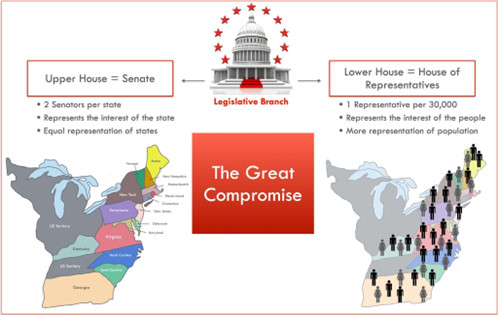
The Great Compromise
This is why Congress has one chamber based on population and one that gives every state equal representation. It also makes lawmaking slower and more deliberate. A temporary majority in one chamber cannot act alone. National policy has to survive two different electorates, two different structures, and two different debates.
The House and the Senate Compared
The easiest way to see Congress is to compare the chambers side by side.
| Feature | House | Senate |
|---|---|---|
| Representation | By population | Equal by state |
| Members | 435 voting members | 100 members |
| Constituency | Congressional district | Entire state |
| Term | 2 years | 6 years |
| Elections | All seats every 2 years | About 1/3 every 2 years |
| Minimum age | 25 | 30 |
| Citizenship | 7 years | 9 years |
| Presiding leader | Speaker of the House | Vice President |
| Special note | More formal rules | More individual influence |
Representation and membership
House seats are apportioned by population after the census. California has far more House members than Wyoming. In the Senate, both get 2 senators. That is why the House reflects population differences, while the Senate does not.
Article V protects equal suffrage in the Senate. No state can lose its equal Senate representation without its consent.
Terms and elections
The House has 2-year terms, so members stay close to district opinion. Every election can reshape the whole chamber.
The Senate has 6-year terms with staggered elections, so it is a continuous body. Only about one-third is elected every two years. A wave election can flip the House fast, but the Senate usually changes more slowly.
Qualifications, size, and leadership
- House members must be 25, citizens for 7 years, and inhabitants of their state.
- Senators must be 30, citizens for 9 years, and inhabitants of their state.
Size shapes procedure, and AP questions love that cause-and-effect idea:
- House is much larger, so debate is more formal and tightly limited.
- Senate is smaller, so members have more freedom to speak, object, and influence debate.
The House is led by the Speaker. In the Senate, the constitutional presiding officer is the vice president, who only votes to break ties. In the VP’s absence, the president pro tempore presides. The Seventeenth Amendment changed senators from being chosen by state legislatures to being directly elected by voters.
Separate Powers of Each Chamber
Both chambers make laws, but some powers belong to only one chamber.
- House only
- Revenue bills must start here.
- Has the sole power of impeachment.
- Chooses the president if no candidate wins an Electoral College majority.
- Senate only
- Confirms presidential appointments such as judges, ambassadors, and executive officials.
- Ratifies treaties by a two-thirds vote.
- Tries impeachments and removes by a two-thirds vote.
- Chooses the vice president if no candidate wins an Electoral College majority.
Lock in this distinction: the House impeaches, the Senate tries.
How Congress’s Structure Shapes Politics
Political parties are not in the Constitution, but Congress runs through the two-party system. Democrats and Republicans form caucuses, pick leaders, coordinate votes, and compete for majorities.
Because the chambers have different terms and constituencies, members behave differently:
- House members watch short-term district opinion closely because reelection is always near.
- Senators can take a longer view, but they must appeal to an entire state.
Party control can split. One party can control the House and the other the Senate. Add divided government, and policymaking gets harder because both chambers must still agree.
Congress’s Enumerated and Implied Powers
Article I, Section 8 lists Congress’s enumerated powers. The Necessary and Proper Clause, also called the Elastic Clause, allows implied powers needed to carry those out.
The image below is a quick reminder that Congress’s powers fit into the larger system of separated powers and checks and balances.
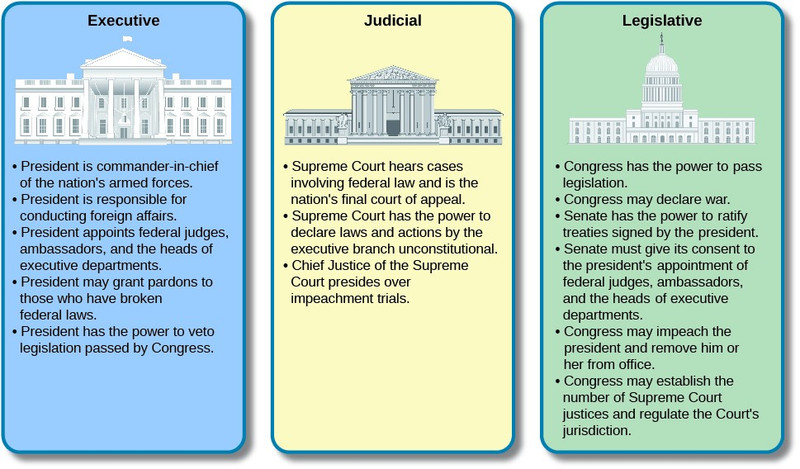
Branches of government and selected powers
For this section, focus on the legislative column.
Major powers include:
- Fiscal powers
Congress can tax, spend, borrow, coin money, pass a budget, and use appropriations. This is the power of the purse. The Omnibus Budget Reconciliation Act of 1985 is a standard example of broad fiscal legislation. - Military powers
Congress can declare war and fund the armed forces, which checks the president’s role as commander in chief. - Naturalization
Congress sets the national rules for becoming a citizen. - Interstate commerce
Congress regulates commerce among the states. This has been a major source of national power. - Judiciary
Congress creates lower federal courts and shapes much of their jurisdiction. - Implied powers
In McCulloch v. Maryland, the Court said Congress could create a national bank because it was a reasonable way to carry out enumerated powers. - Oversight
Congress checks the executive branch through hearings, investigations, testimony, information requests, and funding control. Oversight connects directly to lawmaking and appropriations.
Key Takeaways
Article I
The constitutional article that establishes Congress as the national legislative branch
Bicameralism
Division of Congress into the House and Senate, both of which generally must pass identical legislation
Republicanism
The principle that representatives debate and decide public policy on behalf of the people
House of Representatives
The 435-member chamber apportioned by state population, with district-based members elected together to two-year terms and more formal debate than the Senate
Senate
The 100-member chamber representing each state equally with two senators, six-year staggered terms, statewide constituencies, and less formal debate than the House
Apportionment
Allocation of the 435 House seats among the states by population after each ten-year census
Congressional District
A geographic constituency within a state that elects one member of the House
Congressional Membership Qualifications
House: age 25, seven years a citizen, and state inhabitant; Senate: age 30, nine years a citizen, and state inhabitant
Staggered Senate Terms
Senate seats are divided into three classes, so about one-third are elected every two years while two-thirds remain
Seventeenth Amendment
The amendment establishing direct popular election of senators instead of selection by state legislatures
Speaker of the House
The House’s principal presiding and political officer, chosen by the House and normally the majority-party leader
Vice President as President of the Senate
The vice president constitutionally presides over the Senate and may vote when it is equally divided
President Pro Tempore
The senator who presides over the Senate in the vice president’s absence
Revenue-Bill Origination Requirement
Revenue bills must originate in the House, although the Senate may amend them
Impeachment
The House brings formal charges by majority vote; the Senate tries the case and requires two-thirds of senators present to convict and remove
Advice and Consent
The Senate’s power to approve specified presidential appointments and treaties, with treaties requiring two-thirds of senators present
Contingent Election
If no Electoral College majority exists, the House chooses the president by state delegations and the Senate chooses the vice president
Two-Party System
Congressional organization dominated by the Democratic and Republican parties, with each chamber determining majority control separately
Enumerated Powers
Powers expressly granted to Congress by the Constitution, especially in Article I, Section 8
Implied Powers
Congressional powers not stated word for word but reasonably connected to carrying out enumerated powers
Congressional Fiscal Powers
Congress may tax, spend, borrow, coin money, pass a federal budget, and provide funds for federal programs
Appropriation
Legal authority provided by Congress for federal money to be spent
Power of the Purse
Congress’s control over federal spending through appropriations
Congressional War Powers
Congress may declare war and raise, organize, regulate, and fund the armed forces while the president directs military operations
Naturalization
The legal process by which eligible noncitizens become citizens, under uniform rules established by Congress
Interstate Commerce Power
Congress’s authority to regulate commerce among the states, including activity crossing state lines or substantially affecting interstate commerce
Congressional Power Over Lower Federal Courts
Congress may create and reorganize lower federal courts and define much of their structure and jurisdiction
Necessary and Proper Clause (Elastic Clause)
The clause authorizing Congress to make laws needed to carry out enumerated and other constitutionally vested federal powers
Congressional Oversight
Congressional review, monitoring, and investigation of how the executive branch and federal agencies administer laws
Notes
Article I
The constitutional article that establishes Congress as the national legislative branch
Bicameralism
Division of Congress into the House and Senate, both of which generally must pass identical legislation
Republicanism
The principle that representatives debate and decide public policy on behalf of the people
House of Representatives
The 435-member chamber apportioned by state population, with district-based members elected together to two-year terms and more formal debate than the Senate
Senate
The 100-member chamber representing each state equally with two senators, six-year staggered terms, statewide constituencies, and less formal debate than the House
Apportionment
Allocation of the 435 House seats among the states by population after each ten-year census
Congressional District
A geographic constituency within a state that elects one member of the House
Congressional Membership Qualifications
House: age 25, seven years a citizen, and state inhabitant; Senate: age 30, nine years a citizen, and state inhabitant
Staggered Senate Terms
Senate seats are divided into three classes, so about one-third are elected every two years while two-thirds remain
Seventeenth Amendment
The amendment establishing direct popular election of senators instead of selection by state legislatures
Speaker of the House
The House’s principal presiding and political officer, chosen by the House and normally the majority-party leader
Vice President as President of the Senate
The vice president constitutionally presides over the Senate and may vote when it is equally divided
President Pro Tempore
The senator who presides over the Senate in the vice president’s absence
Revenue-Bill Origination Requirement
Revenue bills must originate in the House, although the Senate may amend them
Impeachment
The House brings formal charges by majority vote; the Senate tries the case and requires two-thirds of senators present to convict and remove
Advice and Consent
The Senate’s power to approve specified presidential appointments and treaties, with treaties requiring two-thirds of senators present
Contingent Election
If no Electoral College majority exists, the House chooses the president by state delegations and the Senate chooses the vice president
Two-Party System
Congressional organization dominated by the Democratic and Republican parties, with each chamber determining majority control separately
Enumerated Powers
Powers expressly granted to Congress by the Constitution, especially in Article I, Section 8
Implied Powers
Congressional powers not stated word for word but reasonably connected to carrying out enumerated powers
Congressional Fiscal Powers
Congress may tax, spend, borrow, coin money, pass a federal budget, and provide funds for federal programs
Appropriation
Legal authority provided by Congress for federal money to be spent
Power of the Purse
Congress’s control over federal spending through appropriations
Congressional War Powers
Congress may declare war and raise, organize, regulate, and fund the armed forces while the president directs military operations
Naturalization
The legal process by which eligible noncitizens become citizens, under uniform rules established by Congress
Interstate Commerce Power
Congress’s authority to regulate commerce among the states, including activity crossing state lines or substantially affecting interstate commerce
Congressional Power Over Lower Federal Courts
Congress may create and reorganize lower federal courts and define much of their structure and jurisdiction
Necessary and Proper Clause (Elastic Clause)
The clause authorizing Congress to make laws needed to carry out enumerated and other constitutionally vested federal powers
Congressional Oversight
Congressional review, monitoring, and investigation of how the executive branch and federal agencies administer laws
