Topic 2.7 Notes – Presidential Communication
Presidential Communication as Informal Power
The president does not have Congress’s lawmaking power, so a lot of presidential influence works indirectly. Presidential communication means using the office’s visibility, the media, and technology to shape what the public and other officials think and do.
Why the president is uniquely strong at this:
- The president and vice president are the only executive officials chosen in a national election, so presidents can claim to speak for the whole country.
- Members of Congress represent states or districts, which makes their audience narrower.
- Presidential speeches, interviews, and posts are automatically more newsworthy because the office itself draws attention.
What presidents try to do through communication:
- Identify problems so the country notices an issue.
- Define urgency so an issue feels like it needs action now.
- Defend policy by explaining why the administration’s position makes sense.
- Build support for legislation by getting citizens on the president’s side.
- Respond to crises with reassurance, explanation, or blame-setting.
- Pressure Congress by turning public opinion into political pressure.
The limit matters just as much as the power. A speech cannot pass a law, spend money, confirm an appointment, or overturn a court ruling.
Agenda Setting, Framing, and the Bully Pulpit
Presidents often shape politics by controlling attention first. Agenda setting means deciding which issues get the most public and political focus. If the president keeps talking about inflation, immigration, or health care, those issues move to the center of debate.
Framing comes after that. It shapes how people understand the issue.
- Economic relief
- National security
- Individual freedom
The same policy can be framed in different ways, and that changes support.
The bully pulpit
The bully pulpit is the president’s use of the office’s prestige and visibility to promote an agenda. Theodore Roosevelt linked the phrase to the presidency. Here, “bully” meant excellent, and “pulpit” meant a platform for speaking.
One common pattern is that presidential attention creates broader political pressure.
- The president highlights an issue.
- Media attention grows.
- Public focus increases.
- Constituents contact Congress.
- Lawmakers feel pressure.
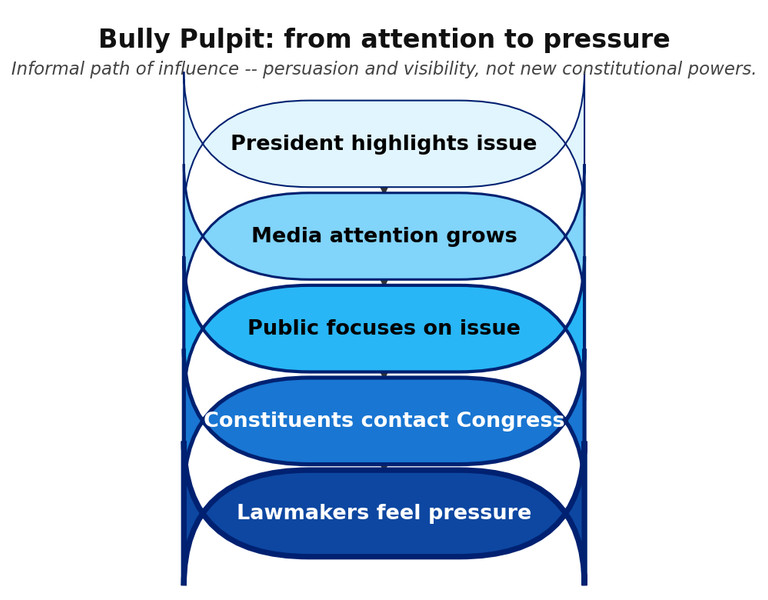
Going public means appealing directly to citizens instead of only bargaining privately with lawmakers. This becomes especially important in divided government. The point is to turn attention into pressure on Congress, like the sequence shown above.
Success depends on:
- presidential approval
- polarization
- divided or unified government
- strong counterarguments from Congress, parties, interest groups, or media
A president can win the debate’s attention and still lose the vote in Congress.
The State of the Union
Article II says the president gives Congress information on the state of the union and recommends measures. That makes the State of the Union a constitutional duty, but today it is also a major media event used for agenda setting.
It usually does several things at once:
- reports national conditions
- identifies priorities
- recommends legislation
- defends the president’s record
- builds public support
Historical development
- George Washington gave it in person.
- Thomas Jefferson switched to a written message.
- Woodrow Wilson brought back the in-person address in 1913.
- Radio, TV, internet, and social media turned it into a national audience event.
Today, the State of the Union is usually delivered as a formal address to a joint session of Congress in the House chamber.
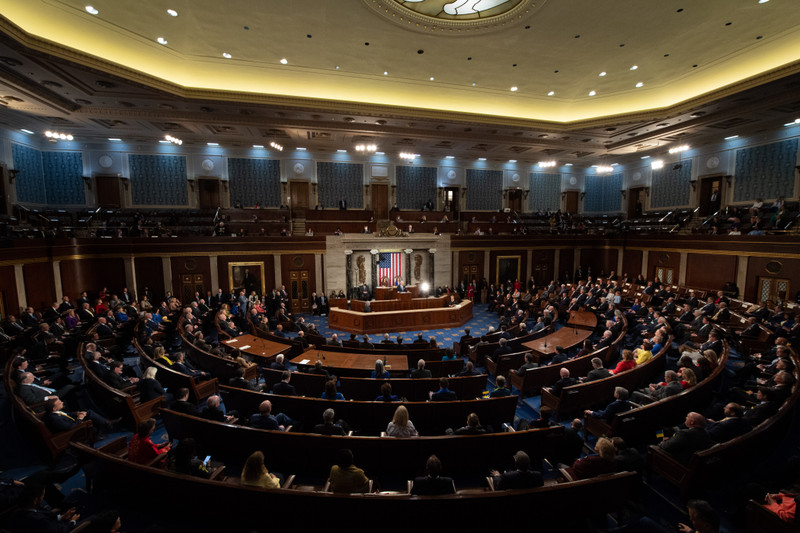
State of the Union address in the House chamber
The key AP point is that the speech raises visibility and pressure. It does not put bills on the calendar or force Congress to act.
How Technology Changed Presidential Communication
As communication tools changed, presidential influence through media grew faster and broader.
- Print era: slower and filtered through newspapers, editors, and party networks.
- Radio: direct national voice. Franklin D. Roosevelt’s fireside chats are the classic example.
- Television: image, tone, and staging started to matter a lot more.
- Cable news: faster cycle, more airtime, less control over competing interpretations.
- Internet and social media: instant response, direct communication, real-time repetition and mobilization.
This timeline gives you the basic shift from slower mass communication to immediate, personal communication.
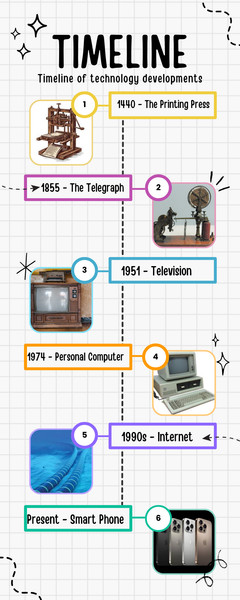
Communication technology timeline
Technology increases speed, reach, and agenda-setting power. It still does not create new constitutional authority.
Effects on the Public and Congress
Modern media gave presidents a more direct relationship with the national public.
Effects on the public:
- stronger direct connection between president and citizens
- faster crisis response
- easier rallying of supporters
- greater risk if messages are inaccurate, contradictory, or inflammatory
Effects on Congress happen through a chain reaction:
- The president promotes a legislative priority.
- Media coverage increases.
- Constituents react.
- Constituents contact lawmakers.
- Lawmakers consider electoral consequences.
Congress still keeps legislative power and answers to its own voters, parties, and rules.
Reagan’s 1981 televised tax reduction address is the standard example. He asked the public to support tax cuts and pressure Congress. Congress later passed the Economic Recovery Tax Act of 1981. His speech influenced the process, but it did not legally compel Congress.
Presidents can also criticize courts in public, but judges are insulated from direct political pressure, and presidential messages cannot reverse court decisions.
Key Takeaways
Agenda Setting
Influencing which issues receive political attention and are treated as policy priorities
Framing
Presenting an issue through a particular interpretation that shapes how people understand it
Bully Pulpit
The president’s use of the office’s prominence as a platform to attract attention, persuade the public, and promote a policy agenda
Going Public
Appealing directly to citizens to build support and generate constituent pressure on lawmakers
State of the Union Address
The constitutionally rooted presidential message to Congress that now serves as a nationally broadcast platform for reporting conditions, recommending legislation, and promoting the president’s agenda
Reagan’s 1981 Tax-Reduction Address
A nationally televised appeal that framed tax reduction as urgent and asked citizens to pressure Congress, which later passed the Economic Recovery Tax Act of 1981
Notes
Agenda Setting
Influencing which issues receive political attention and are treated as policy priorities
Framing
Presenting an issue through a particular interpretation that shapes how people understand it
Bully Pulpit
The president’s use of the office’s prominence as a platform to attract attention, persuade the public, and promote a policy agenda
Going Public
Appealing directly to citizens to build support and generate constituent pressure on lawmakers
State of the Union Address
The constitutionally rooted presidential message to Congress that now serves as a nationally broadcast platform for reporting conditions, recommending legislation, and promoting the president’s agenda
Reagan’s 1981 Tax-Reduction Address
A nationally televised appeal that framed tax reduction as urgent and asked citizens to pressure Congress, which later passed the Economic Recovery Tax Act of 1981
