Topic 4.7 Notes – Ideologies of Political Parties
What Party Ideology Is
Politics gets clearer when you separate ideology from party. An ideology is a set of beliefs about what government should do, how much power it should have, and what goals matter most. A political party is an organized group trying to win elections, run government, and turn its ideas into policy. A party platform is the formal list of positions the party says it stands for.
In modern U.S. politics, Democrats generally align with liberal ideology and Republicans generally align with conservative ideology.
That word generally matters a lot.
- Not every Democrat is liberal.
- Not every Republican is conservative.
- Candidates can break from the national platform because of region, voters in their district, strategy, or fights inside the party.
Quick distinctions students mix up all the time:
- Party affiliation means connection to an organization.
- Ideology means beliefs about government.
- A moderate has centrist or mixed views.
- An independent does not identify with a major party, but can still be liberal, moderate, or conservative.
Liberal and Conservative Alignments
The basic split is about the proper role of government. Liberals usually accept a more active government role in some areas. Conservatives usually prefer more limited government and more reliance on markets, states, communities, and individuals.
Liberal ideology and the Democratic Party
Democratic positions usually support a stronger national government role when it can expand opportunity or protect people.
Common positions include:
- more government involvement in health care and education
- stronger regulation of business, labor, consumer safety, and the environment
- social safety net programs
- progressive taxation, where higher incomes are taxed at higher rates
- national protection of civil rights and voting access
For liberals, liberty can mean freedom from discrimination or exclusion, and equality of opportunity may require government action to remove barriers.
Conservative ideology and the Republican Party
Republican positions usually emphasize limited government, individual responsibility, free enterprise, private property, and state and local control.
Common positions include:
- lower taxes and less domestic spending
- fewer business regulations
- private-sector solutions
- stronger state and local authority
- strong national defense, policing, border security, and Second Amendment protections
- traditional social values
For conservatives, liberty often means freedom from government regulation, and equality of opportunity often means equal rules rather than guaranteed results.
How Ideology Shapes Policy Debates
Ideology shapes the argument before the vote even happens.
- People decide what counts as a public problem.
- They emphasize certain values, like equality, liberty, security, or responsibility.
- They define government action as either protection or intrusion.
- They choose the preferred solution, whether national, state, local, market-based, or individual.
You see the same pattern over and over:
- Regulation
Democrats often say regulation protects workers, consumers, health, and the environment. Republicans often say deregulation protects economic freedom and growth. - Taxation and spending
Democrats stress fairness, public goods, and social programs. Republicans stress property rights, incentives, and private-sector growth. - Civil rights and voting
Democrats usually support stronger national protections. Republicans more often stress state control and election security.
On the exam, trace the chain. Ask what government is being asked to do, which ideology supports that role, and which party usually aligns with that ideology.
Policy Areas Where the Alignment Shows Up
| Policy area | Democrats generally | Republicans generally |
|---|---|---|
| Economic regulation | more oversight | fewer regulations |
| Taxation and spending | progressive taxes, more social spending | lower taxes, restrained domestic spending |
| Health care and education | larger national role | more state control and private choice |
| Environmental policy | national regulation and public investment | limit regulatory costs, protect energy production |
| Civil rights and voting access | broader federal protections | federalism and election security |
The Affordable Care Act as the Standard Example
The Affordable Care Act of 2010 is the classic example of ideology shaping party conflict.
Democrats saw the uninsured and preexisting-condition exclusions as public problems. Their answer was national action through subsidies, Medicaid expansion, and federal rules on insurance.
Republicans argued the ACA expanded federal power too much. They said mandates and regulations reduced choice and increased costs, and they preferred market competition, state flexibility, and a smaller federal role.
That clash came to a head when President Obama signed the law.
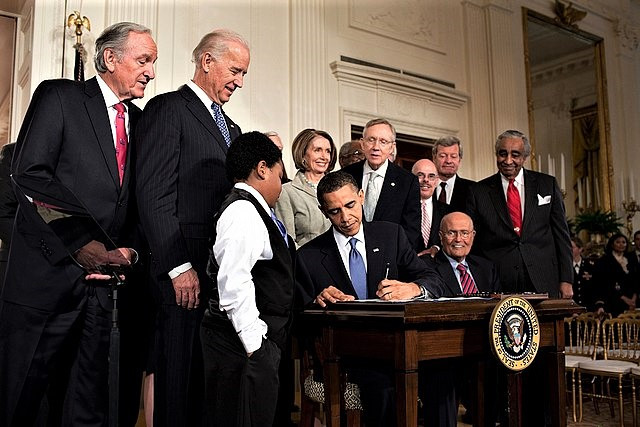
President Obama signs the Affordable Care Act, 2010
The best explanation is not “Democrats supported it, Republicans opposed it.” The real explanation is that they had different beliefs about what government should do.
A useful case here is NFIB v. Sebelius (2012). The Court upheld most of the ACA, but limited mandatory Medicaid expansion. That shows ideology matters, but institutions can still reshape policy.
Key Takeaways
Political Ideology
A coherent set of beliefs about the proper role and purposes of government
Political Party
An organized coalition that seeks to win elections, control government institutions, and influence public policy
Party Platform
A party’s formal statement of principles, priorities, and policy positions; it does not bind every party member
Liberal Ideology (Liberalism)
Generally favors an active government role in expanding opportunity, protecting rights, providing services, regulating markets, and reducing economic insecurity
Conservative Ideology (Conservatism)
Generally emphasizes limited national government, individual responsibility, free enterprise, private property, and greater reliance on markets and state or local action
Democratic Party (D/DEM)
A major U.S. political party whose platforms generally align more closely with liberal ideological positions
Republican Party (R/GOP)
A major U.S. political party whose platforms generally align more closely with conservative ideological positions
Left–Right Ideological Spectrum
A model placing liberalism on the left, moderation near the center, and conservatism on the right, with overlap between party coalitions
Moderate
A person who holds positions near the political center or combines liberal and conservative positions
Independent
A person who does not identify with a major party; the label alone does not indicate an ideology
Notes
Political Ideology
A coherent set of beliefs about the proper role and purposes of government
Political Party
An organized coalition that seeks to win elections, control government institutions, and influence public policy
Party Platform
A party’s formal statement of principles, priorities, and policy positions; it does not bind every party member
Liberal Ideology (Liberalism)
Generally favors an active government role in expanding opportunity, protecting rights, providing services, regulating markets, and reducing economic insecurity
Conservative Ideology (Conservatism)
Generally emphasizes limited national government, individual responsibility, free enterprise, private property, and greater reliance on markets and state or local action
Democratic Party (D/DEM)
A major U.S. political party whose platforms generally align more closely with liberal ideological positions
Republican Party (R/GOP)
A major U.S. political party whose platforms generally align more closely with conservative ideological positions
Left–Right Ideological Spectrum
A model placing liberalism on the left, moderation near the center, and conservatism on the right, with overlap between party coalitions
Moderate
A person who holds positions near the political center or combines liberal and conservative positions
Independent
A person who does not identify with a major party; the label alone does not indicate an ideology
