Topic 5.5 Notes – Third-Party Politics
What Third Parties and Independents Are
A third party or minor party is any party other than the Democrats and Republicans. An independent candidate runs without a party nomination. Those are different things, but on tests they often get discussed together because both run into the same barriers.
The key distinction here is influence vs. winning. A third party can lose the election and still change politics.
Third parties and independents can still:
- put neglected issues on the agenda, which forces people to talk about problems the major parties ignored
- attract dissatisfied voters who feel neither major party represents them
- pressure major parties to change their platforms
- affect which major-party candidate wins by changing the vote totals
The U.S. Constitution does not require only two parties. The strong two-party system comes from electoral rules and from how Democrats and Republicans respond to challengers.
Winner-Take-All Elections and Why They Hurt Third Parties
These terms fit together:
- single-member district means one district elects one officeholder
- plurality voting means the candidate with the most votes wins, even without 50%
- winner-take-all means only the top finisher gets the office
- first-past-the-post is another name for this setup
That system hurts third parties because a party can get lots of votes and still get zero representation. To win, its support has to be concentrated enough to finish first somewhere.
Presidential elections show this clearly. The comparison below makes the pattern easy to see.
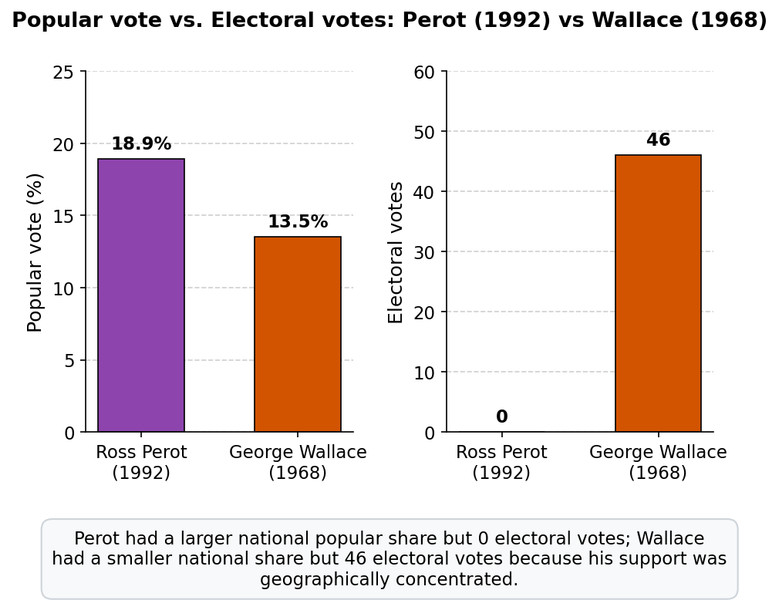
Perot and Wallace in the Electoral College
In presidential elections, most states give all electoral votes to the statewide winner. Maine and Nebraska split some electors by district, but that is still not proportional representation.
Two classic examples show how location matters more than national vote share:
- Ross Perot, 1992 won about 18.9% of the popular vote but 0 electoral votes because his support was spread out.
- George Wallace, 1968 won about 13.5% of the popular vote but carried five states and won 46 electoral votes because his support was geographically concentrated.
Why Two Parties Keep Winning
Winner-take-all creates both mechanical and strategic barriers.
- Mechanical effect means votes do not turn into seats proportionally. A party that keeps finishing second or third may get nothing.
- Strategic effect means people react to that rule. Voters may avoid a “wasted vote,” and donors, activists, and candidates usually choose a major party because it gives them a more realistic path to office.
This also creates the spoiler effect. A third-party or independent candidate can split votes and help the less-preferred major-party candidate win. Be careful, though. Vote totals alone do not prove spoiler status because they do not show what those voters would have done otherwise.
A proportional representation system works differently. If a party gets about 15% of the vote, it gets about 15% of the seats. That makes multiparty systems much easier to sustain than U.S. elections do.
How Major Parties Absorb Third-Party Issues
Major parties do not just beat third parties at the ballot box. They often absorb their best ideas.
A party platform is the formal statement of a party’s principles, policy goals, and issue positions.
Here’s how absorption usually works:
- A third party raises an underrepresented issue.
- The issue gains public support.
- A major party adopts it.
- Voters can support that idea through a major party with a better chance of winning.
- The third party loses its distinct edge.
The best example is the People’s Party, or Populist Party, in the 1890s. It pushed free silver and other farmer and debtor concerns. In 1896, Democrats adopted free silver with William Jennings Bryan. Later reforms linked to Populist goals included the Sixteenth Amendment for a federal income tax and the Seventeenth Amendment for direct election of senators.
So third parties often fail electorally even when they succeed politically.
Other Barriers and How to Read the Data
Election rules create the biggest barrier, but other obstacles pile on:
- ballot access laws
- petition-signature requirements
- filing deadlines
- weaker donor networks, media attention, and campaign organizations
- debate-access rules and doubts about candidate viability
When you read charts or election returns, separate support from representation:
- popular-vote share is not the same as seats or electoral votes won
- zero seats does not mean zero support
- plurality does not mean majority
- broad but scattered support is less useful than concentrated support in a winner-take-all system
Maine and Nebraska are a useful reminder that even Electoral College rules are not perfectly uniform across states.
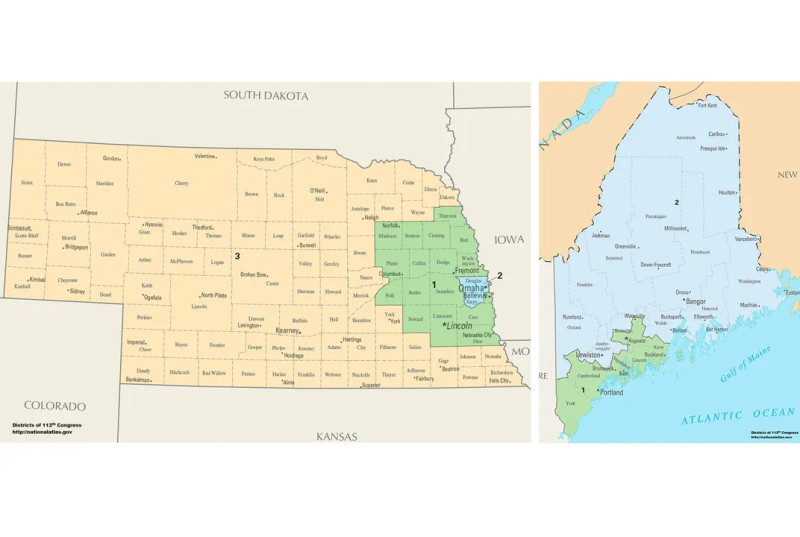
Maine and Nebraska Electoral College districts
Key Takeaways
Third Party (Minor Party)
A political party other than the Democratic and Republican major parties
Independent Candidate
A candidate who runs without the nomination of any political party
Single-Member District
A geographic constituency that elects one officeholder
Plurality Voting
An electoral rule under which the candidate receiving more votes than any other candidate wins, even without a majority
Winner-Take-All
An electoral arrangement in which the top finisher receives the entire office or electoral prize and losing candidates receive none
Single-Member Plurality Election (First-Past-the-Post)
An election in which one officeholder is chosen and the candidate with the most votes wins
Proportional Representation
An electoral system that allocates legislative seats to parties roughly in proportion to their shares of the vote
Mechanical Effect
The direct effect of electoral rules on converting votes into offices, with only the top finisher winning under winner-take-all rules
Strategic Effect
The tendency of candidates, activists, donors, and voters to favor viable major parties in response to winner-take-all rules
Strategic Voting
Voting for an acceptable viable candidate rather than one’s first choice to help defeat a less-preferred candidate
Spoiler Effect (Vote Splitting)
When a minor candidate draws enough likely support from one major-party candidate to allow the other major-party candidate to win
Party Platform
A party’s formal statement of its principles, issue positions, and policy goals
Third-Party Agenda Incorporation (Absorption or Co-optation)
A major party’s adoption of popular third-party positions, reducing the third party’s distinctive appeal and voter base
Notes
Third Party (Minor Party)
A political party other than the Democratic and Republican major parties
Independent Candidate
A candidate who runs without the nomination of any political party
Single-Member District
A geographic constituency that elects one officeholder
Plurality Voting
An electoral rule under which the candidate receiving more votes than any other candidate wins, even without a majority
Winner-Take-All
An electoral arrangement in which the top finisher receives the entire office or electoral prize and losing candidates receive none
Single-Member Plurality Election (First-Past-the-Post)
An election in which one officeholder is chosen and the candidate with the most votes wins
Proportional Representation
An electoral system that allocates legislative seats to parties roughly in proportion to their shares of the vote
Mechanical Effect
The direct effect of electoral rules on converting votes into offices, with only the top finisher winning under winner-take-all rules
Strategic Effect
The tendency of candidates, activists, donors, and voters to favor viable major parties in response to winner-take-all rules
Strategic Voting
Voting for an acceptable viable candidate rather than one’s first choice to help defeat a less-preferred candidate
Spoiler Effect (Vote Splitting)
When a minor candidate draws enough likely support from one major-party candidate to allow the other major-party candidate to win
Party Platform
A party’s formal statement of its principles, issue positions, and policy goals
Third-Party Agenda Incorporation (Absorption or Co-optation)
A major party’s adoption of popular third-party positions, reducing the third party’s distinctive appeal and voter base
