Topic 4.10 Notes – Ideology and Social Policy
What Social Policy Is
Social policy covers issues tied to health, safety, welfare, morals, and everyday life. That’s why education and public health fit here, and so do abortion, same-sex marriage, and school choice.
A lot of these arguments are also federalism arguments. States have broad police powers over health, safety, welfare, and morals. The national government has to act through enumerated powers, spending, civil rights laws, and constitutional rights enforcement.
What people are usually arguing about:
- Should government act at all? Some want direct action, others want private choice.
- Which level should lead? A national rule creates uniformity. State control allows variation.
- What kind of action? Government might provide a service, fund it, regulate it, or leave it mostly private.
- Should rules be the same everywhere? This matters a lot in rights disputes.
- What value is being protected? People frame policies as protecting liberty, equality, or social order.
Liberal, Conservative, and Libertarian Views
These ideologies often disagree less about whether an issue matters and more about who should decide and what government should do.
Liberal ideology
Liberals usually support more national government action on selected social issues, especially when state differences create unequal access or unequal rights.
- In education, liberals often support federal aid for disadvantaged students, civil rights enforcement, and national accountability or standards.
- In public health, liberals often support broader access through subsidies, regulation, Medicaid, and the Affordable Care Act.
- On personal autonomy issues, liberals usually support reproductive choice and same-sex marriage protections.
The value underneath this is usually equality, equal opportunity, and nationally protected rights.
Conservative ideology
Conservatives usually want less national involvement and more control by states, local communities, families, and private institutions.
- In education, conservatives often support local control, parental authority, charter schools, vouchers, and school choice.
- In public health, they tend to prefer state flexibility, private insurance, and fewer national mandates.
Important nuance that gets tested a lot: conservatives do not oppose all government action. Social conservatives may support government restrictions on abortion or other policies meant to uphold traditional moral norms.
Libertarian ideology
Libertarians want minimal government involvement from either level, except to protect liberty and private property.
- In education, they prefer private choice and minimal regulation. Vouchers split libertarians because vouchers still use public money.
- In public health, they usually oppose mandates, subsidies, and heavy regulation.
- On personal conduct, they are usually permissive unless someone is violating another person’s rights.
The key difference from conservatives is that libertarians usually oppose state coercion too, not just national power.
Federalism and the Government Role in Social Policy
Social policy fights often turn into fights over where power should sit. This division of power is the basic idea of federalism.
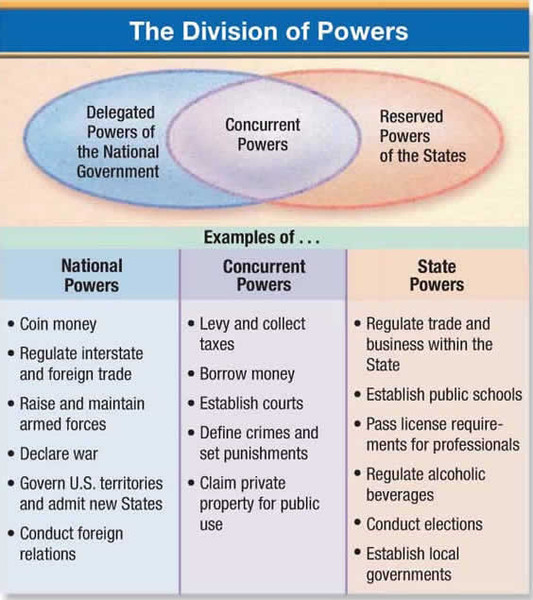
Federalism and the division of powers
- Education is mostly state and local, which fits the diagram’s state powers, but the national government shapes it through funding, grant conditions, and civil rights enforcement.
- Public health is shared, so it often falls into concurrent powers. States regulate professions and local health matters. The national government funds programs, supports research, and coordinates across states.
Common arrangements:
| Arrangement | What it looks like |
|---|---|
| Mainly state action | States write and run the policy |
| Separate national and state policies | Both levels act in their own ways |
| National funding with state administration | Washington pays, states run |
| National minimum standards | States can go stricter |
| National constitutional requirements | All states must follow |
| Devolution | Power shifts back to states/localities |
Tradeoff to remember:
- More national action = more uniform rights and access
- More state control = more experimentation, but more geographic variation
Key Social Policy Examples
School choice and vouchers
A voucher uses public money to help families choose private schools. That fits conservative ideology because it mixes public funding with parental choice and private provision.
Zelman v. Simmons-Harris (2002) upheld a neutral voucher program where aid reached religious schools through private choice. The Court said this was constitutionally allowed under the Establishment Clause. It did not require states to adopt vouchers.
Abortion policy
Planned Parenthood v. Casey (1992) kept Roe’s core rule before viability and created the undue burden standard. States could regulate abortion, but not place a substantial obstacle in the path of someone seeking a pre-viability abortion.
Liberals emphasized autonomy and national protection. Conservatives emphasized state authority and protection of prenatal life.
Dobbs v. Jackson Women’s Health Organization (2022) overruled Roe and Casey. Abortion policy then returned mainly to elected state and national institutions.
Same-sex marriage
Obergefell v. Hodges (2015) held that the 14th Amendment requires states to license and recognize same-sex marriages. This is a strong example of national constitutional protection overriding state variation.
How Ideology Becomes Policy
Ideology turns into policy through parties, elections, legislation, executive action, state policymaking, and litigation. Democrats usually align more with liberal social-policy views. Republicans usually align more with conservative ones.
When liberal views win power, you often see more national funding, regulation, programs, or nationally protected rights. When conservative views win power, you often see more devolution, state discretion, private provision, school choice, or moral regulation.
Key Takeaways
Social Policy
Government decisions about well-being, social relationships, public services, and personal conduct
Liberal Approach to Social Policy
Generally favors greater national action to expand access, reduce inequality, and establish consistent rights and minimum standards
Conservative Approach to Social Policy
Generally favors less national involvement and more state, local, family, community, and private responsibility, while sometimes supporting laws that uphold traditional values
Libertarian Approach to Social Policy
Favors minimal national and state involvement except to protect individual liberty, private property, voluntary exchange, and people from coercion
School Choice
Policies that let families choose among educational providers rather than rely only on an assigned government-operated school
School Voucher
Public funds that help a family pay tuition at a participating private school
Devolution
The transfer of governmental responsibility or discretion from the national government to states or localities
Notes
Social Policy
Government decisions about well-being, social relationships, public services, and personal conduct
Liberal Approach to Social Policy
Generally favors greater national action to expand access, reduce inequality, and establish consistent rights and minimum standards
Conservative Approach to Social Policy
Generally favors less national involvement and more state, local, family, community, and private responsibility, while sometimes supporting laws that uphold traditional values
Libertarian Approach to Social Policy
Favors minimal national and state involvement except to protect individual liberty, private property, voluntary exchange, and people from coercion
School Choice
Policies that let families choose among educational providers rather than rely only on an assigned government-operated school
School Voucher
Public funds that help a family pay tuition at a participating private school
Devolution
The transfer of governmental responsibility or discretion from the national government to states or localities
