Topic 5.1 Notes – Voting Rights and Models of Voting Behavior
Voting Rights and the Expansion of Suffrage
Suffrage or franchise means the right to vote. Enfranchisement means gaining that right. Disenfranchisement means losing it or being blocked from using it.
The starting point matters. The original Constitution did not create universal suffrage. States set most voter qualifications, and in practice voting was mostly limited to white men, often with property or taxpaying rules attached.
That helps explain the pattern you see later. Voting rights grew piece by piece, mostly through amendments that either:
- banned a specific reason for excluding people from voting, or
- made government offices more directly accountable to voters
This timeline gives you the big picture before you move into the specific amendments and laws.
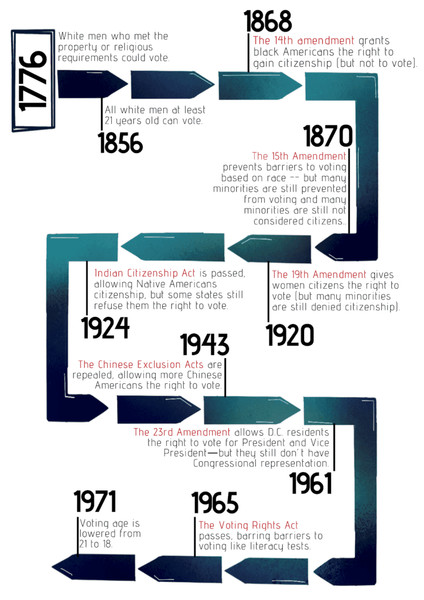
Timeline of voting rights expansion in the United States
One distinction AP loves is this: legal access to vote is different from actual turnout. Someone can have the right to vote and still not register, not show up, or face obstacles that lower participation.
The Constitutional Protections for Voting Rights
These amendments do different jobs. Some expand who can vote. Some remove barriers. One changes how senators are selected.
Fourteenth Amendment
The Fourteenth Amendment made all people born or naturalized in the U.S. citizens, including formerly enslaved people. It also includes due process and equal protection, which later became major tools in voting-rights cases.
The key nuance is that citizenship is not the same thing as suffrage. The amendment created a foundation, but it did not by itself give everyone the vote.
Fifteenth Amendment
The Fifteenth Amendment says voting rights cannot be denied because of race, color, or previous condition of servitude. You’ll usually see this summarized as giving African American men the right to vote.
In practice, Southern states got around it with:
- literacy tests
- poll taxes
- grandfather clauses
- white primaries
- intimidation and violence
That gap between the law on paper and reality is one of the biggest ideas in this topic.
Seventeenth Amendment
The Seventeenth Amendment changed senators from being chosen by state legislatures to being chosen by direct vote of the people.
This expanded democracy by making senators answer to voters. The common mistake is saying it changed voter eligibility. Its main effect was changing how senators were selected.
Nineteenth Amendment
The Nineteenth Amendment banned denying the vote on account of sex. It granted women the right to vote nationwide.
Important nuance: many women, especially Black women in the South, still faced racial barriers after 1920.
Twenty-Fourth Amendment
The Twenty-Fourth Amendment banned poll taxes in federal elections. A poll tax meant paying money as a condition of voting, so it hurt poor voters and disproportionately harmed Black voters.
In Harper v. Virginia Board of Elections (1966), the Supreme Court used the Fourteenth Amendment to strike down poll taxes in state elections too.
Twenty-Sixth Amendment
The Twenty-Sixth Amendment lowered the voting age to 18. The Vietnam-era slogan was “old enough to fight, old enough to vote.”
The Voting Rights Act and Why Enforcement Matters
The Voting Rights Act of 1965 enforced the Fifteenth Amendment. It banned racial discrimination in voting nationwide, targeted literacy tests and similar devices, and required some places with histories of discrimination to get federal approval, called preclearance, before changing voting rules.
This is the core takeaway. Constitutional rights alone did not end disenfranchisement. Federal law gave the government tools to enforce those rights against state and local suppression.
In Shelby County v. Holder (2013), the Court struck down the formula used to decide which jurisdictions needed preclearance. It did not strike down the whole Voting Rights Act. Preclearance became mostly unusable unless Congress creates a new formula.
Models of Voting Behavior
Once people have access to the ballot, these models explain how they choose. One scenario can fit more than one model, so go by what the question emphasizes.
- Rational-choice voting means voting for the option you think best serves your interests, such as taxes, safety, values, or community needs.
- Retrospective voting means looking backward and judging the recent performance of the incumbent or party in power. Think economy, war, scandal, inflation, crisis response.
- Prospective voting means looking forward and choosing based on promises, policy plans, ideology, or expected future results.
- Straight-ticket voting means choosing all candidates from one party across the ballot. In the ballot shown here, focus on the straight-party section on the left.
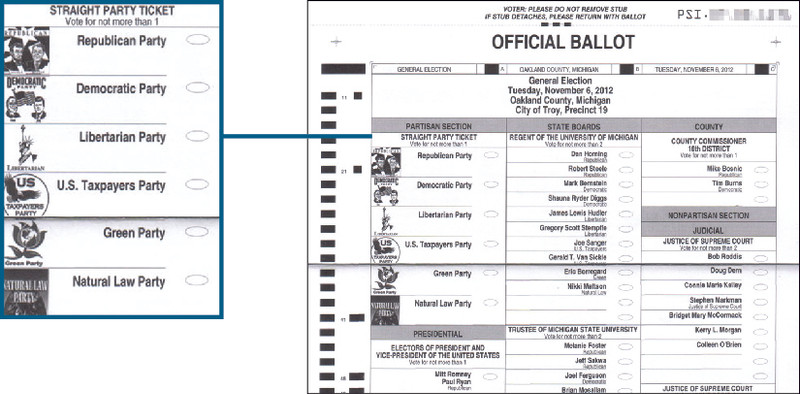
Straight-party section of a ballot
How to Tell the Models Apart Fast
Use the clue words in the scenario.
| Model | What the voter is asking | Common clues |
|---|---|---|
| Rational choice | Which choice helps me most? | self-interest, benefits, costs |
| Retrospective | How has the party in power done? | record, performance, past term, economy |
| Prospective | Who will do better in the future? | plans, promises, future results |
| Straight ticket | Did the voter choose one party’s whole slate? | all Democrats, all Republicans |
Key Takeaways
Suffrage / Franchise
The right to vote
Enfranchisement vs. Disenfranchisement
Enfranchisement is gaining voting rights; disenfranchisement is losing the vote or being prevented from exercising it
Fourteenth Amendment (14th Amendment)
The 1868 amendment granting citizenship to persons born or naturalized in the United States and providing due-process and equal-protection guarantees
Fifteenth Amendment (15th Amendment)
The 1870 amendment prohibiting denial or abridgment of voting rights because of race, color, or previous condition of servitude
Seventeenth Amendment (17th Amendment)
The 1913 amendment replacing selection of U.S. senators by state legislatures with direct election by voters
Nineteenth Amendment (19th Amendment)
The 1920 amendment prohibiting denial or abridgment of voting rights on account of sex, granting women nationwide voting rights
Poll Tax
A payment required as a condition of voting, creating a wealth-based structural barrier to participation
Twenty-Fourth Amendment (24th Amendment)
The 1964 amendment prohibiting poll taxes or other voting taxes in federal elections
Twenty-Sixth Amendment (26th Amendment)
The 1971 amendment prohibiting age-based denial of voting rights to citizens 18 or older, lowering the voting age from 21 to 18
Voting Rights Act of 1965
Federal legislation enforcing the Fifteenth Amendment by prohibiting racial discrimination in voting and targeting literacy tests and similar suppression tactics
Preclearance
The Voting Rights Act system requiring certain jurisdictions with histories of discrimination to obtain federal approval before changing voting laws
Rational-Choice Voting
Choosing the candidate or party perceived to best serve the voter's interests after comparing expected costs, benefits, or preferences
Retrospective Voting
Choosing whether to reward or punish an incumbent or governing party based on its past performance and recent conditions
Prospective Voting
Choosing based on predictions about a candidate's or party's future performance, policies, or leadership
Straight-Ticket Voting
Voting for the full slate of one political party's candidates across the contests on a ballot
Notes
Suffrage / Franchise
The right to vote
Enfranchisement vs. Disenfranchisement
Enfranchisement is gaining voting rights; disenfranchisement is losing the vote or being prevented from exercising it
Fourteenth Amendment (14th Amendment)
The 1868 amendment granting citizenship to persons born or naturalized in the United States and providing due-process and equal-protection guarantees
Fifteenth Amendment (15th Amendment)
The 1870 amendment prohibiting denial or abridgment of voting rights because of race, color, or previous condition of servitude
Seventeenth Amendment (17th Amendment)
The 1913 amendment replacing selection of U.S. senators by state legislatures with direct election by voters
Nineteenth Amendment (19th Amendment)
The 1920 amendment prohibiting denial or abridgment of voting rights on account of sex, granting women nationwide voting rights
Poll Tax
A payment required as a condition of voting, creating a wealth-based structural barrier to participation
Twenty-Fourth Amendment (24th Amendment)
The 1964 amendment prohibiting poll taxes or other voting taxes in federal elections
Twenty-Sixth Amendment (26th Amendment)
The 1971 amendment prohibiting age-based denial of voting rights to citizens 18 or older, lowering the voting age from 21 to 18
Voting Rights Act of 1965
Federal legislation enforcing the Fifteenth Amendment by prohibiting racial discrimination in voting and targeting literacy tests and similar suppression tactics
Preclearance
The Voting Rights Act system requiring certain jurisdictions with histories of discrimination to obtain federal approval before changing voting laws
Rational-Choice Voting
Choosing the candidate or party perceived to best serve the voter's interests after comparing expected costs, benefits, or preferences
Retrospective Voting
Choosing whether to reward or punish an incumbent or governing party based on its past performance and recent conditions
Prospective Voting
Choosing based on predictions about a candidate's or party's future performance, policies, or leadership
Straight-Ticket Voting
Voting for the full slate of one political party's candidates across the contests on a ballot
