Topic 5.12 Notes – The Media
What the Media Does as a Linkage Institution
The media is a linkage institution, which means it connects citizens to government and the political process. In AP Gov, the full set of linkage institutions is political parties, interest groups, elections, and media.
This connection goes both ways:
- Government officials, candidates, and political actors use media to send information out. That includes speeches, press conferences, campaign ads, interviews, and debate appearances.
- Citizens send reactions back into politics through things the media covers, like polls, protests, interviews, public comments, and social media activity. Policymakers watch that reaction.
The media gives people a shared forum for political debate. You see arguments, commentary, campaign messaging, and public responses in one place.
A common phrase is the “fourth branch.” That is only informal. The media is not a constitutional branch and has no formal power to make laws, enforce laws, or issue court rulings. Its influence comes from communication power. It can decide what gets public attention, and that can shape politics.
That link is never perfectly neutral. Editors, reporters, producers, users, and algorithms all affect which stories rise and which ones fade.
Forms of Media and the Political Information They Provide
Political information reaches you through several forms of media, and AP Gov wants you to recognize all of them together:
- Traditional news media includes newspapers, news magazines, radio, broadcast TV, and cable news.
- New communication technologies includes online news sites, podcasts, streaming, email, and digital video.
- Social media lets officials, candidates, activists, journalists, and citizens communicate directly.
All three can shape what people pay attention to and know.
Kinds of political information
- News events report things like laws passed, court rulings, speeches, crises, and protests.
- Investigative journalism digs up hidden facts or wrongdoing through deep reporting. This is the media’s watchdog role.
- Election coverage includes candidates, debates, fundraising, endorsements, campaign strategy, and polls.
- Political commentary interprets or argues about politics. It is analysis or opinion, not the same thing as straight reporting.
Watergate
The classic investigative example is Watergate.
- Bob Woodward and Carl Bernstein of the Washington Post helped expose connections between the 1972 Watergate break-in and Nixon’s reelection organization.
- Their reporting pushed presidential misconduct onto the public agenda and the government’s agenda.
- Nixon resigned in 1974.
The exam loves this distinction: investigative journalism uncovers and verifies, but commentary interprets or advocates.
Agenda Setting
Agenda setting means the media influences which issues people think about. It does not mean the media fully controls what people think.
How it works
- Many issues compete for attention.
- Media outlets and platforms select some stories and downplay others.
- Prominence matters. Lead stories and repeated coverage signal importance.
- Citizens keep seeing those issues.
- Those issues become important on the public agenda.
- Officials may respond because public attention creates pressure.
Terms to know
- Gatekeeping means choosing which stories get broad attention.
- Prominence means some coverage matters more because it is repeated or highly visible.
- Public agenda means the issues citizens see as important.
- Policy agenda means the issues government officials are actively considering.
Investigative journalism can move an issue onto both agendas before officials act.
Agenda setting has limits. It is powerful, but not all-powerful. Candidates, interest groups, public opinion, major events, and government officials all compete to shape attention too.
Polls and Horse Race Journalism
Polls tell people about candidate support, approval ratings, and trust in government. A poll is an estimate from a sample, not a final result.
You can see the kind of data horse race coverage loves in a polling chart like this one, which tracks head-to-head margins for different voter groups over several months.
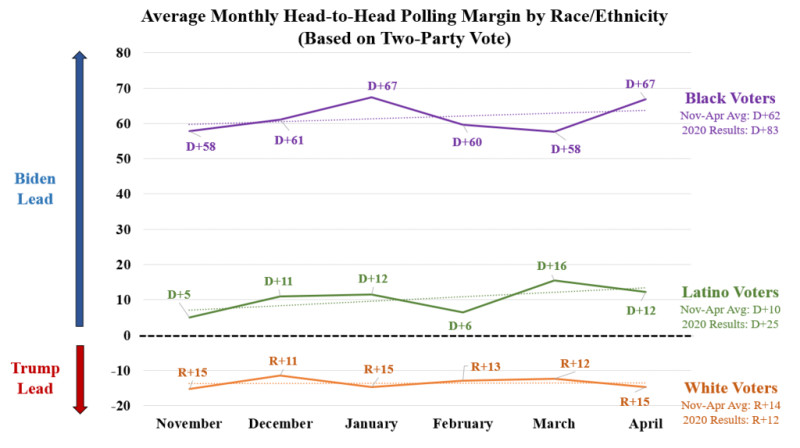
Polling margins by voter group
When media coverage leans heavily on polls, campaigns can turn into horse race journalism. That means the story becomes who is ahead, behind, surging, fading, or “electable.”
Common signs:
- standings in the polls
- momentum
- viability or electability
- fundraising and endorsements as strength signals
- campaign strategy and winner predictions
That is different from substantive coverage, which looks at qualifications, experience, record, and policy platforms.
Horse race coverage matters because it can pull attention away from issues, influence donors and volunteers, encourage strategic voting, and create a feedback loop. Better poll numbers bring more coverage. More coverage can bring more money and support. That can improve later poll numbers.
One AP caution students forget: poll-heavy coverage can make tiny or statistically uncertain leads sound much bigger than they are.
Why the Media Matters in Democracy
The media helps democracy by informing citizens, exposing wrongdoing, giving visibility to public concerns, and helping both citizens and officials identify major issues.
Its limits come from selection. Some issues get ignored. Repeated coverage can distort priorities. Poll-centered election coverage can reduce campaigns to popularity contests.
Key Takeaways
Media as a Linkage Institution
Connects citizens and government by transmitting political information to the public and communicating public concerns and reactions to policymakers
Agenda Setting
Media influence over which political issues citizens notice and regard as important through selection, prominence, repetition, and sustained coverage
Investigative Journalism
Sustained reporting that examines evidence and sources to uncover and verify information not already public or easily available
Media Watchdog Role
The media’s scrutiny and exposure of misconduct by government officials and other powerful institutions on behalf of the public
Political Commentary
Media interpretation, analysis, evaluation, or advocacy rather than straight reporting of newly verified facts
Public Agenda vs. Policy Agenda
The public agenda contains issues citizens consider important; the policy agenda contains issues government officials are actively considering
Horse Race Journalism
Election coverage centered on polling, popularity, standings, momentum, strategy, and who is winning rather than candidates’ qualifications and policy platforms
Notes
Media as a Linkage Institution
Connects citizens and government by transmitting political information to the public and communicating public concerns and reactions to policymakers
Agenda Setting
Media influence over which political issues citizens notice and regard as important through selection, prominence, repetition, and sustained coverage
Investigative Journalism
Sustained reporting that examines evidence and sources to uncover and verify information not already public or easily available
Media Watchdog Role
The media’s scrutiny and exposure of misconduct by government officials and other powerful institutions on behalf of the public
Political Commentary
Media interpretation, analysis, evaluation, or advocacy rather than straight reporting of newly verified facts
Public Agenda vs. Policy Agenda
The public agenda contains issues citizens consider important; the policy agenda contains issues government officials are actively considering
Horse Race Journalism
Election coverage centered on polling, popularity, standings, momentum, strategy, and who is winning rather than candidates’ qualifications and policy platforms
