Topic 4.8 Notes – Ideology and Policymaking
Political Culture, Ideology, Public Opinion, and Public Policy
This topic works like a chain. You need to know each link and how it connects to the next.
- Political culture means the shared democratic ideals Americans use to judge government. In this topic, the key values are individualism, equality of opportunity, free enterprise, and rule of law.
- Ideology is a more organized set of beliefs about what those values mean and what government should do. Two people can believe in equality of opportunity and still disagree about whether government should actively remove barriers.
- Public opinion is what people think at a given time.
- Public policy is government’s response to a public issue. It can come through laws, executive action, agency rules, court-enforced requirements, or state and local action.
The relationship to remember is:
political culture → ideology → public opinion → participation → institutions make policy → implementation shapes real effects

Political culture to policy flowchart
That chain is not automatic. Public opinion does not instantly become policy because federalism, separation of powers, institutional rules, and interest groups all shape what actually happens.
How Participation Shapes Policy
In a democracy, policy reflects the beliefs of the people who actually participate at that moment.
Participation includes:
- Voting because it decides who controls government.
- Donating, campaigning, and contacting officials because those actions get politicians’ attention.
- Protesting, organizing, petitioning, and using interest groups because they push issues onto the agenda and show intensity.
Intensity matters a lot. A large group with weak feelings can lose to a smaller group that is organized, wealthy, and highly motivated.
- Unequal participation means unequal influence.
- Groups differ in turnout, money, access, organization, and time.
- Interest groups can amplify voices that might otherwise be ignored, but they can also give wealthy or organized groups extra power.
A common test trap is thinking “most people support it” means “it becomes policy.” Support can be broad but weak, divided, or blocked by institutions.
Core Values in Policy Debates
Shared values create conflict because people interpret them differently.
Individualism
- Stresses self-reliance, personal responsibility, and limits on government.
- It can also support personal freedom from government interference.
Equality of opportunity
- One view says government should remove barriers such as discrimination or poverty.
- Another says fairness means the same rules for everyone, without special treatment.
Free enterprise
- Supports private property, competition, and voluntary exchange.
- Here, it mostly shows how beliefs about government’s role shape policy choices.
Rule of law
- Means laws apply to public officials and ordinary people alike.
- It supports order, due process, and limits on arbitrary government action.
On the exam, both sides usually claim American values. Do not frame one side as pro-American and the other as anti-American.
Liberty Versus Stability and Order
A recurring question in U.S. policy is how much government power is justified to protect safety and order without violating liberty.
- Individual liberty means freedom to choose, speak, organize, and act without unjustified interference.
- Stability and order means public safety, predictable rules, enforcement, and social peace.
Some laws protect liberty by creating order. Laws against violence make freedom possible. But heavy enforcement or broad restrictions can threaten liberty.
Useful scenario questions:
- What liberty interest is at stake?
- What government goal is being pursued?
- Are the restrictions justified, too broad, or unevenly applied?
Crises often increase support for stronger government power. Later, social movements or changing attitudes often expand liberty again.
Main Policy Examples You Need to Know
These examples show the values in action.
| Policy | What it did | Values in conflict |
|---|---|---|
| PRWORA 1996 | Replaced AFDC with TANF. Used block grants to states, work requirements, and a 60-month federal lifetime limit. | Individualism and personal responsibility vs equality of opportunity |
| DREAM Act and DACA | DREAM Act was proposed legislation first introduced in 2001 and never fully enacted. DACA was Obama’s 2012 executive program giving temporary protection and work authorization, not citizenship. | Opportunity and fairness vs rule of law and enforcement |
| Official English and multilingual access | Executive Order 14224 in 2025 designated English as official language but left agencies discretion. States also vary. | Unity and easier administration vs equal access and inclusion |
Multiculturalism supports full participation while keeping distinct identities. Assimilation stresses shared language, norms, and common citizenship. In this topic, the key point is that federalism matters. States can implement these ideas differently, so policy effects vary by place.
The map gives you a quick example of that state-by-state variation. Focus on the contrast between states with official English laws and states without final action.
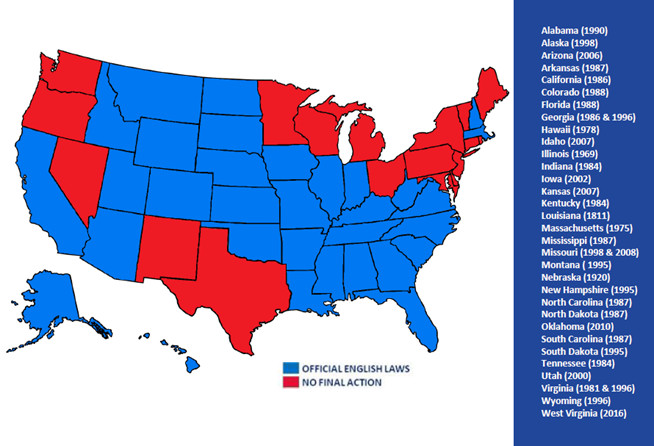
State official English laws
Key Takeaways
Political Culture
The broadly shared democratic ideals, principles, and core values Americans use to evaluate government and public policy
Political Ideology
An organized set of beliefs about how political values should be interpreted and what government should do
Public Opinion
The attitudes held by members of the public at a particular time, which influence policy through political participation rather than automatically determining it
Public Policy
An authoritative governmental response to a public issue, such as legislation, executive action, administrative rules, or enforceable requirements
Policy Formation
The process of recognizing a public problem, placing it on the governmental agenda, developing alternatives, and adopting or rejecting a proposal
Policy Implementation
The process of putting an adopted policy into effect through rules, eligibility standards, enforcement choices, funding, and administrative discretion
Individualism
The belief that people can shape their lives through their own choices, supporting personal responsibility, self-reliance, and protection from government interference
Equality of Opportunity
The principle that people should have a fair chance to compete, disputed between removing unequal barriers and applying uniform rules without preferences
Free Enterprise
The value favoring private property, voluntary exchange, competition, self-interest, and limited government regulation of markets
Rule of Law
The principle that laws govern officials and private persons alike through consistent enforcement, lawful procedures, and limits on arbitrary government action
Individual Liberty vs. Stability and Order
The recurring policy balance between freedom from unjustified government interference and government authority needed for public safety, predictable rules, and effective enforcement
Personal Responsibility and Work Opportunity Reconciliation Act of 1996
The welfare-reform law that replaced AFDC with TANF block grants, work-related requirements, a general 60-month federal limit, and greater state flexibility
DREAM Act (Development, Relief, and Education for Alien Minors Act)
Federal legislative proposals offering certain immigrants brought to the United States as children a conditional route to lawful status; unlike DACA, the DREAM Act has not been enacted
Official-English Policy
Policy designating English as the government's official language, justified by unity and administrative efficiency but contested over liberty and equal access to services
Multiculturalism vs. Assimilation
Multiculturalism supports full participation while retaining distinct identities; assimilation emphasizes incorporation into common public norms, civic practices, and language
Policy Goals
The intended results a policy pursues, expressing how policymakers prioritize or reconcile values such as liberty, opportunity, responsibility, safety, and limited government
Notes
Political Culture
The broadly shared democratic ideals, principles, and core values Americans use to evaluate government and public policy
Political Ideology
An organized set of beliefs about how political values should be interpreted and what government should do
Public Opinion
The attitudes held by members of the public at a particular time, which influence policy through political participation rather than automatically determining it
Public Policy
An authoritative governmental response to a public issue, such as legislation, executive action, administrative rules, or enforceable requirements
Policy Formation
The process of recognizing a public problem, placing it on the governmental agenda, developing alternatives, and adopting or rejecting a proposal
Policy Implementation
The process of putting an adopted policy into effect through rules, eligibility standards, enforcement choices, funding, and administrative discretion
Individualism
The belief that people can shape their lives through their own choices, supporting personal responsibility, self-reliance, and protection from government interference
Equality of Opportunity
The principle that people should have a fair chance to compete, disputed between removing unequal barriers and applying uniform rules without preferences
Free Enterprise
The value favoring private property, voluntary exchange, competition, self-interest, and limited government regulation of markets
Rule of Law
The principle that laws govern officials and private persons alike through consistent enforcement, lawful procedures, and limits on arbitrary government action
Individual Liberty vs. Stability and Order
The recurring policy balance between freedom from unjustified government interference and government authority needed for public safety, predictable rules, and effective enforcement
Personal Responsibility and Work Opportunity Reconciliation Act of 1996
The welfare-reform law that replaced AFDC with TANF block grants, work-related requirements, a general 60-month federal limit, and greater state flexibility
DREAM Act (Development, Relief, and Education for Alien Minors Act)
Federal legislative proposals offering certain immigrants brought to the United States as children a conditional route to lawful status; unlike DACA, the DREAM Act has not been enacted
Official-English Policy
Policy designating English as the government's official language, justified by unity and administrative efficiency but contested over liberty and equal access to services
Multiculturalism vs. Assimilation
Multiculturalism supports full participation while retaining distinct identities; assimilation emphasizes incorporation into common public norms, civic practices, and language
Policy Goals
The intended results a policy pursues, expressing how policymakers prioritize or reconcile values such as liberty, opportunity, responsibility, safety, and limited government
