Topic 2.2 Notes – Structures, Powers, and Functions of Congress
How Congress Is Built to Make Policy
Article I creates a bicameral legislature, which means Congress has two chambers. A bill has to pass the House and the Senate in the exact same wording before it can become law. That alone creates a major hurdle.
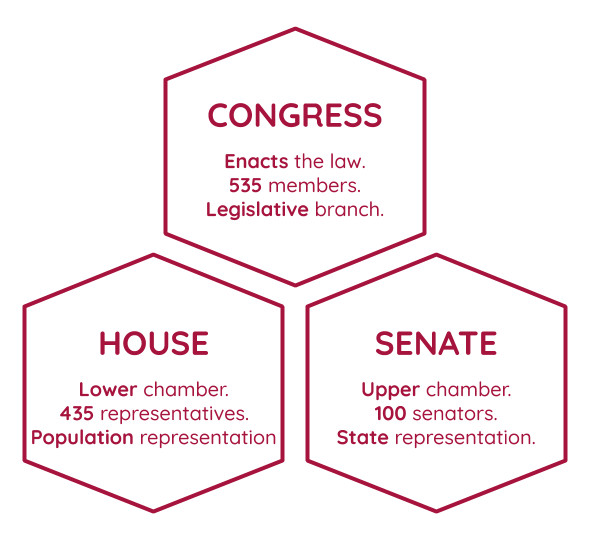
Congress has broad policymaking power. It can make laws, tax, spend, borrow, regulate commerce, declare war, create lower federal courts, investigate the executive branch, and use the power of the purse to shape policy through funding.
Some powers are enumerated powers, meaning they are listed in the Constitution. Others are implied powers, which come from the Necessary and Proper Clause. In McCulloch v. Maryland, the Supreme Court backed this idea by saying Congress can use reasonable means to carry out its listed powers.
The House and Senate were designed to work differently:
| Chamber | Design | Policy effect |
|---|---|---|
| House | 435 members, 2-year terms, strong leadership, strict rules | faster action, less debate, majority party control |
| Senate | 100 members, 6-year terms, looser rules, more individual power | slower action, more bargaining, easier delay |
The big test idea is that Congress has legislative power, but its structure creates many veto points before policy can pass.
Committees and Leadership as Gatekeepers
Most bills do not go straight to the floor. They go first to committees, where the real detailed work happens. Committees hold hearings, debate, investigate, and mark up bills by changing their language.
A committee can also just do nothing. That matters because committee inaction can kill a bill as effectively as a no vote.
Types of committees
- Standing committees are permanent and do most legislative work.
- Select committees are temporary or issue-specific and often investigate.
- Joint committees include House and Senate members and usually study issues.
- Conference committees are temporary groups that reconcile House and Senate versions of a bill.
Committee leadership reflects party control:
- The majority party controls the chair.
- The ranking member is the top minority-party member.
Party leaders matter too:
- Speaker of the House is elected by a majority of House members and shapes the agenda.
- Majority and minority leaders organize party strategy.
- Whips count votes, pressure members, and keep the party organized.
A bill may also get calendar assignment, which means it is placed on the schedule for possible floor action.
House Rules and Senate Rules
Different chamber rules produce different outcomes.
House procedures
- Revenue bills must originate in the House.
- The Rules Committee decides how debate will work.
- Open rule allows amendments.
- Closed rule blocks amendments.
- Modified rule allows only some amendments.
- The Committee of the Whole lets the House debate and amend major bills more quickly.
- A discharge petition can force a bill out of committee, but it almost never works.
Senate procedures
- Bills usually reach the floor by unanimous consent.
- A hold is an informal warning from a senator who wants delay.
- A filibuster delays or blocks final action by extending debate.
- Cloture ends debate, usually with 60 votes on ordinary legislation.
Reconciling the chambers
If the House and Senate pass different versions, a conference committee writes a compromise. Then both chambers must pass the identical final version.
Other tools show up a lot on tests:
- Rider amendments attach extra provisions to bigger bills.
- Omnibus bills package many measures into one large bill.
The Budget and Spending Politics
Budget choices are policy choices. Congress decides where money goes.
- Mandatory spending is required by existing law. Main examples are Social Security, Medicare, and Medicaid.
- Discretionary spending is decided yearly through appropriations. Examples include defense, education, and infrastructure.
As entitlement costs rise, Congress has less room to move money around unless it raises taxes, cuts programs, or increases the deficit. If appropriations do not pass, some discretionary parts of government can shut down.
When you read a budget graph, say what the data shows before you explain why. Also, do not confuse a share of spending with a dollar amount.
How Congress Actually Builds Coalitions
Lawmaking is a long process of agenda control, bargaining, amendment, and compromise.
- Pork-barrel legislation gives local projects funding inside larger bills and helps members claim credit at home.
- Logrolling means trading votes or favors to build support.
These practices can help bills pass in a fragmented Congress, but they can also raise spending and hide who is responsible.
The usual path looks like this:
- Introduce bill
- Refer to committee
- Hearings and markup
- Calendar assignment and leadership scheduling
- Floor debate under chamber rules
- Passage in each chamber
- Conference committee if needed
- Identical passage by both chambers
Key Takeaways
Bicameralism
Division of Congress into the House and Senate, both of which must pass identical legislative text
Enumerated Powers
Congressional powers expressly listed in the Constitution, such as taxing, spending, regulating commerce, and declaring war
Implied Powers
Congressional powers derived from the necessary and proper clause rather than expressly listed in the Constitution
Power of the Purse
Congress's authority to tax, appropriate, limit, or withhold federal funds
Bill
A proposed law formally introduced by a member of the House or Senate
Origination Clause
Article I requirement that all bills for raising revenue through taxation originate in the House
Legislative Calendar
A list placing bills among those eligible for floor consideration, without guaranteeing that leaders will schedule them
Congressional Committee
A group that divides Congress's workload by reviewing, investigating, revising, and deciding whether to advance legislation
Congressional Hearing
A committee proceeding used to gather testimony and information, question officials, and publicize policy issues
Markup
A committee session in which members consider a bill section by section and vote on revisions, additions, or deletions
Standing Committee
A permanent congressional committee with continuing jurisdiction over a broad policy area
Select Committee / Special Committee
A committee created for a particular investigation or study, often temporarily and sometimes without power to report legislation
Joint Committee
A committee containing House and Senate members that generally conducts studies, investigations, or administrative coordination
Conference Committee
A temporary bicameral committee that reconciles differences between House and Senate versions of legislation
Committee Chair
The majority-party member who leads a committee and influences hearings, witnesses, markups, and voting schedules
Ranking Member
The senior member of the minority party on a congressional committee
Speaker of the House
The majority-elected House presiding officer and chief agenda setter who helps schedule legislation and assemble support
House Majority and Minority Leaders
Party leaders who coordinate their respective parties' legislative strategies in the House
Party Whips
Party officials who count votes, communicate leadership positions, persuade members, and encourage attendance for important votes
House Rules Committee
The House committee that sets the conditions for debating most major bills, including debate time and permitted amendments
Special Rule
A House Rules Committee resolution specifying how a particular bill will be debated and amended
Open Rule
A House debate rule permitting members to offer relevant floor amendments under ordinary House procedures
Closed Rule
A House debate rule prohibiting floor amendments to a bill
Modified Rule
A House debate rule allowing only designated amendments or amendments meeting specified conditions
Committee of the Whole
All House members meeting under expedited debate rules and a 100-member quorum, without authority to pass a bill finally
Discharge Petition
A House procedure through which 218 representatives can remove a bill from committee and move it toward floor consideration
Senate Majority Leader
The Senate's principal scheduler and legislative strategist, who must negotiate within rules protecting individual senators
Unanimous Consent
A Senate arrangement that bypasses procedural steps or sets debate terms when no senator objects
Hold
An informal senator's request that party leaders delay floor consideration of a bill or nomination
Filibuster
A Senate tactic of prolonging or threatening extended debate to delay or prevent a final vote
Cloture
The procedure for limiting Senate debate, normally requiring three-fifths of senators duly chosen and sworn, or 60 when all 100 seats are filled
Rider
A provision attached to a larger bill, sometimes unrelated to its main subject, to improve its chance of passage
Omnibus Bill
A large legislative package combining numerous subjects, programs, or appropriations into one bill
Mandatory Spending
Federal spending required by existing law and determined by legal commitments and eligibility, not annual appropriations
Entitlement Program
A program whose law guarantees authorized benefits to people who satisfy its eligibility rules, such as Social Security or Medicare
Discretionary Spending
Federal spending approved through the annual appropriations process, including defense, education, research, and infrastructure
Authorization vs. Appropriation
Authorization establishes or continues a program's legal authority; appropriation supplies money for it
Budget Deficit
The amount by which federal expenditures exceed federal revenues during a fiscal period
Government Shutdown
A lapse in funding for affected discretionary operations when Congress fails to enact necessary appropriations
Pork-Barrel Legislation
Funding for a project benefiting a particular district, state, or locality, usually included in a larger bill
Earmark
A specifically directed expenditure for a designated project, often associated with pork-barrel legislation
Logrolling
The exchange of political favors among legislators, especially reciprocal vote trading on different priorities
House vs. Senate Legislative Structure
The larger House uses centralized leadership and tightly structured debate; the smaller Senate allows less restricted debate and greater procedural influence for individual members and minorities
Notes
Bicameralism
Division of Congress into the House and Senate, both of which must pass identical legislative text
Enumerated Powers
Congressional powers expressly listed in the Constitution, such as taxing, spending, regulating commerce, and declaring war
Implied Powers
Congressional powers derived from the necessary and proper clause rather than expressly listed in the Constitution
Power of the Purse
Congress's authority to tax, appropriate, limit, or withhold federal funds
Bill
A proposed law formally introduced by a member of the House or Senate
Origination Clause
Article I requirement that all bills for raising revenue through taxation originate in the House
Legislative Calendar
A list placing bills among those eligible for floor consideration, without guaranteeing that leaders will schedule them
Congressional Committee
A group that divides Congress's workload by reviewing, investigating, revising, and deciding whether to advance legislation
Congressional Hearing
A committee proceeding used to gather testimony and information, question officials, and publicize policy issues
Markup
A committee session in which members consider a bill section by section and vote on revisions, additions, or deletions
Standing Committee
A permanent congressional committee with continuing jurisdiction over a broad policy area
Select Committee / Special Committee
A committee created for a particular investigation or study, often temporarily and sometimes without power to report legislation
Joint Committee
A committee containing House and Senate members that generally conducts studies, investigations, or administrative coordination
Conference Committee
A temporary bicameral committee that reconciles differences between House and Senate versions of legislation
Committee Chair
The majority-party member who leads a committee and influences hearings, witnesses, markups, and voting schedules
Ranking Member
The senior member of the minority party on a congressional committee
Speaker of the House
The majority-elected House presiding officer and chief agenda setter who helps schedule legislation and assemble support
House Majority and Minority Leaders
Party leaders who coordinate their respective parties' legislative strategies in the House
Party Whips
Party officials who count votes, communicate leadership positions, persuade members, and encourage attendance for important votes
House Rules Committee
The House committee that sets the conditions for debating most major bills, including debate time and permitted amendments
Special Rule
A House Rules Committee resolution specifying how a particular bill will be debated and amended
Open Rule
A House debate rule permitting members to offer relevant floor amendments under ordinary House procedures
Closed Rule
A House debate rule prohibiting floor amendments to a bill
Modified Rule
A House debate rule allowing only designated amendments or amendments meeting specified conditions
Committee of the Whole
All House members meeting under expedited debate rules and a 100-member quorum, without authority to pass a bill finally
Discharge Petition
A House procedure through which 218 representatives can remove a bill from committee and move it toward floor consideration
Senate Majority Leader
The Senate's principal scheduler and legislative strategist, who must negotiate within rules protecting individual senators
Unanimous Consent
A Senate arrangement that bypasses procedural steps or sets debate terms when no senator objects
Hold
An informal senator's request that party leaders delay floor consideration of a bill or nomination
Filibuster
A Senate tactic of prolonging or threatening extended debate to delay or prevent a final vote
Cloture
The procedure for limiting Senate debate, normally requiring three-fifths of senators duly chosen and sworn, or 60 when all 100 seats are filled
Rider
A provision attached to a larger bill, sometimes unrelated to its main subject, to improve its chance of passage
Omnibus Bill
A large legislative package combining numerous subjects, programs, or appropriations into one bill
Mandatory Spending
Federal spending required by existing law and determined by legal commitments and eligibility, not annual appropriations
Entitlement Program
A program whose law guarantees authorized benefits to people who satisfy its eligibility rules, such as Social Security or Medicare
Discretionary Spending
Federal spending approved through the annual appropriations process, including defense, education, research, and infrastructure
Authorization vs. Appropriation
Authorization establishes or continues a program's legal authority; appropriation supplies money for it
Budget Deficit
The amount by which federal expenditures exceed federal revenues during a fiscal period
Government Shutdown
A lapse in funding for affected discretionary operations when Congress fails to enact necessary appropriations
Pork-Barrel Legislation
Funding for a project benefiting a particular district, state, or locality, usually included in a larger bill
Earmark
A specifically directed expenditure for a designated project, often associated with pork-barrel legislation
Logrolling
The exchange of political favors among legislators, especially reciprocal vote trading on different priorities
House vs. Senate Legislative Structure
The larger House uses centralized leadership and tightly structured debate; the smaller Senate allows less restricted debate and greater procedural influence for individual members and minorities
