Topic 2.5 Notes – Checks on the Presidency
Why the President and Congress Clash
The presidential agenda is the set of policies the president wants to push. The congressional agenda is the formal list of policies Congress is actually considering. Those overlap sometimes, but they are never automatically the same.
This tension comes from separated institutions sharing powers. Federalist No. 51 said government should be structured so that ambition counteracts ambition. In plain English, each branch has reasons and powers to push back on the others. The checks-and-balances diagram below is a quick visual of that back-and-forth.
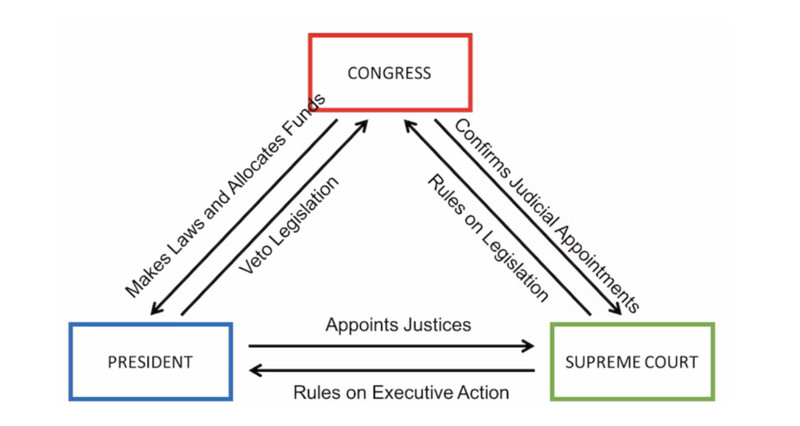
Checks and balances among the branches
Why conflict happens:
- Different constituencies and election cycles shape priorities. Presidents answer to the whole nation every four years. House members answer local districts every two years. Senators answer whole states every six years.
- Partisan and ideological disagreement matters. If they want different policy outcomes, compromise gets harder.
- Divided government causes the most confrontation. That means the president’s party does not control at least one chamber of Congress.
- Unified government does not erase conflict. Senators and representatives still protect their chamber’s power and their own voters’ interests.
How Congress resists:
- Refuse to consider a proposal and let it die quietly.
- Rewrite or reject legislation so the final bill looks different from what the president wanted.
- Use appropriations to attach limits or deny money.
- Conduct oversight through hearings and investigations.
How the president responds:
- Bargaining and persuasion to win votes.
- Veto threats to pressure Congress.
- Executive orders to direct executive action.
- Directives to agencies to shape how laws are carried out.
Senate Confirmation as a Check on Appointments
Article II gives the president the power to nominate, but the Senate must give advice and consent for major offices. The House has no role here.
The sequence
- The president nominates someone.
- A Senate committee reviews the nominee, investigates, and may hold hearings.
- The committee votes on whether to advance the nomination.
- The full Senate debates and votes.
- If confirmed, the appointment goes forward. If rejected, the president needs a new nominee.
Confirmation usually takes a simple majority.
A nomination can still fail without a final no vote:
- committee refuses to advance it
- Senate leaders do not schedule it
- delays build opposition
- nominee withdraws
Offices requiring Senate confirmation
- Cabinet members
- Ambassadors
- Some Executive Office of the President positions, such as the OMB director
- Supreme Court justices
- Court of Appeals judges
- District Court judges
Senators look at qualifications, experience, ethics, conflicts of interest, ideology, and general fitness for office.
Examples you should know:
- John Tower was rejected for secretary of defense.
- Robert Bork failed to win confirmation to the Supreme Court.
- Abe Fortas failed in his bid to become chief justice.
A common trap is thinking all presidential advisers need confirmation. They do not. Many White House staff jobs do not.
Judicial Appointments and the President’s Longest-Lasting Influence
Judges matter more than most appointees because Article III gives federal judges life tenure during good behavior. Cabinet officials usually leave with the administration. Judges can shape law for decades.
That makes judicial appointments the president’s longest-lasting influence. Still, the Senate can confirm, delay, block, or pressure a nominee to withdraw.
Judicial confirmations get intense because senators care about:
- ideology
- judicial philosophy
- approach to precedent
- whether the nominee could shift a court’s balance
Key examples:
- Thurgood Marshall was confirmed in 1967 and became the first Black Supreme Court justice.
- Sandra Day O’Connor was confirmed in 1981 and became the first woman on the Supreme Court.
- Robert Bork was rejected in 1987.
- Abe Fortas was blocked for chief justice in 1968 and withdrew.
Executive Orders, Bureaucratic Action, and War Powers
When Congress will not pass the president’s priorities, presidents often act through the executive branch. Executive orders and other directives manage government operations and tell agencies how to carry out existing law. They cannot override a federal statute, and later presidents can usually reverse them.
Congress can answer by:
- passing limiting legislation
- restricting funding through appropriations
- holding hearings and investigations
- questioning nominees about implementation
No Child Left Behind Act shows the limit of unilateral action. It was a presidential priority, but it still required Congress to pass a law.
War powers bring this conflict into sharp focus. The president is commander in chief, but Congress declares war and controls funding. The War Powers Resolution of 1973 requires reporting troop involvement within 48 hours and, without authorization, withdrawal generally within 60 days plus 30 more for withdrawal. The timeline below gives you the sequence students are expected to know.
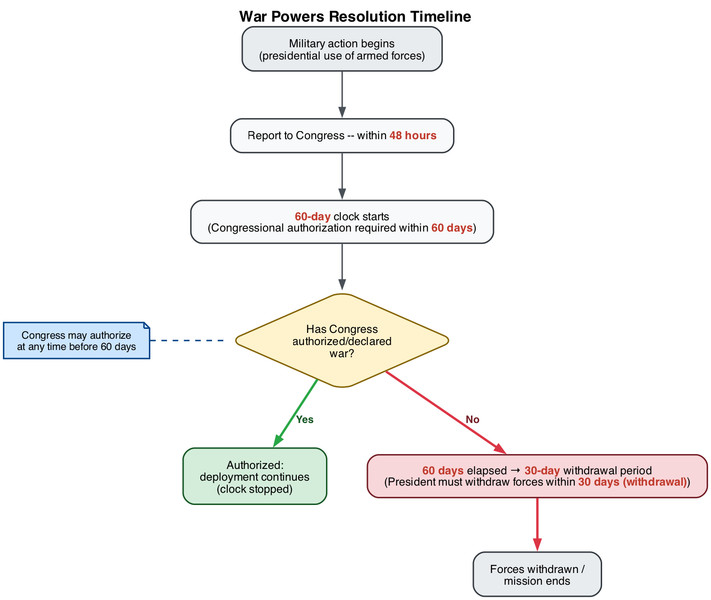
War Powers Resolution timeline
Examples of military conflict:
- Vietnam
- Iraq
- Kosovo
- Libya
- Syria
Key Takeaways
Presidential Agenda
The policies and priorities a president seeks to advance
Congressional Agenda
The formal list of policies Congress is considering at a given time
Presidential Appointment Power
The president’s Article II authority to nominate ambassadors, federal judges, and other federal officers, many subject to Senate consent
Senate Confirmation Power (Advice and Consent for Appointments)
The Senate’s check over specified presidential nominees through approving, rejecting, or delaying confirmation; approval ordinarily requires a simple majority
Life Tenure for Article III Judges
Service until death, retirement, resignation, or removal by impeachment and conviction, allowing judicial appointments to outlast a presidency
Executive Order
A presidential directive managing the federal government or directing executive officials in carrying out existing constitutional or statutory authority
Directives to the Bureaucracy
Presidential instructions, including orders and memoranda, that guide agencies’ enforcement, organization, or implementation of existing law
War Powers
Shared military authority: the president commands the armed forces, while Congress declares war, authorizes operations, regulates the military, and controls funding
War Powers Resolution
The 1973 law requiring the president to consult Congress where possible, report the introduction of forces into hostilities within 48 hours, and generally withdraw them within 60 days without authorization, with 30 additional days for withdrawal
Notes
Presidential Agenda
The policies and priorities a president seeks to advance
Congressional Agenda
The formal list of policies Congress is considering at a given time
Presidential Appointment Power
The president’s Article II authority to nominate ambassadors, federal judges, and other federal officers, many subject to Senate consent
Senate Confirmation Power (Advice and Consent for Appointments)
The Senate’s check over specified presidential nominees through approving, rejecting, or delaying confirmation; approval ordinarily requires a simple majority
Life Tenure for Article III Judges
Service until death, retirement, resignation, or removal by impeachment and conviction, allowing judicial appointments to outlast a presidency
Executive Order
A presidential directive managing the federal government or directing executive officials in carrying out existing constitutional or statutory authority
Directives to the Bureaucracy
Presidential instructions, including orders and memoranda, that guide agencies’ enforcement, organization, or implementation of existing law
War Powers
Shared military authority: the president commands the armed forces, while Congress declares war, authorizes operations, regulates the military, and controls funding
War Powers Resolution
The 1973 law requiring the president to consult Congress where possible, report the introduction of forces into hostilities within 48 hours, and generally withdraw them within 60 days without authorization, with 30 additional days for withdrawal
