Topic 2.13 Notes – Discretionary and Rulemaking Authority
Delegated Authority, Bureaucratic Discretion, and Rulemaking
Congress often passes broad statutes, creates or funds agencies, and gives them power through enabling legislation. That delegated authority lets an agency carry out a law within the limits Congress set.
Here’s the key distinction students mix up a lot:
- Delegated authority means Congress gave the agency legal power to act.
- Discretionary authority means the agency has room to choose how to interpret and implement the law.
- Rulemaking authority means the agency can write binding regulations under that delegated power.
So discretion is broader. Rulemaking is one formal way an agency uses discretion.
Agencies do not pass laws. Congress passes statutes. Agencies issue regulations that have the force of law because Congress authorized them to.
Agencies must stay within:
- the statute Congress passed
- the Constitution
- required procedures such as the Administrative Procedure Act
Congress delegates because modern policy is complicated. Air pollution, securities markets, education funding, and campaign finance all need expertise, constant attention, and flexibility that Congress does not have time to handle line by line. Broad language also helps Congress compromise politically, then leave the details to specialists.
That’s why the bureaucracy is more than a machine carrying out orders. It helps shape policy during implementation.
How Agencies Turn Statutes into Policy Outcomes
A law does not finish policy. It starts it.
The sequence works like this:
- Congress passes a statute and delegates authority.
- The agency interprets what the statute means.
- The agency uses discretion to choose standards, procedures, and priorities.
- The agency may issue regulations.
- The agency administers and enforces the policy.
- People, businesses, states, and groups respond, producing policy outcomes.
Agencies make choices about:
- definitions and standards
- application procedures
- where staff and money go
- how often inspections happen
- what counts as proof of compliance
- which violations get priority
- what penalties to pursue
A huge exam point here is that implementation and enforcement can happen even without a new rule. An agency may keep the same regulation but enforce it more aggressively, inspect different targets, or shift resources.
That is enforcement discretion. Agencies cannot chase every violation equally, so they focus on the most serious, visible, widespread, or politically important cases.
Policy can change without a new law because leadership changes, presidents set new priorities, resources shift, or conditions in the field change.
The Rulemaking Process
Rulemaking usually follows the Administrative Procedure Act of 1946. The flowchart below tracks the basic path from drafting a proposed rule to publishing a final rule.
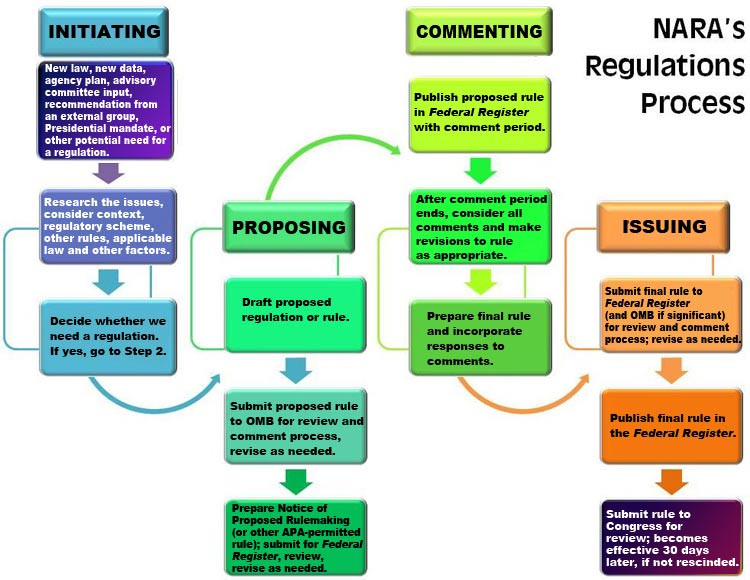
Federal agency rulemaking process
- Congress authorizes the agency by statute.
- The agency drafts a proposed rule.
- It publishes a notice of proposed rulemaking in the Federal Register.
- The public, experts, businesses, states, and interest groups submit comments.
- The agency reviews comments and may revise the proposal.
- The agency issues a final rule with its reasoning and effective date.
- Final regulations are compiled in the Code of Federal Regulations.
Public comments matter, and the comment stage in the diagram is often the part AP questions emphasize most. Agencies do not have to follow the most popular view. They do have to consider relevant input.
Rulemaking is quasi-legislative because agencies create general rules. They still are not an independent lawmaking branch.
Agencies With Delegated Discretion
| Agency | What it does here |
|---|---|
| Department of Homeland Security | Border security, immigration enforcement, emergency management, cybersecurity, TSA rules; uses discretion in staffing and security priorities. |
| Department of Transportation | Implements transportation safety laws; sets technical standards, including vehicle safety through agencies like NHTSA. |
| Department of Veterans Affairs | Runs veterans’ health care and benefits; issues rules on eligibility, applications, evidence, and benefits decisions. |
| Department of Education | Administers federal education laws and funding conditions; regulates student aid and civil-rights compliance. |
| Environmental Protection Agency | Major example of delegation in environmental law; sets technical pollution standards. |
| Federal Election Commission | Regulates federal campaign finance, disclosure, contributions, and spending; does not run elections. |
| Securities and Exchange Commission | Regulates securities markets and investor disclosures in a highly technical field. |
The EPA and the Limits of Agency Power
The Clean Air Act is the classic example. Congress set the framework, and the EPA filled in technical details.
The EPA sets National Ambient Air Quality Standards for six criteria pollutants:
- carbon monoxide
- lead
- nitrogen dioxide
- ozone
- particulate matter
- sulfur dioxide
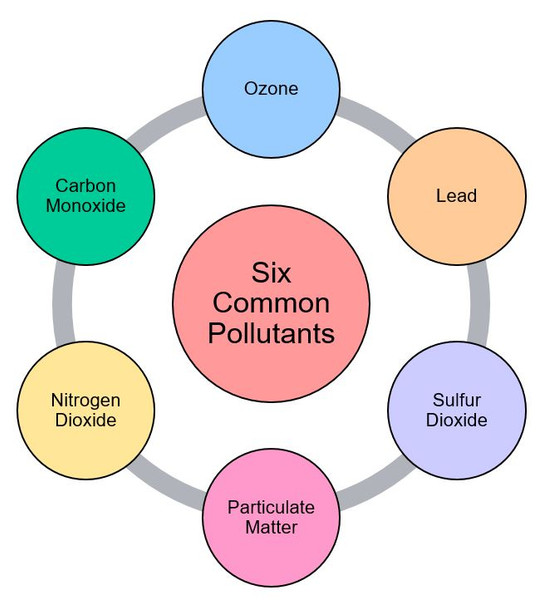
EPA criteria pollutants
EPA discretion includes interpreting statutory language, weighing scientific evidence, and choosing monitoring and compliance methods. EPA rulemaking includes issuing binding air-quality standards. EPA enforcement includes inspections, reviewing state plans, compliance monitoring, investigations, and penalties.
All agencies face the same limits. They must act under congressional authority, stay within the statute, follow procedures, and can be checked by Congress, the president, and the courts.
Key Takeaways
Delegated Authority
Governmental power transferred by Congress to an administrative agency through a statute
Enabling Legislation / Enabling Statute
A law that creates or empowers an agency, defines its mission and powers, and limits its authority
Discretionary Authority / Bureaucratic Discretion / Administrative Discretion
An agency’s freedom to choose among legally permissible methods of interpreting and implementing policy
Enforcement Discretion
An agency’s authority to set enforcement priorities, such as which violations to investigate first or most intensely
Rulemaking Authority
Delegated agency power to issue binding regulations that implement, interpret, or enforce a statute
Regulation
A binding administrative rule issued under delegated statutory authority that has the force of law
Administrative Procedure Act of 1946
The federal law that generally governs agency procedures, including the notice-and-comment rulemaking process
Notice-and-Comment Rulemaking
The process in which an agency publishes a proposed rule, receives and considers public comments, and then issues an explained final rule
Federal Register
The federal publication in which agencies announce proposed rules and publish final rules and related notices
Code of Federal Regulations
The organized collection of permanent regulations issued by federal agencies
Department of Homeland Security
The cabinet department that implements laws involving border security, immigration enforcement, emergency management, cybersecurity, and transportation security
Department of Transportation
The cabinet department whose agencies implement transportation laws and issue technical and safety standards
Department of Veterans Affairs
The cabinet department that administers veterans’ benefits and services through regulations, procedures, and case-specific decisions
Department of Education
The cabinet department that administers federal education laws, funding programs, student aid, and education civil-rights requirements
Environmental Protection Agency (EPA)
The executive agency that implements federal environmental laws through scientific standards, regulations, monitoring, and enforcement
Federal Election Commission (FEC)
The independent regulatory commission that administers and enforces federal campaign-finance law, not the casting or counting of votes
Securities and Exchange Commission (SEC)
The independent regulatory commission that administers securities laws, regulates markets, requires disclosures, and enforces its rules
Notes
Delegated Authority
Governmental power transferred by Congress to an administrative agency through a statute
Enabling Legislation / Enabling Statute
A law that creates or empowers an agency, defines its mission and powers, and limits its authority
Discretionary Authority / Bureaucratic Discretion / Administrative Discretion
An agency’s freedom to choose among legally permissible methods of interpreting and implementing policy
Enforcement Discretion
An agency’s authority to set enforcement priorities, such as which violations to investigate first or most intensely
Rulemaking Authority
Delegated agency power to issue binding regulations that implement, interpret, or enforce a statute
Regulation
A binding administrative rule issued under delegated statutory authority that has the force of law
Administrative Procedure Act of 1946
The federal law that generally governs agency procedures, including the notice-and-comment rulemaking process
Notice-and-Comment Rulemaking
The process in which an agency publishes a proposed rule, receives and considers public comments, and then issues an explained final rule
Federal Register
The federal publication in which agencies announce proposed rules and publish final rules and related notices
Code of Federal Regulations
The organized collection of permanent regulations issued by federal agencies
Department of Homeland Security
The cabinet department that implements laws involving border security, immigration enforcement, emergency management, cybersecurity, and transportation security
Department of Transportation
The cabinet department whose agencies implement transportation laws and issue technical and safety standards
Department of Veterans Affairs
The cabinet department that administers veterans’ benefits and services through regulations, procedures, and case-specific decisions
Department of Education
The cabinet department that administers federal education laws, funding programs, student aid, and education civil-rights requirements
Environmental Protection Agency (EPA)
The executive agency that implements federal environmental laws through scientific standards, regulations, monitoring, and enforcement
Federal Election Commission (FEC)
The independent regulatory commission that administers and enforces federal campaign-finance law, not the casting or counting of votes
Securities and Exchange Commission (SEC)
The independent regulatory commission that administers securities laws, regulates markets, requires disclosures, and enforces its rules
