Topic 1.1 Notes – Introducing Calculus: Can Change Occur at an Instant?
1. Average Rate of Change
For a function , the average rate of change over an interval is
This is:
- Change in output divided by change in input
- The slope of the secant line through and
- A measure of how fast the function changes over an interval
If the function is not linear, this value depends on which interval you choose.
Units matter
If is in seconds and is in meters, then the average rate of change is in meters per second. The structure is always
Important details
- You need two distinct x-values.
- If , the denominator is 0, so the expression is undefined.
- Linear functions have constant average rate of change. Nonlinear ones do not.
What this looks like
On a graph, the average rate of change is the slope of a secant line connecting two points on the curve.
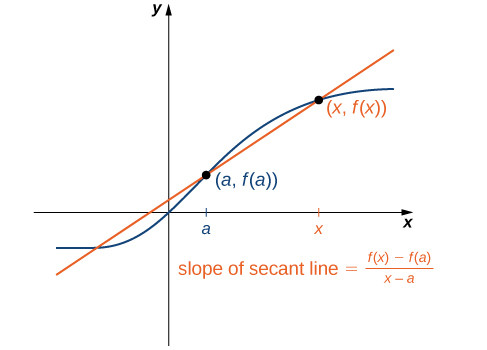
Secant line and average rate of change
The straight line connecting and has slope . That slope is exactly the average rate of change over that interval.
But what if you only care about one point?
2. From Secant Lines to the Instantaneous Rate of Change
If we try to plug the same x-value into the average rate formula, we divide by zero. That’s impossible. So we take a different approach.
Instead of using and , use:
The average rate of change becomes:
Now imagine shrinking . As gets closer to 0, the two points get closer together.
The key idea:
If this limit exists, it gives the instantaneous rate of change at .
That value is:
- The slope of the tangent line
- The derivative at ** (formal name comes next topic)
What this looks like
As the second point moves closer to , the secant line through the two points approaches a single line at that point.
On quizzes, teachers love asking you to explain this in words. A strong answer sounds like:
“As the interval shrinks, the slopes of the secant lines approach the slope of the tangent line.”
3. What the Limit Is Doing
A limit describes what a function value approaches as the input approaches something.
In this topic, the limit:
- Prevents direct division by zero
- Describes what happens as the interval gets smaller
- Converts an average rate into an instantaneous rate
This is the big conceptual move of calculus. We never actually let . We examine what happens as it approaches 0.
If the slopes approach one single number, the instantaneous rate exists.
If they don’t settle on one value, then there is no instantaneous rate there. That situation will matter later when we talk about sharp corners and cusps.
4. Interpreting Instantaneous Rate of Change
You should recognize it in multiple forms.
Graphically
It is the slope of the tangent line at a point.
Numerically
A table of average rates that get closer and closer to one number.
In context
If is position, the instantaneous rate is velocity at that exact time.
With units
Same structure as average rate. Output units per input unit.
Language translation you’ll see on tests:
- “Rate at an instant”
- “Slope at a point”
- “As the interval shrinks”
- “Approaches zero”
They’re all pointing to this same limit idea.
5. Common Mistakes That Cost Points
- Plugging in too soon and getting 0 in the denominator.
- Forgetting that instantaneous rate comes from the average rate formula.
- Mixing up secant line (two points) and tangent line (one point).
- Leaving off units in word problems.
- Thinking a single point cannot have a rate. It can, because of limits.
On the AP exam, explanation matters. If they ask why a rate exists, say that the slopes of the secant lines approach a single value.
