Topic 8.1 Notes – Finding the Average Value of a Function on an Interval
What the Average Value of a Function Is
If is continuous on , the average value of on that interval is
Think about what each piece means:
→ total signed area (net accumulation) between and
→ length of the interval
So you’re doing:
It’s the continuous version of
Except instead of adding up individual y-values, the integral adds up infinitely many values smoothly.
Also important: the average value has the same units as . If is in meters per second, the average value is meters per second.
The Formula and What Each Part Means
Here’s how to interpret it correctly:
- If most of the graph is above the x-axis → average value is positive.
- If most is below → average value is negative.
- If positive and negative areas cancel → the average could be small or even zero.
This is about signed area, not total area. That difference matters a lot on tests.
There’s also a helpful geometric interpretation. The average value is the height of a rectangle that has:
- Base
- The same area as the region under
In equation form:
Picture a rectangle drawn from to with a constant height that matches the area under the curve on that interval.
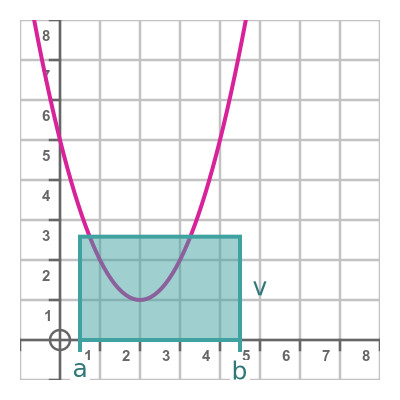
Average value as an equivalent-area rectangle
The rectangle’s height is exactly the average value.
How to Find the Average Value
When you’re given a formula, the process is mechanical:
- Write
- Find an antiderivative .
- Evaluate .
- Divide by .
Example (quick one):
Find the average value of on .
Antiderivative:
Evaluate:
Divide by 2:
Even though the function isn’t zero everywhere, the positive and negative accumulation cancel over that interval.
From a Graph
If they give you a graph:
- Break the region into geometric shapes.
- Add signed areas (below the x-axis counts negative).
- Divide by .
This shows up often in no-calculator multiple choice. If you forget to treat below-axis area as negative, you’ll pick the trap answer.
Common Confusions
Average value vs. average rate of change
- Average value uses an integral:
- Average rate of change uses endpoints:
These are completely different ideas. One averages outputs over an interval. The other measures slope between endpoints.
Forgetting the denominator
A lot of students stop after computing the definite integral. That’s only the total accumulation, not the average.
Using total area instead of signed area
Definite integrals include negatives automatically. Don’t convert everything to positive unless the question explicitly says “total area.”
