Topic 1.7 Notes – Selecting Procedures for Determining Limits
How to Choose a Method to Evaluate a Limit
When you see pause for a second. Look at what you’re given. The structure of the problem tells you the method.
There are four main scenarios in Unit 1:
- A graph
- A table
- An expression where direct substitution works
- An expression that gives and needs algebra
Let’s walk through each.
Limits from a Graph
If the problem gives you a graph, your job is visual.
In the example below, notice the hole at around , and the filled-in dot at a different height. That difference is the whole point.
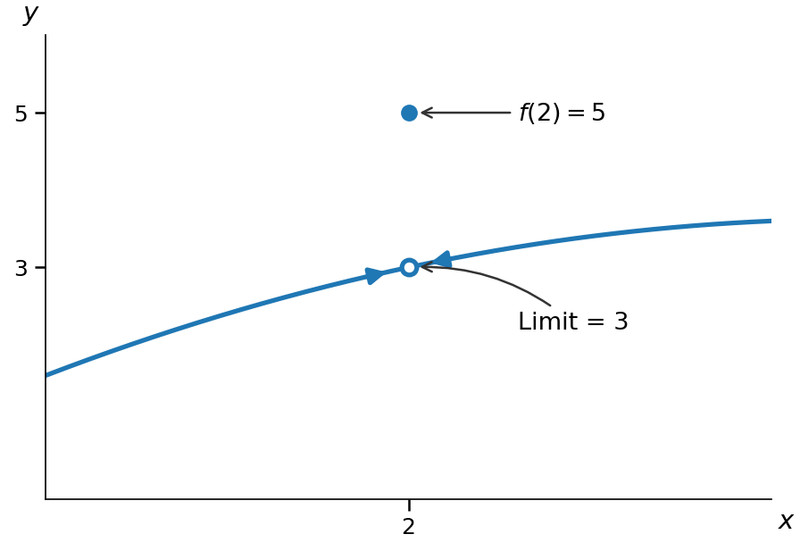
Limit vs. function value at x = 2
What you’re looking for:
- As , what y-value does the graph approach?
- Check both sides:
- Left-hand limit
- Right-hand limit
If both sides approach the same value, the limit exists.
Key situations:
- Hole (open circle) → limit can exist even if the function isn’t defined there.
- Jump → left and right approach different numbers → limit does not exist.
- Vertical asymptote → values grow toward or . That’s an infinite limit.
On multiple-choice questions, they love to trick you by putting the function value as an answer choice. The limit is about approach, not the filled-in dot. In the graph above, the limit is 3 even though .
Limits from a Table
If you’re given numerical values, you’re estimating a trend.
You’ll see -values getting closer to from:
- Slightly smaller numbers
- Slightly larger numbers
Then you watch the -values.
What matters:
- Do both sides seem to approach the same number?
- Are the values growing very large positive or negative?
- Are left and right heading toward different numbers?
Don’t just grab the value at . Sometimes it’s missing on purpose.
On calculator-active questions, you may generate your own table. Make sure you test values from both sides.
When Direct Substitution Works
If you plug in and get a normal real number, you’re done.
This works for:
- Polynomials
- Trig functions
- Exponential and logarithmic functions (in their domains)
- Rational functions where the denominator isn’t zero
Example idea:
Just substitute:
That’s it.
Composite Functions
If you see :
- Find .
- Plug that result into .
This works as long as the outer function is continuous at that value.
When You Get
If substitution gives that’s an indeterminate form. Now you simplify.
Common fixes:
1. Factor and Cancel
Factor numerator:
Cancel the factor, then substitute.
Important: you can cancel factors, not individual terms.
2. Multiply by the Conjugate
Used when radicals are involved.
Multiply top and bottom by .
This removes the square root in the numerator so you can cancel.
3. Trig Identities
The big one you must know:
If you can rewrite something to use this pattern, you’re set.
How to Think During a Test
Mentally run this checklist:
- Is there a graph? → Read it.
- Is there a table? → Look for trends.
- Can I substitute directly?
- If yes → stop.
- Did I get ? → Simplify.
- What structure do I see?
- Factoring?
- Conjugate?
- Trig identity?
Efficiency matters. Some students try to factor everything automatically and waste time when substitution would have worked instantly.
