Topic 8.9 Notes – Volume with Disc Method: Revolving Around the x- or y-Axis
What the Disc Method Is
When you rotate a region around an axis, it creates a 3D solid. The disc method works when:
- The region is bounded by one function and the axis of rotation
- The solid has no hole in the middle
If you slice the solid perpendicular to the axis of rotation, each slice is a thin disc.
Each disc has:
- Radius = distance from the curve to the axis
- Thickness = or
- Volume = area of circle × thickness
So one tiny piece has volume:
A definite integral adds all those tiny volumes together.
Revolving Around the x-Axis
If the region is rotated around the x-axis, your slices are vertical and you integrate with respect to x.
In the example below, the region under from to is revolved around the x-axis. A vertical slice becomes a circular disc when rotated.
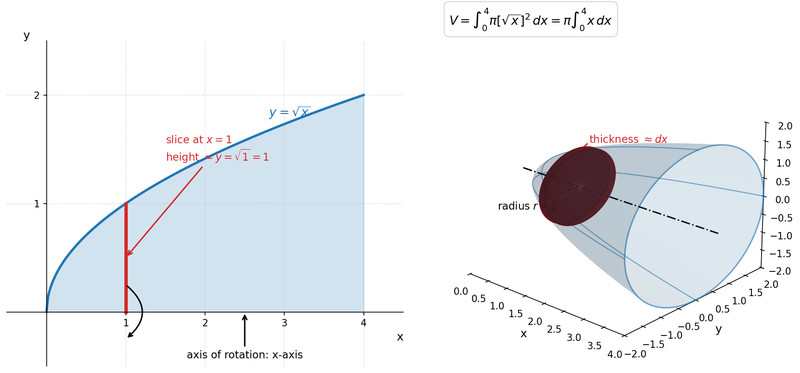
Disc method around the x-axis
If the function is , then:
- Radius = distance from curve to x-axis =
- Bounds are x-values
The volume formula is:
Quick Example
Rotate from to around the x-axis.
Since ,
Notice how the squaring often simplifies nicely.
Revolving Around the y-Axis
Now suppose we rotate around the y-axis.
Your slices must still be perpendicular to the axis, so they are horizontal. That means you integrate with respect to y.
If written as , then:
- Radius = distance from curve to y-axis =
- Bounds are y-values
The formula becomes:
Important move
If you're given but rotating around the y-axis, you must rewrite it:
If your integrand has in it but you're integrating with respect to , something is wrong.
How to Set It Up Correctly
When you're staring at a problem, walk through this logic:
- What axis am I rotating around?
- x-axis → use
- y-axis → use
- What is the radius?
- It is always the distance from the curve to the axis.
- Around x-axis → radius is a y-value.
- Around y-axis → radius is an x-value.
- Square the radius. This is the mistake people make most often.
- Use bounds that match your variable.
- → x-bounds
- → y-bounds
On FRQs, even if you don’t finish the integral, a correct setup earns most of the credit. The π, the square, and the correct bounds all matter.
When Disc Method Works (and When It Doesn’t)
The disc method applies when:
- The region touches the axis of rotation
- There is only one boundary function
- The cross-section is a solid circle
If there’s a gap between the curve and the axis, the cross-section is a ring. That’s the washer method, which is the next topic.
Quick mental check:
- Filled-in circle → disc
- Circle with a hole → washer
