Topic 1.8 Notes – Determining Limits Using the Squeeze Theorem
What the Squeeze Theorem Says
Here’s the statement in mathematical form:
If
- for all near (not necessarily at ), and
- ,
then
The idea is simple. If a function is trapped between two others, and those outer functions both approach the same number, the middle one has no choice but to approach that number too.
Here’s what that looks like visually.
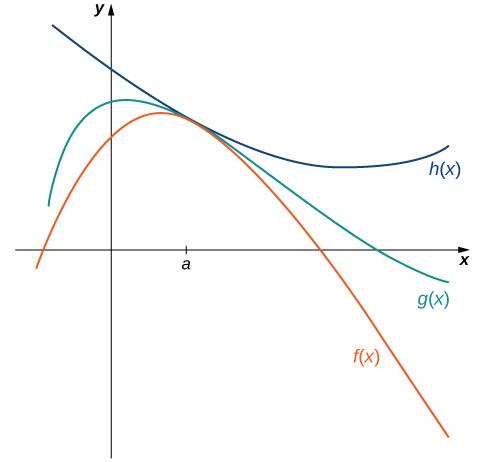
Visual model of the Squeeze Theorem
In the graph, stays between and as gets close to . Since the outer curves meet at the same height near , the middle curve is forced to head to that same value.
Notice that we only care about behavior near . The function doesn’t even have to be defined at .
The Three Conditions You Must Check
When you use this on a quiz or FRQ, you need all three pieces.
1. An Inequality Near
You must show
for values of sufficiently close to .
It doesn’t have to work at . Just around it.
2. The Outer Limits Exist
Both
must exist.
3. They Match
They must equal the same number .
If the outer limits are different, the theorem does nothing for you.
On an FRQ, skipping any of these justifications can cost you a point. The AP rubric wants to see that you verified the squeeze setup, not that you guessed correctly.
A Classic Oscillation Example
Consider
Direct substitution fails. The sine term oscillates wildly as .
Start with something you know:
Multiply everything by :
Now take limits of the outer functions:
Since both go to 0, the middle function must also go to 0.
So,
The graph makes the squeeze clear.
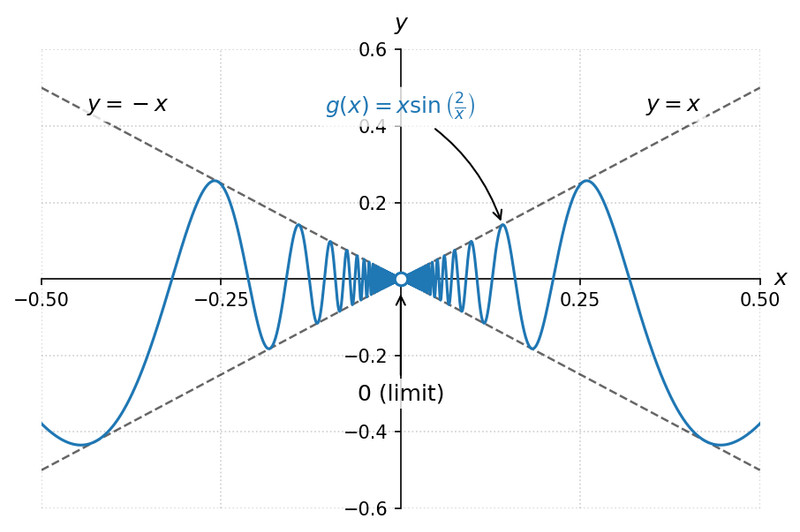
Graph of with and
The oscillations get tighter near 0, and the lines and pinch the graph toward the origin. The factor forces the height to shrink to 0.
Two Essential Trig Limits
These are foundational results that come from the Squeeze Theorem:
You are expected to know these. They get used later in derivative definitions and trig derivatives. You won’t reprove them every time, but you should understand they come from a squeeze argument using geometric inequalities.
If you see something that can be rewritten to look like one of these, do it. That’s often faster than building a new squeeze from scratch.
The Absolute Value Strategy
Sometimes it’s cleaner to write:
If you can show , then .
Example idea:
If
and , then the whole expression goes to 0.
This avoids worrying about flipping inequalities when multiplying by negatives.
When You Should Think “Squeeze”
- A trig function like sine or cosine is oscillating.
- The limit involves .
- Direct substitution fails.
- Algebra doesn’t simplify the expression cleanly.
If it simplifies algebraically, do that instead. Squeeze is a tool, not a requirement.
