Topic 1.12 Notes – Confirming Continuity over an Interval
1. What It Means for a Function to Be Continuous on an Interval
You already know continuity at a point. At , a function is continuous if:
- exists
- exists
Now zoom out.
A function is continuous on an interval if it is continuous at every single point in that interval.
That means:
- Every interior point satisfies the full 3-part test.
- If the interval includes endpoints (like ), then:
- At : the right-hand limit must equal
- At : the left-hand limit must equal
Graphically, this means no holes, no jumps, no vertical asymptotes anywhere inside the interval.
The four common types of discontinuities are shown below:
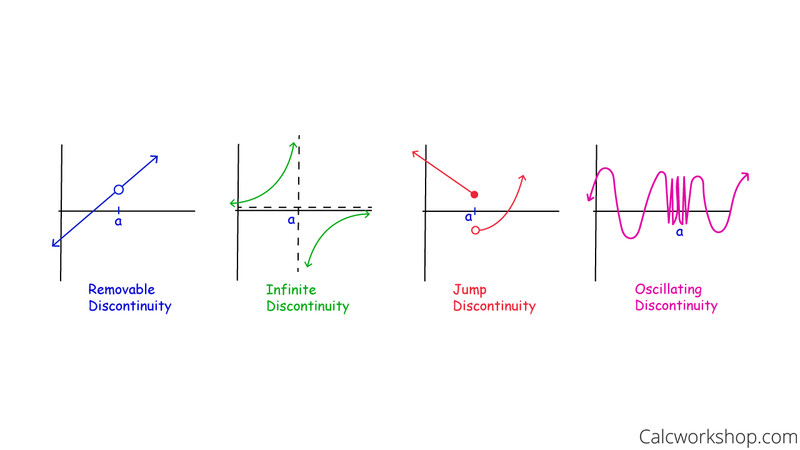
Common types of discontinuities
Any one of these inside your interval means the function is not continuous there.
On FRQs, you don’t say “you can draw it without lifting your pencil.” You justify using the definition or function properties.
2. Function Types That Are Automatically Continuous (on Their Domains)
This is one of the most useful shortcuts in the unit.
These families are continuous everywhere they are defined:
- Polynomials → continuous for all real numbers
- Rational functions → continuous wherever the denominator ≠ 0
- Power functions → continuous on their domains (watch fractional exponents)
- Exponential functions → continuous for all real numbers
- Logarithmic functions → continuous where the argument > 0
- Trigonometric functions → continuous where defined (e.g. is undefined at odd multiples of )
This means your reasoning often sounds like:
“Since is a rational function, it is continuous on its domain. The denominator equals zero at , so the function is continuous on .”
That sentence earns full credit on written responses.
The key move is always checking whether the entire interval stays inside the domain.
3. How to Determine Whether a Function Is Continuous on a Given Interval
When a problem gives you a specific interval, walk through this logically.
Step 1 - Check the Domain
Look for restrictions:
- Denominator equals 0
- Even root of a negative number
- Log of zero or negative
- Trig undefined values
If any number inside the interval isn’t in the domain, the function cannot be continuous there.
Example:
The denominator is zero at .
So it is continuous on:
It is not continuous on because −3 and 3 are inside that interval.
Step 2 - Identify Possible Trouble Points
You only need to check:
- Domain restrictions
- Where a formula changes (piecewise functions)
No need to test every number.
Step 3 - Verify with Limits (if necessary)
At each suspect value , confirm:
If this fails anywhere in the interval, the function is not continuous there.
4. Continuity of Piecewise Functions
Piecewise functions are where students lose easy points.
Example structure:
Each piece here is a polynomial, so each piece is continuous on its own interval.
The only possible issue is where the rule changes, at .
Check:
- Left-hand limit using : gives 3
- Right-hand limit using : gives 1
- Function value
Since the one-sided limits are not equal, the function is not continuous at 1, so not continuous on any interval containing 1.
Important detail:
The inequality symbol (≤ or <) tells you which expression gives the actual function value at the boundary.
On tests, graders want to see both one-sided limits written out clearly.
5. Common AP Mistakes
- Forgetting to check the domain before talking about continuity
- Saying “rational functions are continuous everywhere” without mentioning the denominator
- Skipping the boundary check in a piecewise function
- Ignoring endpoint behavior on closed intervals
- Giving informal explanations instead of referencing domain or limit equality
When justifying, name the function type and reference the domain. That language earns points.
