5m left·0%
Reading Time: 5 min
Last Updated: February 17, 2026
Main Ideas: 4
Reading Time: 5 min
Last Updated: February 17, 2026
Main Ideas: 4

Topic 3.3 Notes – Differentiating Inverse Functions

Verified for 2027 AP® Calculus AB Exam
Read aloud
You’ll use the chain rule and the idea that a function composed with its inverse gives back xx. This shows up both with general inverse functions and with inverse trig functions like arcsin⁡x\arcsin x and arctan⁡x\arctan x.

1. What the Derivative of an Inverse Function Is

If ff is differentiable and has an inverse f−1f^{-1}, then

(f−1)′(x)=1f′(f−1(x)) (f^{-1})'(x) = \frac{1}{f'\big(f^{-1}(x)\big)}

Read that slowly. The derivative of the inverse at xx equals 1 divided by the derivative of the original function, evaluated at the corresponding input.

Where this comes from

You already know that
f(f−1(x))=x. f(f^{-1}(x)) = x.

Differentiate both sides:

f′(f−1(x))⋅(f−1)′(x)=1 f'(f^{-1}(x)) \cdot (f^{-1})'(x) = 1

Solve for (f−1)′(x)(f^{-1})'(x) and you get the formula above. It’s just the chain rule in action.

Geometric meaning

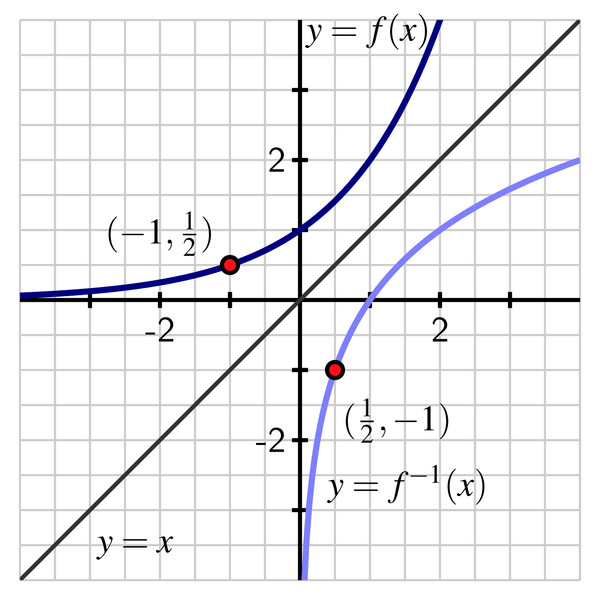
A function and its inverse reflect across the line y=xy = x. In the graph below, the dark curve is y=f(x)y=f(x) and the lighter curve is y=f−1(x)y=f^{-1}(x), mirrored across that line.

Study guide illustration

Notice the labeled points (−1,12)(-1, \tfrac{1}{2}) and (12,−1)(\tfrac{1}{2}, -1). The coordinates swap, which is exactly what an inverse does.

At corresponding points:

  • If f′(a)=mf'(a) = m,
  • Then (f−1)′(f(a))=1m(f^{-1})'(f(a)) = \frac{1}{m}.

So their slopes are reciprocals.

Important conditions:

  • The function must be one-to-one (so the inverse exists).
  • It must be differentiable.
  • And f′(a)≠0f'(a) \neq 0. If f′(a)=0f'(a) = 0, the inverse has a vertical tangent there.

That reciprocal relationship is the whole story.

2. How to Find the Derivative of an Inverse at a Point

This is the most common quiz and FRQ setup.

You’re asked for something like
(f−1)′(4). (f^{-1})'(4).

You cannot just plug 4 into f′f'. You first have to find the matching input.

The process

  1. Find the corresponding value.
    Solve
    f(a)=4. f(a) = 4.
    That means f−1(4)=af^{-1}(4) = a.

  2. Use the formula.
    (f−1)′(4)=1f′(a). (f^{-1})'(4) = \frac{1}{f'(a)}.

That’s it.

Example idea (table setup)

Suppose a table tells you:

  • f(2)=4f(2) = 4
  • f′(2)=6f'(2) = 6

Then:

  • f−1(4)=2f^{-1}(4) = 2
  • (f−1)′(4)=16(f^{-1})'(4) = \frac{1}{6}

On FRQs, this often becomes a tangent line question. If the problem asks for the tangent line to y=f−1(x)y = f^{-1}(x) at x=4x = 4:

  • Point: (4,2)(4, 2)
  • Slope: 16\frac{1}{6}

Use point-slope form:

y−2=16(x−4) y - 2 = \frac{1}{6}(x - 4)

The most common mistake is plugging 4 into f′f' instead of finding the matching input first.

3. Derivatives of Inverse Trigonometric Functions

You are expected to know these.

ddx(arcsin⁡x)=11−x2 \frac{d}{dx}(\arcsin x) = \frac{1}{\sqrt{1 - x^2}}

ddx(arccos⁡x)=−11−x2 \frac{d}{dx}(\arccos x) = -\frac{1}{\sqrt{1 - x^2}}

ddx(arctan⁡x)=11+x2 \frac{d}{dx}(\arctan x) = \frac{1}{1 + x^2}

These come from the same inverse-function idea, but you don’t have to re-derive them on the exam.

When there’s an inside function

If you see something like:

arctan⁡(5x), \arctan(5x),

you must use the chain rule:

11+(5x)2⋅5. \frac{1}{1 + (5x)^2} \cdot 5.

Same pattern for arcsin⁡(g(x))\arcsin(g(x)) and arccos⁡(g(x))\arccos(g(x)). Always multiply by g′(x)g'(x).

A common multiple-choice trap is forgetting that extra factor.

4. Common Mistakes and Exam Traps

  • Mixing up inverse and reciprocal.
    sin⁡−1x\sin^{-1}x means arcsin, not 1/sin⁡x1/\sin x.

  • Using
    1f′(b) \frac{1}{f'(b)}
    instead of
    1f′(a) \frac{1}{f'(a)}
    where f(a)=bf(a)=b.

  • Ignoring when f′(a)=0f'(a)=0. That means the inverse derivative does not exist there.

  • Dropping the negative sign for arccos⁡x\arccos x.

On no-calculator sections, inverse trig derivatives show up inside larger chain rule problems. On FRQs, inverse derivatives often appear in table-based reasoning where you must clearly show the reciprocal relationship.

Key Takeaways

(f−1)′(x)=1f′(f−1(x))(f^{-1})'(x) = \frac{1}{f'(f^{-1}(x))} and the inside value matters.
Slopes of inverse functions at corresponding points are reciprocals.
To find (f−1)′(b)(f^{-1})'(b), first solve f(a)=bf(a)=b.
If f′(a)=0f'(a)=0, the inverse has a vertical tangent there.
ddx(arcsin⁡x)=11−x2, ddx(arccos⁡x)=−11−x2, ddx(arctan⁡x)=11+x2\frac{d}{dx}(\arcsin x)=\frac{1}{\sqrt{1-x^2}},\ \frac{d}{dx}(\arccos x)=-\frac{1}{\sqrt{1-x^2}},\ \frac{d}{dx}(\arctan x)=\frac{1}{1+x^2}.
Inverse trig with an inside function always requires the chain rule.

AP® is a trademark registered by the College Board, which is not affiliated with, and does not endorse this website.

Notes

1 credit used · 5/5 remaining