Topic 6.6 Notes – Applying Properties of Definite Integrals
What a Definite Integral Represents
This is a number. It represents the net (signed) area between and the x-axis from to .
- Above the x-axis → positive contribution
- Below the x-axis → negative contribution
- If , there’s no width → the integral is 0
Here’s the picture you should always have in your head. The left sketch shows area entirely above the axis. The right sketch shows part of the region below the axis, which counts as negative.
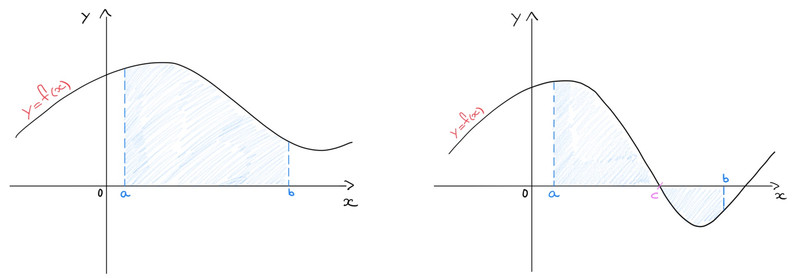
Net (signed) area from to
By the Fundamental Theorem of Calculus,
But in this topic, you often don’t find . You use geometry and properties instead.
Geometry and the Definite Integral
Sometimes integrating would be overkill. If the graph forms basic shapes, use area formulas.
Common shapes on AP problems:
- Rectangle → base × height
- Triangle →
- Trapezoid →
- Semicircle →
Example idea:
If a graph forms a triangle from to with height 6 above the axis, then
If that same triangle were below the axis, the integral would be −12.
Two very common mistakes:
- Forgetting that area below the axis is negative.
- Forgetting to split the integral if the graph crosses the x-axis.
On the AP exam, piecewise linear graphs and semicircles show up a lot. When you see straight lines or curved half-circles, think geometry first.
Core Properties of Definite Integrals
These are algebra rules. You should recognize them instantly.
Zero Rule
Same start and end → zero width → zero area.
Reversing Limits Changes the Sign
Switch the bounds → multiply by −1.
Students lose easy points here by forgetting the sign change.
Constant Multiple Rule
Constants factor out exactly like derivatives.
Sum and Difference Rule
You can break integrals apart to make them manageable.
Additivity Over Adjacent Intervals
If , then
This one drives most “manipulation” questions.
Manipulating Given Integral Values
These show up constantly on quizzes and multiple choice.
Suppose you know:
To find :
Use additivity:
If instead you needed , reverse the limits and change the sign at the end.
A helpful habit: draw a quick number line with the intervals marked. It keeps the signs straight.
Integrals and Discontinuous Functions
The definite integral still works if the function has:
- Removable discontinuities (holes)
- Jump discontinuities
The integral measures accumulated area. A single hole has no effect on area. A jump just changes heights but doesn’t break the accumulation.
Only vertical asymptotes create improper integrals, and those are handled separately in later topics.
If you see a graph with a hole and the problem asks for a definite integral, don’t panic. You can still compute the net area.
