Topic 5.5 Notes – Using the Candidates Test to Determine Absolute (Global) Extrema
Absolute Extrema on a Closed Interval
First, let’s be clear about vocabulary.
- Absolute maximum: the greatest value of on the entire interval.
- Absolute minimum: the least value of on the entire interval.
- These are different from local extrema, which only compare nearby points.
The big theorem behind all of this is the Extreme Value Theorem:
If a function is continuous on a closed interval , then it must have both an absolute maximum and an absolute minimum somewhere on that interval.
That guarantees existence. The derivative helps us find where.
Here’s the critical fact you’re responsible for knowing:
On a closed interval, absolute extrema can only occur at
1) critical points, or
2) endpoints.
A critical point is where:
- , or
- does not exist (but does).
That’s it. No other locations are possible candidates.
Why Only Critical Points and Endpoints?
Think about what the derivative tells you. If , the function is increasing or decreasing there. So the value at that point can’t be the highest or lowest overall because nearby points beat it.
The only places something “extreme” can happen are:
- Where the slope flattens or breaks (critical points), or
- At the edges of the interval (endpoints).
Look at this graph of a function on a closed interval .
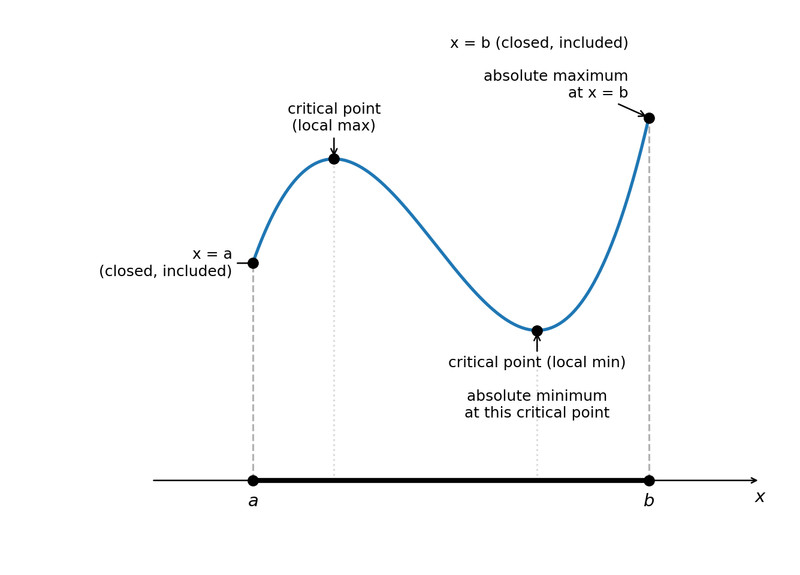
Absolute extrema on a closed interval
The curve has two interior critical points, one local maximum and one local minimum. The absolute minimum happens at the interior critical point, but the absolute maximum is actually at the right endpoint , not at the local maximum inside. That’s why endpoints must always be checked.
The Candidates Test
When a problem says “Find the absolute maximum and minimum on ,” this is your process.
- Find critical points inside the interval
- Compute
- Solve
- Find where is undefined
- Keep only values in
- Evaluate the original function at:
- Each critical point
- Each endpoint and
- Compare all the function values
- Largest value → absolute maximum
- Smallest value → absolute minimum
You are comparing function values, not derivative values.
Quick Example
Suppose
Step 1: Find critical points
Set equal to zero:
Both are in .
Step 2: Evaluate
Step 3: Compare
Values:
- Absolute minimum: at
- Absolute maximum: at and
Notice something subtle. A critical point at was also an endpoint. That’s fine. You still check it.
When the Function Is Given Differently
If Given a Graph
- Look for highest and lowest visible points within the interval.
- Include endpoints even if they don’t look dramatic.
- Closed dot means included. Open circle means not included.
If Given
- Solve for critical numbers.
- Use additional information (a graph, table, or given values) to compute .
- You may need the Fundamental Theorem of Calculus if the function is defined by an integral.
Common Mistakes That Cost Points
- Forgetting to evaluate endpoints.
- Including critical points outside the interval.
- Comparing derivative values instead of function values.
- Using first derivative test language instead of actually comparing numbers.
- Assuming a local maximum is automatically absolute.
On FRQs, you must show evaluations and clearly state where the absolute max/min occurs. A final sentence naming the -value matters.
