5m left·0%
Reading Time: 5 min
Last Updated: February 11, 2026
Main Ideas: 4
Reading Time: 5 min
Last Updated: February 11, 2026
Main Ideas: 4

Topic 2.7 Notes – Derivatives of cos x, sin x, e^x, and ln x

Verified for 2027 AP® Calculus AB Exam
Read aloud
Topic 2.7 is about knowing the derivatives of four core functions - sin⁡x\sin x, cos⁡x\cos x, exe^x, and ln⁡x\ln x - and using them correctly inside bigger expressions. You also need to recognize when a limit is secretly the definition of a derivative so you can evaluate it instantly. These are foundational results that show up everywhere.

The Core Derivative Facts You Must Know Cold

These are base rules. You are expected to know them without deriving them.

ddx(sin⁡x)=cos⁡x \frac{d}{dx}(\sin x) = \cos x

ddx(cos⁡x)=−sin⁡x \frac{d}{dx}(\cos x) = -\sin x

ddx(ex)=ex \frac{d}{dx}(e^x) = e^x

ddx(ln⁡x)=1x \frac{d}{dx}(\ln x) = \frac{1}{x}

A few reminders that matter on tests:

  • Radians only for trig derivatives. If xx is in degrees, these formulas do not work.
  • ln⁡x\ln x is defined only for x>0x > 0, so its derivative 1x\frac{1}{x} applies there.
  • Think of these like the power rule. They are just standard derivative tools.

One easy memory trick:

  • sin⁡\sin becomes cos⁡\cos
  • cos⁡\cos becomes negative sin⁡\sin
  • exe^x stays the same
  • ln⁡x\ln x turns into a fraction

That negative on cosine is where a lot of small mistakes happen.

Using These Rules Inside Larger Expressions

On quizzes and the AP exam, these almost never appear alone. They’re usually inside sums, products, or compositions.

With the Sum and Constant Multiple Rules

Differentiate term by term.

Example:

f(x)=6sin⁡x−4ex+9x f(x) = 6\sin x - 4e^x + 9x

Then

f′(x)=6cos⁡x−4ex+9 f'(x) = 6\cos x - 4e^x + 9

You just:

  • Apply the special-function rule
  • Keep constants attached
  • Use the power rule for polynomial pieces

Nothing fancy here. Just careful execution.

With the Chain Rule

This is where it becomes very testable.

If the input is not just xx, you must multiply by the derivative of the inside.

General patterns:

ddx[sin⁡(g(x))]=cos⁡(g(x))⋅g′(x) \frac{d}{dx}[\sin(g(x))] = \cos(g(x)) \cdot g'(x)

ddx[cos⁡(g(x))]=−sin⁡(g(x))⋅g′(x) \frac{d}{dx}[\cos(g(x))] = -\sin(g(x)) \cdot g'(x)

ddx[eg(x)]=eg(x)⋅g′(x) \frac{d}{dx}[e^{g(x)}] = e^{g(x)} \cdot g'(x)

ddx[ln⁡(g(x))]=1g(x)⋅g′(x) \frac{d}{dx}[\ln(g(x))] = \frac{1}{g(x)} \cdot g'(x)

Example:

ddx[e3x2] \frac{d}{dx}[e^{3x^2}]

  • Outside derivative: e3x2e^{3x^2}
  • Inside derivative: 6x6x

Final answer:

6xe3x2 6x e^{3x^2}

If your final answer does not include a factor from differentiating the inside, pause and check. That missing factor is one of the most common lost points on FRQs.

Common Errors That Cost Points

Forgetting the negative

ddx(cos⁡x)=−sin⁡x \frac{d}{dx}(\cos x) = -\sin x

Students often drop the minus sign under time pressure.

Mixing up exe^x and ln⁡x\ln x

  • exe^x stays the same.
  • ln⁡x\ln x becomes 1x\frac{1}{x}.

They are inverses, but their derivatives behave very differently.

Ignoring the domain of ln⁡x\ln x

If you see something like ln⁡(5−x)\ln(5 - x), remember:

  • You must use the chain rule.
  • The inside must stay positive.

Using Derivative Definitions to Evaluate Limits

Sometimes a limit is disguised as a derivative.

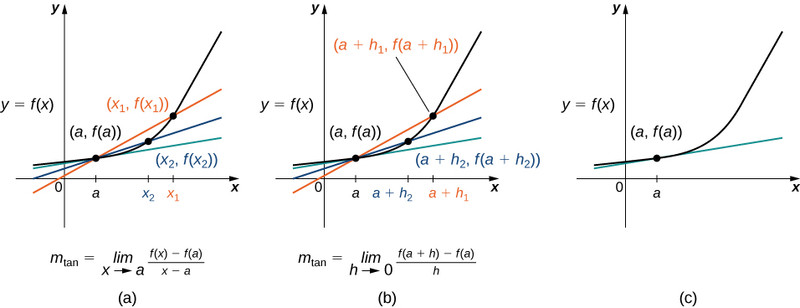
Recall the definition:

f′(a)=lim⁡h→0f(a+h)−f(a)h f'(a) = \lim_{h \to 0} \frac{f(a+h) - f(a)}{h}

If a limit matches that structure, replace it with the derivative value.

Here’s what that structure looks like visually as the secant line approaches the tangent line at x=ax = a.

Study guide illustration

Derivative as a limit of secant slopes

Now look at this example:

lim⁡h→0sin⁡(2+h)−sin⁡(2)h \lim_{h \to 0} \frac{\sin(2 + h) - \sin(2)}{h}

This matches the definition with:

  • f(x)=sin⁡xf(x) = \sin x
  • a=2a = 2

So the limit equals:

cos⁡(2) \cos(2)

You did not need trig identities. Just recognition.

Another example:

lim⁡h→0e5+h−e5h \lim_{h \to 0} \frac{e^{5+h} - e^5}{h}

That equals e5e^5.

The AP likes giving these because students try to expand or simplify instead of recognizing the pattern. If you see f(a+h)−f(a)f(a+h) - f(a) over hh, stop and think derivative.

Key Takeaways

ddx(cos⁡x)=−sin⁡x\frac{d}{dx}(\cos x) = -\sin x and that negative sign is easy to lose under pressure.
Every time you differentiate sin⁡(g(x))\sin(g(x)), eg(x)e^{g(x)}, or ln⁡(g(x))\ln(g(x)), multiply by g′(x)g'(x).
ddx(ex)=ex\frac{d}{dx}(e^x) = e^x, but ddx(ln⁡x)=1x\frac{d}{dx}(\ln x) = \frac{1}{x}; they are not interchangeable.
If a limit looks like f(a+h)−f(a)h\frac{f(a+h)-f(a)}{h}, replace it with f′(a)f'(a) immediately.
Trig derivatives only work in radians.

AP® is a trademark registered by the College Board, which is not affiliated with, and does not endorse this website.

Notes

1 credit used · 5/5 remaining