Topic 1.13 Notes – Removing Discontinuities
Removable Discontinuities
A removable discontinuity is a hole in the graph at .
It happens when:
- exists,
- but either
- is undefined, or
- .
Continuity at requires all three:
- exists
- exists
- They are equal
If #2 fails, you cannot fix it.
Here’s what a removable discontinuity looks like. This graph shows a function that follows the line everywhere except at one missing point.
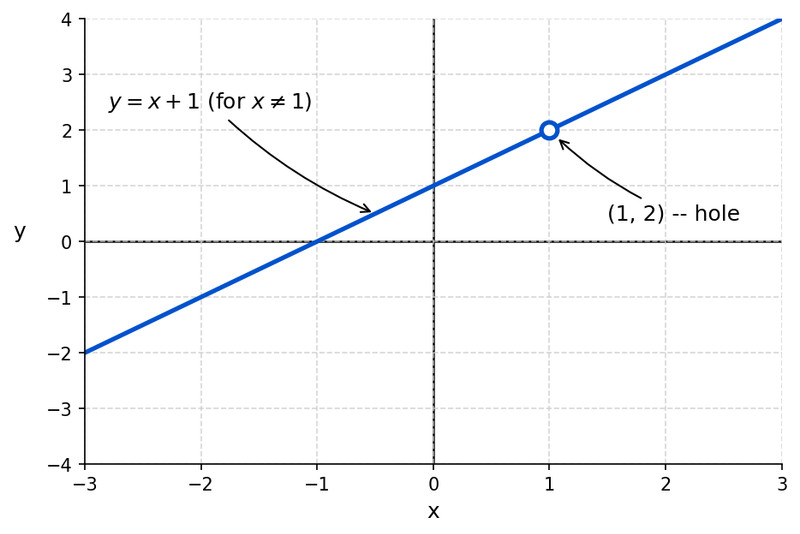
Removable discontinuity at
Notice the graph behaves like a line, but there’s an open circle at . That’s the hole. The limit as is 2, but the function is not defined at that point.
How to Remove a Hole in a Rational Function
Most removable discontinuities in AB come from canceling factors.
Suppose:
First factor:
So for ,
Now the limit:
The hole exists because the original function was undefined at .
To remove it, define:
That’s it. You don’t change the formula everywhere. You only redefine the single point.
Step-by-step process
- Factor completely.
- Cancel common factors.
- Find the x-value that made the denominator zero.
- Plug that value into the simplified expression.
- Redefine the function at that point to equal the limit.
When You Can’t Remove It
- If nothing cancels → vertical asymptote
- If left and right limits differ → jump discontinuity
Only holes can be patched.
This shows up on free-response questions where you must justify continuity using the definition. You’ll need to explicitly state that the limit exists and equals the function value.
Making a Piecewise Function Continuous
Now let’s switch to piecewise functions. These often ask you to solve for a constant that makes the function continuous at a boundary.
Suppose:
Continuity at requires:
Compute the one-sided limits
Left-hand limit:
Right-hand limit:
These are not equal, so this function cannot be made continuous by choosing . The limit does not exist.
That’s a subtle AP trap. If the two expressions don’t agree, no constant will fix it.
Now suppose instead the right side were .
Right-hand limit:
Now both sides approach 10. So define:
Then the function is continuous.
Graphically, both pieces approach the same y-value at , and we choose to fill in that point:
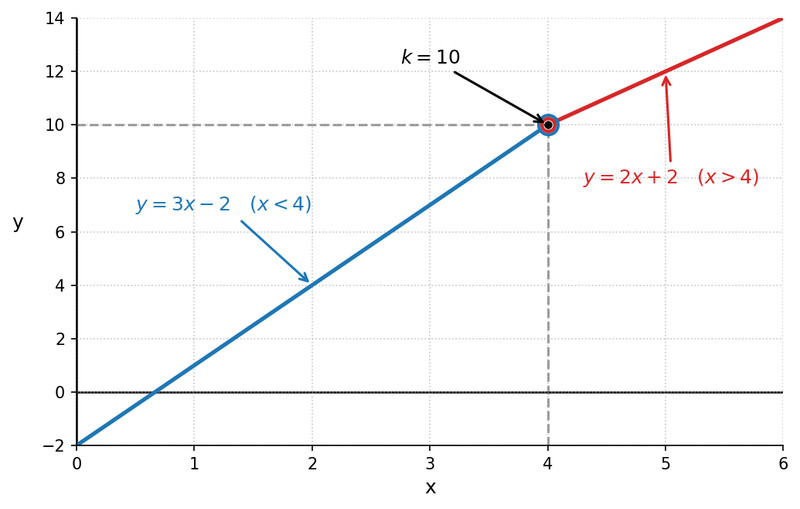
Piecewise function made continuous at by choosing
Step-by-step for solving parameters
- Identify the boundary point.
- Compute left-hand limit.
- Compute right-hand limit.
- Set them equal.
- Make that value equal to .
- Solve for the parameter.
On tests, they often skip directly to “Find the value of that makes the function continuous.” That’s your cue to set the expressions equal at the boundary.
