Topic 7.3 Notes – Sketching Slope Fields
What a Slope Field Is
A slope field (also called a direction field) represents a differential equation of the form
At every point , the equation gives you a slope value.
A slope field:
- Chooses a grid of points in the plane.
- Computes the slope at each point.
- Draws a short line segment with that slope centered at the point.
So instead of graphing one function, you’re graphing the slope information for all possible solutions at once.
Here’s what that looks like for the differential equation :
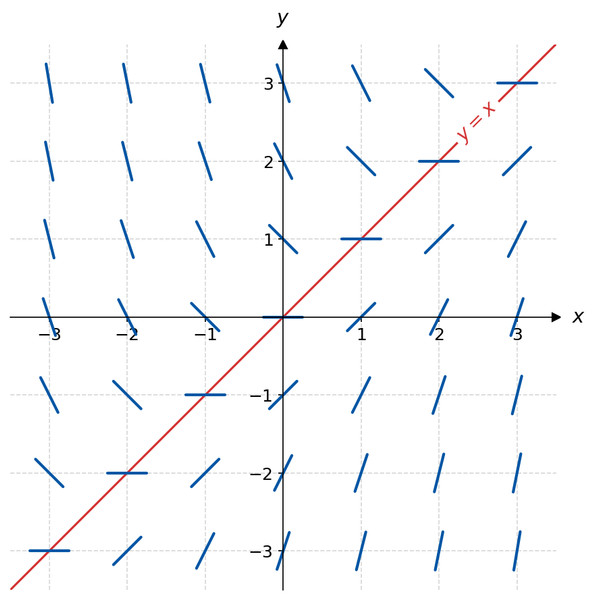
Slope field for
Notice how along the line , the slopes are 0, so the line segments are horizontal there. That pattern tells you something important about how solutions behave near that line.
How to Construct a Slope Field by Hand
If you had to sketch one on a quiz (usually no calculator), here’s the thinking process.
Suppose
1. Pick a simple grid
Use easy values like .
2. Plug points into the equation
You don’t need every single point. Look for patterns.
Example calculations:
- At : slope =
- At : slope =
- At : slope =
You’re mainly deciding:
- Positive or negative?
- Steep or shallow?
- Zero?
3. Draw short line segments
- Slope 0 → horizontal
- Positive → rising
- Negative → falling
- Larger magnitude → steeper
Keep them short and separate. Don’t connect them.
Patterns often appear:
- If the equation depends only on , slopes repeat in vertical columns.
- If it depends only on , slopes repeat across horizontal rows.
- If it’s mixed (like most), look for special lines where slope = 0.
Sketching a Solution Curve
A solution curve is a function whose derivative satisfies the equation.
If you’re given an initial condition like , you:
- Start at .
- Follow the direction of nearby line segments.
- Keep the curve smooth.
- Stay tangent to the segments everywhere.
A solution curve is always tangent to the little line pieces. If your curve cuts across them at weird angles, it’s wrong.
Also important:
- Solution curves never cross each other.
- If two curves crossed, they’d have two different slopes at the same point, which can’t happen.
What Slope Fields Tell You About Behavior
Even without solving, you can learn a lot.
Increasing vs Decreasing
- Slopes positive → solution increasing.
- Slopes negative → solution decreasing.
- Slopes near zero → flattening out.
On multiple choice, they love asking: Is the solution increasing at (a,b)?
You just evaluate .
Equilibrium Solutions
If slopes are 0 along a horizontal line , then is an equilibrium solution.
That means:
Solutions might:
- Approach it
- Move away from it
- Stay exactly on it
Recognizing equilibrium lines quickly saves time on both MC and FRQs.
Undefined Slopes
If the equation has a denominator and it equals 0 at some -value:
- Slopes are undefined there.
- Solution curves cannot cross that line.
- The domain may be restricted.
Students often forget to check this when sketching.
