Topic 6.7 Notes – The Fundamental Theorem of Calculus and Definite Integrals
The Fundamental Theorem of Calculus
Before using the theorem, lock in one definition:
An antiderivative of is a function such that
So if you differentiate , you get back . Integration asks the reverse question: “What function has this derivative?”
The Fundamental Theorem of Calculus explains how this connects to definite integrals.
Part 1 - Accumulation Functions
Suppose you define a function by accumulating area:
If is continuous, then
That’s huge. It says: the derivative of accumulated area is the original function.
What this means visually
Here’s the idea. Focus on the shaded region from to the moving right endpoint .
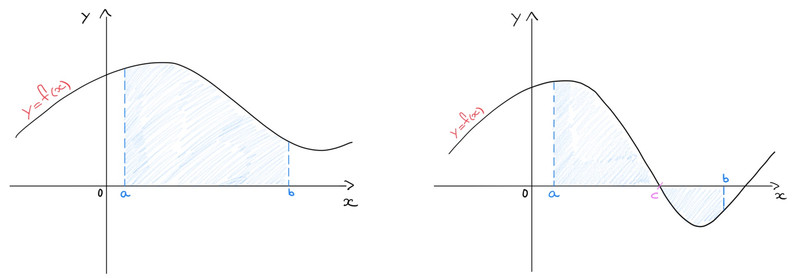
Signed area under
- The integral represents signed area from to .
- As moves, the accumulated area changes.
- The instantaneous rate at which that area changes equals the height of the curve.
So if the graph is high above the x-axis, area is increasing quickly. If the graph is below the axis, accumulated area decreases.
This shows up often on FRQs where they define something like
and ask for . The answer is just . No integration needed.
Part 2 - Evaluating a Definite Integral
Now the computational tool you’ll use constantly.
If:
- is continuous on , and
- is any antiderivative of ,
then
This replaces Riemann sums with simple substitution.
Why this works
The definite integral measures total signed area. The antiderivative keeps track of accumulation. Evaluating at endpoints gives the net change.
The disappears because constants cancel when you subtract.
Evaluating a Definite Integral Step-by-Step
Let’s walk through one:
Find an antiderivative.
Plug in the upper bound:
Plug in the lower bound:
Subtract:
That’s it.
On no-calculator multiple choice, algebra mistakes here are common. Keep parentheses when plugging in negative bounds.
Geometry and Properties That Save Time
Not every integral needs power rule work.
Signed Area
- Above x-axis → positive contribution
- Below x-axis → negative contribution
If a graph forms simple shapes, use geometry. In the example below, the region from to is a triangle above the x-axis, and from to is a semicircle below the x-axis.
You might compute:
- Triangle area using
- Semicircle using
Then subtract the negative portion.
Useful Integral Properties
Splitting intervals helps when:
- A function changes sign
- A graph is piecewise
- You’re given table values
Recognizing structure is part of what this topic is testing.
