Topic 1.5 Notes – Determining Limits Using Algebraic Properties of Limits
1. The Limit Laws
Suppose
When those limits exist, you can treat them like regular numbers.
The Laws You Need
- Sum Rule
- Difference Rule
- Constant Multiple Rule
- Product Rule
- Quotient Rule
, provided - Power Rule (positive integers)
- Root Rule
(Expression must be defined near .)
The pattern is simple. If each piece has a limit, combine them using normal algebra.
Quick Example
Break it apart:
So the limit is .
On a no-calculator multiple choice question, this is often just clean substitution hidden inside algebra.
2. Direct Substitution and When It Works
Most functions you see early in AB are continuous at ordinary points. That means:
Direct substitution works for:
- Polynomials
- Exponential functions like or
- Roots, if defined at that point
- Rational functions, as long as the denominator is not zero at
- Constants (the limit of 7 is 7)
Example:
Just plug in:
If substitution gives a real number immediately, you’re done. That’s the majority of algebraic limits on quizzes.
Things only get interesting when substitution causes trouble.
3. A Step-by-Step Process for Algebraic Limits
When you see of an algebraic expression, move through it calmly.
Try direct substitution.
- If you get a number → that’s the limit.
- If denominator is nonzero → done.
If you get
This is an indeterminate form. It signals algebra work.Example:
Substitution gives . Factor:
Cancel:
Now substitute:
You removed a hole. The limit exists even if the original function was undefined there.
If you get nonzero/0
That leads to an infinite limit, which you’ll analyze more later. For now, recognize it does not produce a finite number.
On free response questions, if you simplify algebraically, show the factor and cancellation. That earns justification points.
4. One-Sided Limits and the Limit Laws
A two-sided limit exists only if:
If the left-hand and right-hand limits do not match, the overall limit does not exist. The graph below shows exactly what that looks like at .
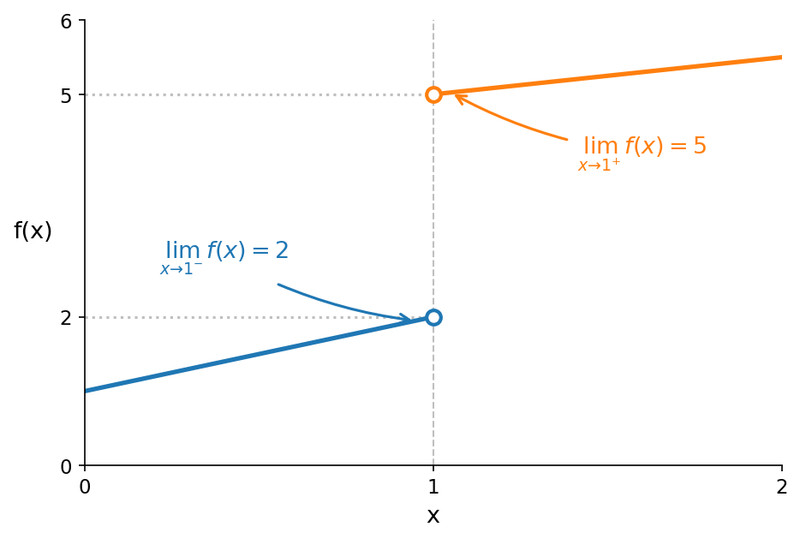
One-sided limits that do not match at
From the left, the function approaches 2.
From the right, it approaches 5.
Since they’re different, the two-sided limit does not exist.
Piecewise Functions
If
To find , use .
To find , use .
Evaluate each separately. If they match, the limit exists.
On tests, students often plug into the wrong piece. Always look at which side of you're approaching.
5. Common Mistakes and Exam Traps
- Forgetting the denominator check
The quotient rule only works if the denominator’s limit is not zero. - Thinking
It means “simplify first.” - Confusing limit with function value
The limit describes behavior near the point. The function might not even be defined there. - Ignoring one-sided differences
If left and right don’t match, the limit does not exist, even if both sides individually exist.
