Topic 1.6 Notes – Determining Limits Using Algebraic Manipulation
When Direct Substitution Fails
Most limits start the same way. Plug in the value.
- If the function is continuous at that point, substitution works and you’re done.
- If you get a real number, that’s the limit.
- If you get something undefined, pause and look closer.
The most important signal is:
This is an indeterminate form. It does not mean the limit is 0. It means the algebra is hiding something removable.
Think of as your cue to simplify.
Other signs you need algebra:
- A rational function with obvious factoring potential.
- Radicals that create messy denominators.
- Trig expressions near .
Factoring and Canceling Common Factors
This shows up constantly with rational functions (polynomial over polynomial).
Suppose
Plug in 2 → . So factor.
Now:
Cancel the factor :
Now plug in 2 → 4.
What actually happened? There was a hole at , not a vertical asymptote. After canceling, the graph follows the line , but the original function is missing the point where .
Here’s what that situation looks like visually:
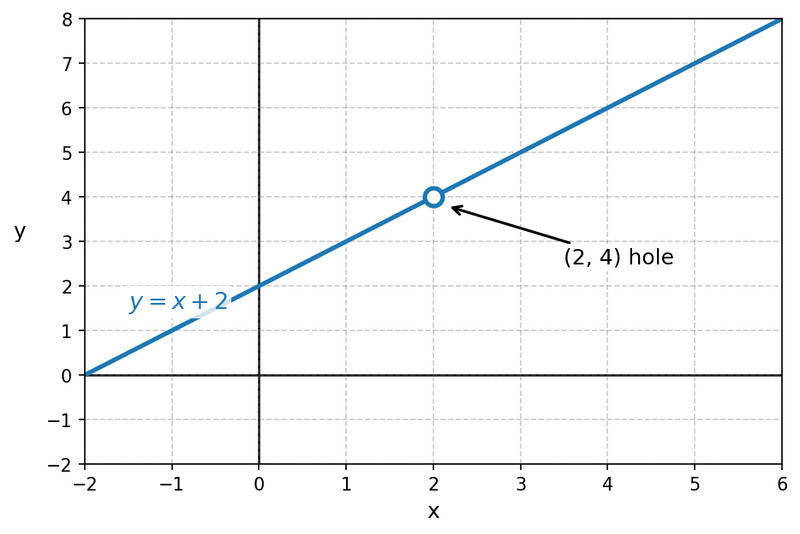
Removable discontinuity at (2, 4)
Important reminders:
- You can only cancel factors, not individual terms.
- If something is being added or subtracted, factor first.
- If the denominator is still 0 after canceling, then you’re looking at a vertical asymptote and the limit may be or DNE.
Common factoring patterns to recognize quickly:
- GCF
- Trinomials
- Difference of squares
Rationalizing with Conjugates
Radicals often create . That’s when you multiply by a conjugate.
Conjugate pattern:
Example:
Plug in 9 → .
Multiply by the conjugate:
Numerator becomes:
Now:
Cancel :
Now plug in 9 → .
What conjugates do:
- Remove radicals.
- Create a factor that cancels.
- Turn a messy expression into something continuous.
Common mistake: multiplying only the numerator. You must multiply the entire fraction.
Special Trig Limits and Alternate Forms
There are two trig limits you must know:
These only apply when .
Here’s the classic geometric picture behind on the unit circle:
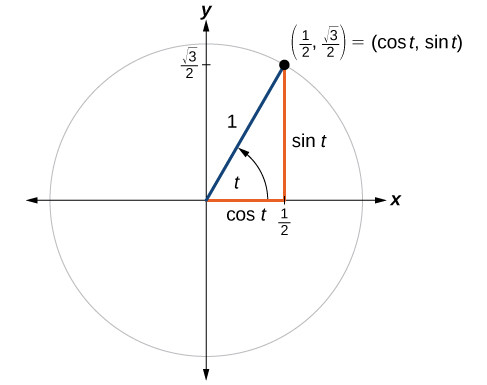
Unit circle with angle , showing
For a small angle , the vertical side has length and the arc length is . Comparing those lengths leads to as .
Now apply it.
Example:
Rewrite:
Now it matches the known limit.
Result → .
For something like:
Rewrite as:
Each trig ratio approaches 1, leaving .
Big trap on quizzes: forgetting to adjust constants when matching the inside.
Also remember: sine and cosine are continuous. If there’s no , just plug in.
Using Equivalent Expressions to Justify the Limit
Every algebra move you make creates an equivalent expression near the point.
You are not changing the limit. You’re uncovering it.
Even if the original function isn’t defined at that point, the limit can still exist. That’s the entire idea behind removable discontinuities.
This is what AP graders want to see on FRQs:
- Clear algebra.
- Proper cancellation.
- Correct substitution after simplifying.
