Topic 6.4 Notes – The Fundamental Theorem of Calculus and Accumulation Functions
The Fundamental Theorem of Calculus and Accumulation Functions
Suppose is continuous, and you define a new function:
This is an accumulation function. It measures the net (signed) area under from a fixed starting point to a moving endpoint .
Here’s the key result:
That’s Fundamental Theorem of Calculus Part 1.
What this means
- Integration builds area.
- Differentiation measures rate of change.
- When you differentiate accumulated area, you get back the original function.
The variable inside the integral (usually ) is a dummy variable. It disappears when you differentiate. Only the upper bound matters.
What Accumulation Functions Represent
Think of as “total change so far.”
- If , area is added → increases.
- If , area is subtracted → decreases.
- If , then → horizontal tangent.
- If changes sign, can have a local max or min.
The integrand controls the slope of the accumulation function.
Here’s what that relationship looks like visually. In the graph below, the red curve is the accumulation function and its slope at any point matches the value of .
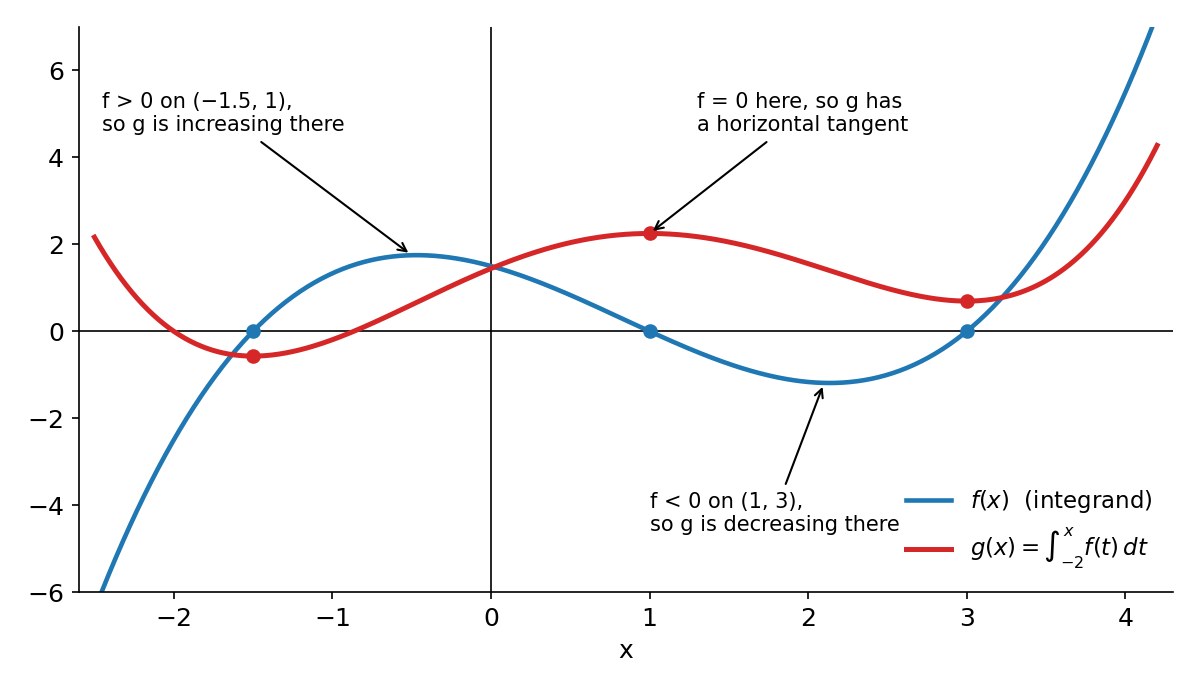
Accumulation function g and its derivative f on the same axes
You should be able to look at a graph of and describe where is increasing, decreasing, or has extrema. That’s a common no-calculator multiple choice setup.
How to Differentiate Accumulation Functions
1. Upper bound is just
If
Then
You replace with . Nothing else.
If asked for , compute .
You never needed to evaluate the integral.
2. Upper bound is a function of
If
Now the upper bound is , so the chain rule joins the party:
What happened?
- Plug in the upper bound.
- Multiply by the derivative of the upper bound.
This shows up a lot on FRQs. Students often forget the extra factor.
3. Variable in the lower bound
If
Rewrite first by switching bounds:
Now differentiate:
Switching bounds introduces a negative sign. Missing that sign costs easy points.
Representing Functions with Definite Integrals
A definite integral can define a function.
Example:
You cannot find an elementary antiderivative for . That’s fine.
By FTC:
This is powerful. You can:
- Find slopes
- Determine increasing/decreasing intervals
- Evaluate derivatives at specific points
All without ever computing the integral.
That’s the point of this topic. The integral defines the function. The derivative reveals its behavior.
