Topic 6.10 Notes – Integrating Functions Using Long Division and Completing the Square
Using Polynomial Long Division
You use long division when the integrand is a rational function
and the degree of the numerator is greater than or equal to the degree of the denominator.
That’s your signal that the fraction can be rewritten as:
Once it’s split, the integral becomes manageable.
What This Looks Like in Practice
Suppose you’re integrating:
The numerator has degree 3 and the denominator degree 1, so divide. Here’s the setup:
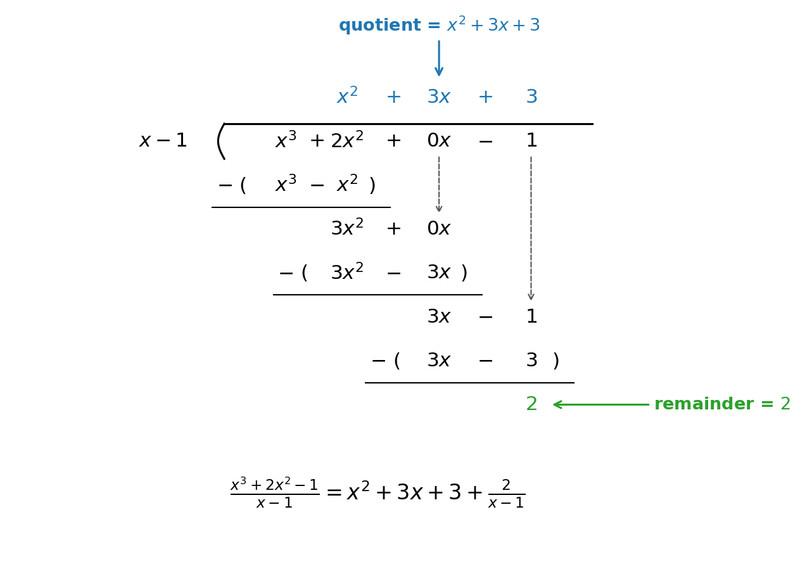
Polynomial long division of
After dividing, you get:
Now integrate term by term:
Final answer:
Notice how the leftover fraction almost always turns into a natural log term.
Things That Cost Points
- Forgetting to divide when degrees are equal.
- Dropping the absolute value in .
- Making small algebra mistakes during division.
- Trying substitution before simplifying.
On multiple-choice, if answers look like “polynomial + ln term,” that’s often your clue long division was needed.
Completing the Square
This shows up when you see a quadratic that isn’t factorable or a perfect square, especially inside:
- A denominator
- A square root
- Something that resembles an inverse trig pattern
The goal is to rewrite the quadratic so it matches a known inverse trig form.
The Two Forms You Want
From your formula sheet:
So you’re trying to turn a messy quadratic into:
- → arctan
- → arcsin
Example with Arctan
Consider:
Here’s the algebra visually, since this is where most mistakes happen:
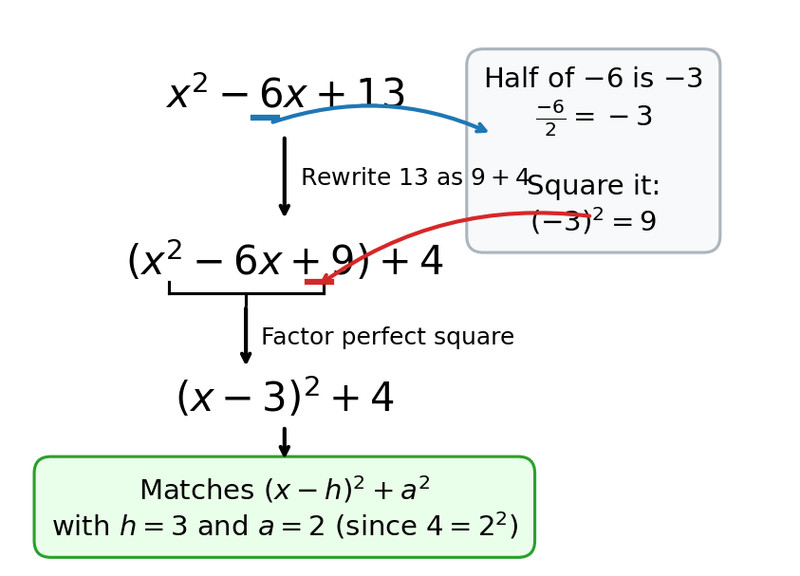
Completing the square for
Half of −6 is −3. Square it to get 9.
Now the integral becomes:
This matches the arctan formula with:
- shift
So the answer is:
Definite Integrals
For definite integrals:
- Do the algebra first.
- Integrate fully.
- Plug in bounds carefully.
No .
With inverse trig answers, use parentheses when evaluating bounds. Calculator sections often include these because evaluating arctan or arcsin numerically is expected.
Strategy Pattern You Should See
When stuck, ask:
- Is this a rational function with numerator degree ≥ denominator?
→ Long division. - Is there a quadratic that won’t factor nicely?
→ Complete the square. - Does the result resemble or ?
→ Inverse trig.
The calculus part is familiar. The rearranging is the skill.
