Topic 6.3 Notes – Riemann Sums, Summation Notation, and Definite Integral Notation
1. What a Riemann Sum Is
A Riemann sum approximates the signed area under on by adding up rectangle areas.
Here’s the structure you need to see as one connected object:
- Partition of
Break the interval into subintervals. - Width of each subinterval (equal widths in AB):
- Sample point in each subinterval
Call it . This determines the rectangle’s height. - Area of one rectangle
- Full Riemann sum
That sigma expression literally means “add up all the rectangle areas.”
Here’s what that looks like geometrically using right endpoints and .
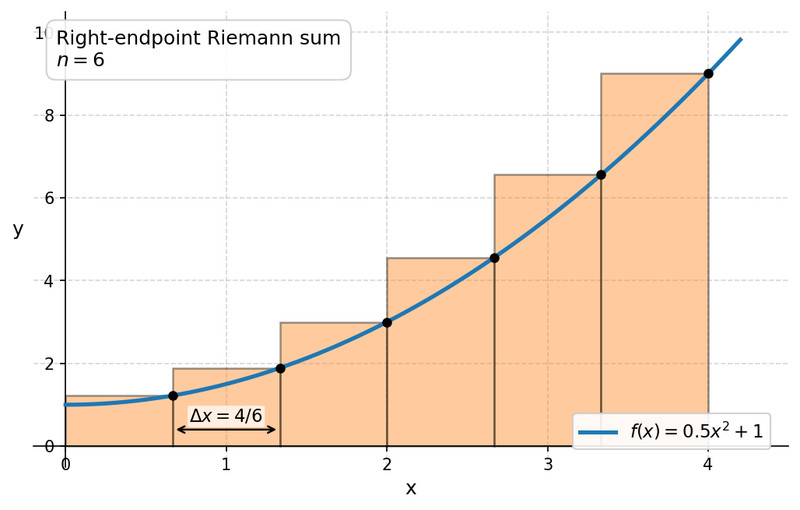
Right-endpoint Riemann sum with 6 rectangles
Each rectangle’s height comes from the function value at the right edge of its subinterval. Because the function is increasing, these right-endpoint rectangles slightly overestimate the true area.
As increases, rectangles get thinner and the approximation improves.
Choosing the Sample Point
The structure stays the same. Only changes.
For equal partitions:
- Right endpoint:
- Left endpoint:
- Midpoint:
On tests, they often give you the formula for and expect you to recognize which type it is.
2. Sigma Notation for Riemann Sums
Sigma notation just compresses repeated addition.
General form:
Know what each symbol represents:
- : number of rectangles
- : index (counts rectangles)
- : specific sample point
- Entire expression: approximate area
Building One From Scratch
Suppose you’re approximating area of on using right endpoints.
- Compute width:
- Right endpoint:
- Plug into function:
- Multiply by and write the sum:
If is fixed, that’s an approximation. If you take , you’re heading toward an exact value.
3. The Definite Integral as a Limit
Here’s the key idea of this entire topic:
A definite integral is the limit of Riemann sums as the widths go to zero.
Formally,
As :
- Rectangles become infinitely thin
- Approximation becomes exact
You can see that process happening below as the number of rectangles increases.
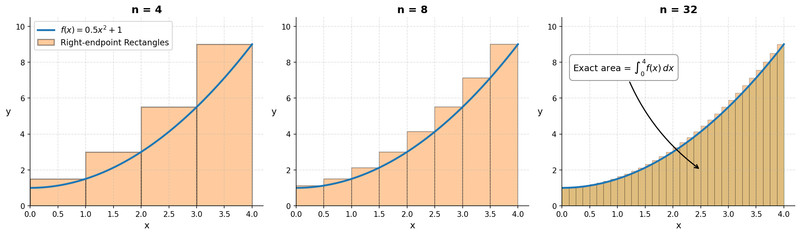
Riemann sums approaching the definite integral as n increases
Each panel shows more right-endpoint rectangles. By the time is large, the rectangles hug the curve so closely that the total area matches the exact value of the integral.
This limit is not an estimate. It is the exact signed area.
On FRQs, they often want you to state this relationship clearly using correct notation. Missing the limit or the costs points.
4. Converting Between Riemann Sums and Definite Integrals
This is where pattern recognition matters.
From Definite Integral to Riemann Sum
Given:
Write:
Everything must be written in terms of . That’s the most common mistake.
From Riemann Sum to Definite Integral
Given:
Spot the structure:
- → interval length is 2
- Lower bound is 7
- Upper bound is
So this equals:
On multiple choice, this often shows up disguised with messy algebra. Focus on identifying and the expression playing the role of .
