Topic 4.1 Notes – Interpreting the Meaning of the Derivative in Context
What the Derivative Means in Context
You’ve learned that
is the instantaneous rate of change of with respect to its independent variable.
That means:
- It tells you how fast the output is changing at a specific input value.
- Graphically, it’s the slope of the tangent line at that point.
- In context, it describes a rate, not a total amount.
Here’s the mental structure you should always use:
- → some quantity (population, revenue, temperature, distance, volume, etc.)
- → the input (time, length, production level, etc.)
- → how fast that quantity is changing per unit of the input
Quick Examples
- If is the height of a rocket in meters after seconds, then is its velocity in meters per second at time .
- If is revenue in dollars from selling items, then is dollars per item at production level .
The key idea:
The derivative answers the question, “How fast is this changing right now?”
Units of the Derivative
The units are not random. They always follow this rule:
If:
- is measured in gallons
- is measured in hours
Then:
- is gallons per hour.
More examples:
- Miles over hours → miles per hour
- Dollars over weeks → dollars per week
- Degrees over minutes → degrees per minute
The AP loves checking units. If time is in months, your derivative must be “per month.” Not per year. Not per week.
Sign Matters
- → the quantity is increasing at that moment.
- → the quantity is decreasing at that moment.
A negative derivative does not mean the amount is negative. It means it’s going down.
Interpreting a Statement Like
When you see something like
You should automatically think in this order:
- What does represent?
- What are the units of the input?
- What are the units of the output?
Interpretation Template
“At , the [quantity described by ] is increasing/decreasing at a rate of [output units] per [input unit].”
Example:
Suppose is the temperature of a chemical in degrees Celsius after minutes, and .
Interpretation:
“At 10 minutes, the temperature is decreasing at 2 degrees Celsius per minute.”
Notice what we did:
- Mentioned the specific time.
- Used the correct units.
- Included increasing or decreasing.
- Made it about rate, not total amount.
Common mistake:
Confusing with .
- = amount at that time.
- = rate at that time.
If a problem says , do not say “the company made 500 dollars.”
You must say “the company is earning money at 500 dollars per ___.”
Instantaneous vs Average Rate of Change
These get mixed up constantly.
Here’s the difference clearly:
| Average Rate of Change | Instantaneous Rate of Change |
|---|---|
| Over an interval | At a single point |
| Slope of a secant line | Slope of a tangent line |
To picture this, think about the graph below. The line connecting and is a secant line, which represents the average rate of change over that interval. The line that just touches the curve at the interior point is a tangent line, which represents an instantaneous rate of change.
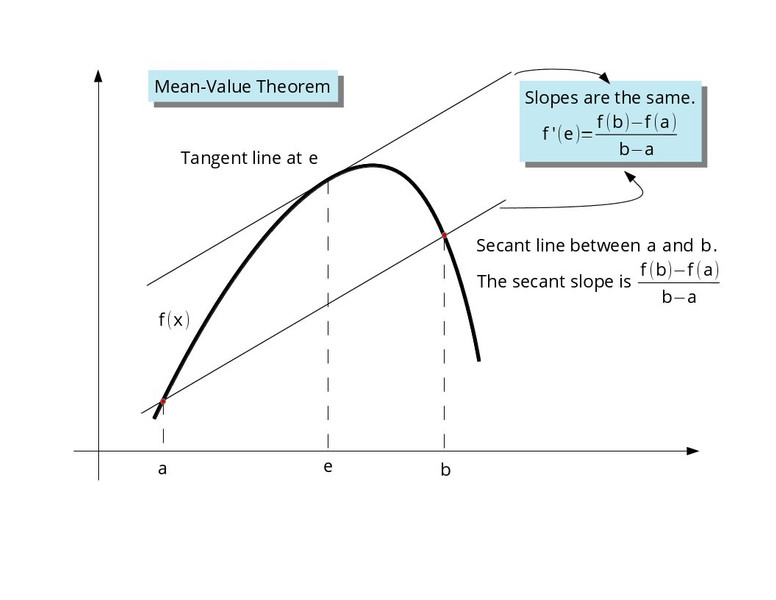
Secant vs. tangent line on a curve
If a question gives you , it is asking about the instantaneous rate. Not an average over time.
How This Shows Up on Tests
On quizzes and the AP exam, you’ll often see:
- A function described in words.
- A value like .
- A multiple-choice option that forgets units.
- A choice that describes instead of .
- A choice that ignores the negative sign.
They’re testing precision in language. Your interpretation must include:
- The specific input value.
- The quantity changing.
- The rate.
- Correct units.
- Increasing or decreasing.
No vague wording.
