Topic 5.2 Notes – Extreme Value Theorem, Global Versus Local Extrema, and Critical Points
1. The Extreme Value Theorem
The Extreme Value Theorem (EVT) is a guarantee statement.
If a function is continuous on a closed interval , then:
- has at least one absolute maximum on
- has at least one absolute minimum on
It guarantees existence. It does not tell you where the extrema are.
What must be true
Two conditions are required:
- The interval is closed → written with brackets , so endpoints are included.
- The function is continuous on the entire interval.
If either fails, EVT does not apply.
Here’s what that looks like visually. Notice how the example on the closed interval has both an absolute maximum and minimum, while the open interval example does not have an absolute maximum.
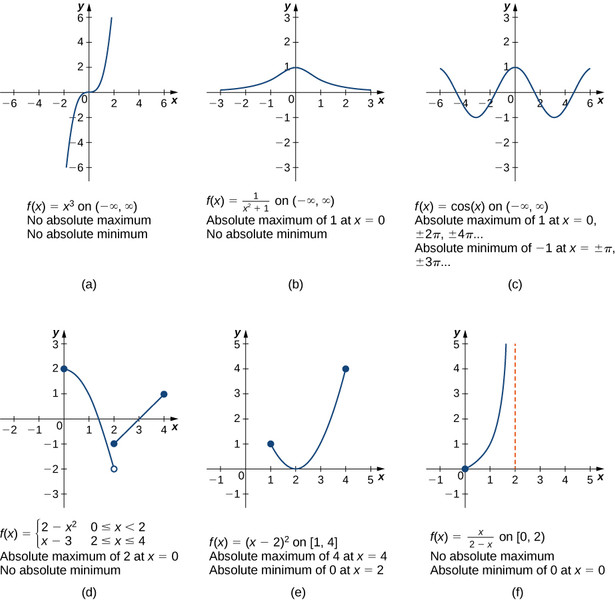
Examples of when absolute extrema do and do not exist
What EVT does NOT say
- It does not say there is only one max or min.
- It does not tell you whether they occur at endpoints or inside.
- It does not apply to open intervals like .
- It does not apply if there’s a discontinuity (hole, jump, asymptote).
How to justify EVT on an FRQ
When you’re asked to justify existence, you must clearly say:
- is continuous on .
- is closed and bounded.
- Therefore, by the Extreme Value Theorem, has an absolute maximum and minimum on .
If continuity is not stated or cannot be verified, you cannot claim the guarantee.
2. Global vs Local Extrema
Now let’s separate the types of extrema.
Absolute (Global) Maximum
- The highest value of the function on the entire interval.
- Can occur at a critical point or an endpoint.
- Guaranteed to exist if EVT conditions are met.
Absolute (Global) Minimum
- The lowest value on the entire interval.
- Also can occur at a critical point or an endpoint.
Local (Relative) Maximum
- Higher than nearby points.
- Only compares to values in a small neighborhood.
- Not required to be the highest overall.
Local (Relative) Minimum
- Lower than nearby points.
- Only compares locally.
Here’s the clean comparison:
| Type | Compared To | Endpoints Allowed? |
|---|---|---|
| Absolute | Entire interval | Yes |
| Local | Nearby points only | No (must have points on both sides) |
Important detail students miss: endpoints can be absolute extrema, but they are not local extrema because there aren’t points on both sides.
3. Critical Points
A critical point occurs at (in the domain of ) where:
- , or
- does not exist.
These are the only possible locations of local extrema.
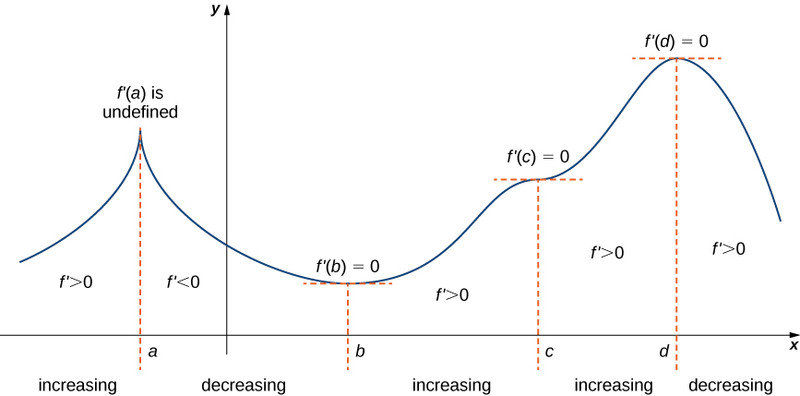
Critical points on a graph of
Why they matter
- Every local max or min occurs at a critical point.
- Not every critical point is an extremum.
In the graph above, notice the local minimum at and the local maximum at , where . Also notice the point at . The tangent is horizontal there, but the function keeps increasing. That point is critical, but it is not an extremum.
A horizontal inflection point is the classic example. The derivative is zero, but the function does not change direction.
Finding critical points
If you’re given :
- Compute .
- Solve .
- Find where is undefined.
- Keep only values in the domain of .
If you’re given a graph of , look for where it equals zero or is undefined.
4. Finding Absolute Extrema on a Closed Interval
When the problem actually asks you to find them, use the Closed Interval Method every time.
- Find critical points in .
- Evaluate at each critical point.
- Evaluate and .
- Compare all values.
Largest value → absolute max.
Smallest value → absolute min.
Skipping endpoints is one of the most common point-loss mistakes on tests.
5. Common Mistakes and Exam Traps
- Applying EVT on an open interval.
- Claiming existence without mentioning continuity.
- Ignoring endpoints when asked for absolute extrema.
- Assuming every critical point is a max or min.
- Confusing local and absolute language in written answers.
