Topic 4.3 Notes – Rates of Change in Applied Contexts Other Than Motion
What a Rate of Change Means in Any Context
If , then:
- is the amount (the output).
- is the input (often time, but not always).
- is the instantaneous rate of change of the amount with respect to .
Think of it this way:
- Average rate of change → slope of a secant line
- Instantaneous rate of change → slope of a tangent line → derivative
Here’s the visual difference:
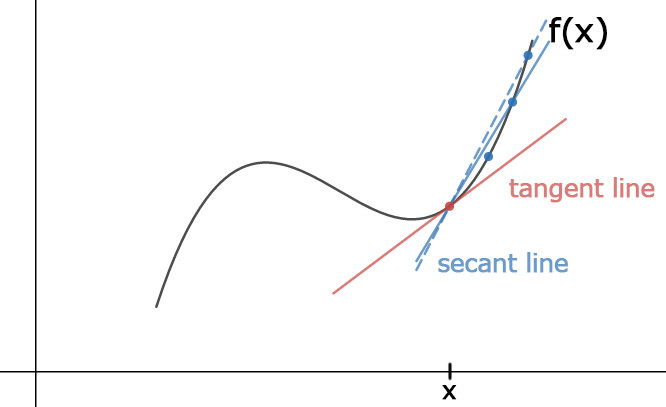
Secant lines approaching a tangent line
The blue secant lines use two points on the curve to compute an average rate of change. As the second point moves closer to the first, the secant line approaches the red tangent line. That limiting slope is the derivative.
The derivative tells you how fast the output is changing at that exact input value.
The units always follow this pattern:
If the function measures gallons and the input is hours, then the derivative is gallons per hour. Always.
Interpreting Units and Meaning Correctly
Before you differentiate anything, ask yourself:
- What does the function represent?
- What are the units of the output?
- What are the units of the input?
Example:
Suppose is the number of bacteria in a lab culture, where is measured in hours.
- → bacteria
- → bacteria per hour
If , you would say:
“At 4 hours, the number of bacteria is increasing at a rate of 120 bacteria per hour.”
Notice what you did:
- Included the time
- Included the units
- Included whether it’s increasing
The sign matters:
- → increasing
- → decreasing
- → momentarily not changing
One of the most common point deductions on FRQs is writing something like “The population is 300 people per year.” That’s a rate. Always state that it is increasing or decreasing at that rate.
How to Find and State an Instantaneous Rate of Change
When a problem asks for “the instantaneous rate of change at ,” your brain should translate that to .
Here’s the process:
- Identify what the function models.
- Differentiate.
- Evaluate the derivative at the requested value.
- Attach units.
- Write a complete interpretation sentence.
Quick example:
Let , where is cost in dollars to produce items.
Differentiate:
If asked for the rate of change when 20 items are produced:
Interpretation:
“When 20 items are produced, the cost is increasing at a rate of 203 dollars per item.”
That phrase “per item” is essential. In economics, this is called marginal cost, and it shows up a lot.
Common Applied Contexts
The derivative always means rate of change. What changes is the story.
Population Models
- = population
- = people per year (growth rate)
Often exponential. Positive derivative means growth.
Volume or Amount Changing
- Water in a tank
- Medication in bloodstream
- Chemical concentration
Units might be liters per minute, grams per hour, etc.
Economics
- = cost
- = revenue
- = profit
Their derivatives represent marginal cost, marginal revenue, marginal profit. These are rates per additional item produced.
Social or Real Data Models
- Subscribers over time
- Spread of disease
- Temperature change
Same structure every time: derivative = how fast the modeled quantity changes with respect to the input.
Common Mistakes and Exam Traps
- Plugging into instead of
- Forgetting units
- Ignoring the sign of the derivative
- Interpreting the derivative as total change instead of instantaneous rate
- Evaluating before differentiating
On multiple choice, they love giving both and as answer choices. That’s not an accident.
