Topic 3.6 Notes – Calculating Higher-Order Derivatives
What Higher-Order Derivatives Are
If , then:
- First derivative:
- Second derivative:
- Third derivative:
- nth derivative:
Each one is just the derivative of the previous one, as long as it exists.
Notation You Must Recognize
For :
First derivative:
, ,Second derivative:
, ,Higher derivatives:
,
One thing that trips people up:
The left means “derivative of the derivative.” The right means “square the first derivative.” Totally different.
Repeated Differentiation in Action
There is no new formula here. You just apply the derivative rules again.
Let’s walk through a quick example.
Suppose
First derivative:
Second derivative:
Third derivative:
Fourth derivative:
Each step used the Power Rule again. Nothing new, just repetition.
Patterns You Should Recognize Fast
Seeing patterns saves serious time on quizzes and MCQs.
Polynomials Eventually Become Zero
Every derivative lowers the degree by 1.
- Degree 4 → Degree 3 → Degree 2 → Degree 1 → Constant → 0
For any polynomial of degree , the th derivative is 0.
That’s a built-in error check.
Trig Functions Cycle
Trig derivatives repeat every 4 steps.
Here’s the standard cycle you should have memorized:
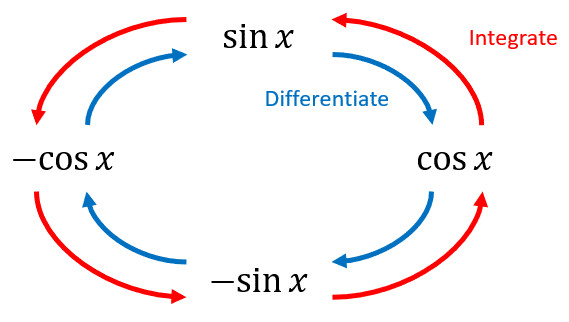
Derivative cycle of and
Following the blue arrows for differentiation, you move
.
After four derivatives, you are back where you started.
If there’s an inner function like , remember the Chain Rule multiplier appears every single time you differentiate.
Example pattern:
If
Notice how the 5 keeps multiplying in.
Exponential Functions Keep Their Shape
For :
- Every derivative is still .
For :
- First derivative →
- Second derivative →
- Third derivative →
Each derivative multiplies by another 3.
Product and Quotient Rule Get Heavy
If the original function used:
- Product Rule
- Quotient Rule
- Chain Rule
Then the second derivative often requires using those rules again.
Algebra can explode quickly. Keep expressions factored when possible. On FRQs, clean structure matters more than fully expanding.
Why the Second Derivative Matters
You’ve already used this in graph analysis:
- tells you increasing/decreasing and critical points.
- tells you concavity.
- → concave up
- → concave down
Many AP questions ask you to compute and interpret what it means about the graph.
Common Mistakes
- Squaring instead of finding
- Forgetting to apply the Chain Rule again on the second derivative
- Losing constants that multiply repeatedly
- Expanding expressions way more than necessary
- Assuming higher derivatives exist when the first derivative doesn’t exist
What You’ll Actually Be Asked
Most commonly:
- Find
- Evaluate
- Occasionally find
The skill being tested is organization and repeated rule application. Nothing new conceptually, just careful execution.
