Topic 5.12 Notes – Exploring Behaviors of Implicit Relations
1. Implicit Relations and Their Derivatives
An implicit relation is an equation involving both and , like
It might not pass the vertical line test, but locally you can still treat as a function of .
Implicit differentiation reminder
When you differentiate with respect to :
- Differentiate every term.
- Treat as a function of .
- Every time you differentiate , multiply by (chain rule).
- Solve for .
Quick example:
Given
Differentiate:
Solve:
That expression gives the slope of the tangent line at any point on the curve.
Below is the circle with two sample tangent lines drawn using .
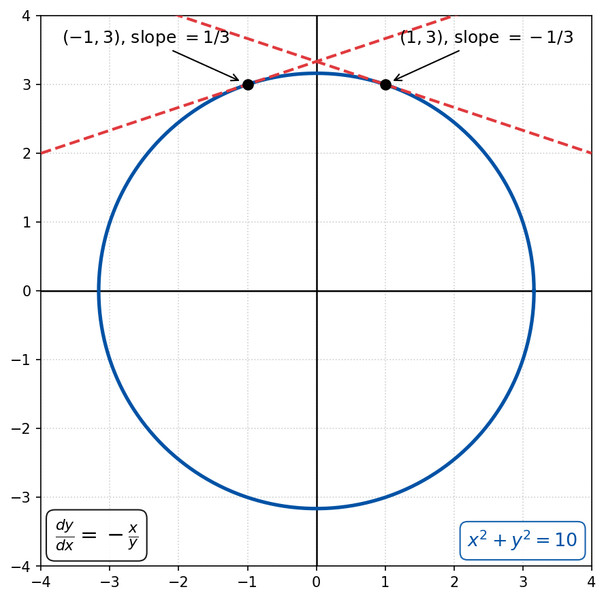
Circle with tangent lines
At , the slope is negative. At , the slope is positive. The formula tells you the slope at every point without ever solving for explicitly.
Even though this isn’t written as , slopes still exist at most points.
Everything you already know about increasing, decreasing, extrema, and concavity now comes from this implicitly found derivative.
2. Critical Points of an Implicit Relation
A critical point occurs where:
- , or
- does not exist
and the point satisfies the original equation.
How to find them
- Find implicitly.
- Set the numerator equal to 0 → horizontal tangents.
- Set the denominator equal to 0 → undefined slopes (often vertical tangents).
- Plug back into the original equation to confirm the point lies on the curve.
Important subtlety:
- Undefined slope does not automatically mean max or min.
- It may be a vertical tangent line.
On tests, students often forget to check where the derivative is undefined. That costs easy points.
To classify a critical point, use a sign chart around that -value. If the sign of changes:
- → local maximum
- → local minimum
- No change → neither
Because this is implicit, you may need to check nearby points that satisfy the original equation.
3. Using the First Derivative to Describe Behavior
Once you have :
- → increasing
- → decreasing
You analyze signs just like with explicit functions.
On FRQs, you must justify conclusions. That means explicitly stating the sign of and what it implies about behavior.
For example:
“If for , the function is increasing for .”
Keep your reasoning tied directly to the derivative.
4. Second Derivative and Concavity of Implicit Relations
Concavity still comes from the second derivative.
Steps
- Find .
- Differentiate again with respect to .
- Solve for .
The second derivative may involve:
That’s completely normal.
Interpreting it
- → concave up
- → concave down
A point of inflection occurs where concavity changes. Setting only finds candidates. You must confirm a sign change.
Here’s a visual reminder of concavity and an inflection point.
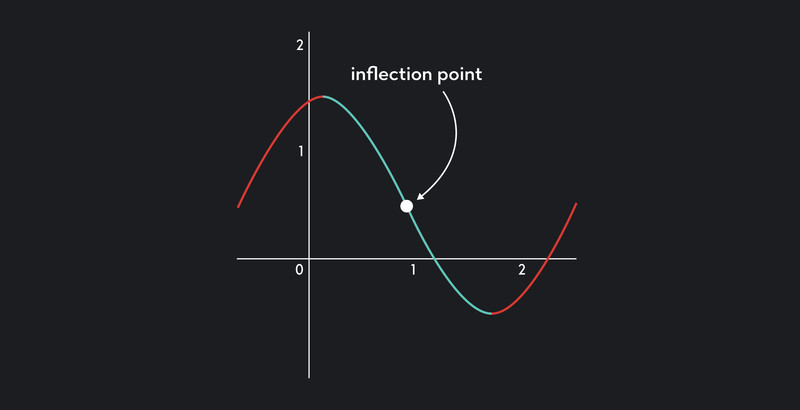
Concavity change at an inflection point
In the graph, the curve changes from concave down to concave up at the labeled point. That change in shape is what your sign chart for must show.
On exams, students lose points by stopping after solving . Always check the sign change.
5. Extending Derivative Applications to Implicit Functions
All derivative applications still work:
- Increasing/decreasing
- Relative extrema
- Concavity
- Inflection points
- Related rates
Related rates with implicit equations
Often the equation naturally relates two variables, like geometry problems.
You differentiate with respect to time :
This is just the chain rule.
Important habits that matter on quizzes and FRQs:
- Differentiate before plugging in numbers.
- Keep track of signs (increasing vs decreasing).
- Clearly state units in your final answer.
