Topic 5.7 Notes – Using the Second Derivative Test to Determine Extrema
1. The Second Derivative Test
A critical point occurs at where:
- , or
- does not exist (but does).
The second derivative tells you about concavity:
- → concave up
- → concave down
Here’s the connection that makes this test work:
If and exists, then:
- If → local minimum
- If → local maximum
- If → inconclusive
Why? Because concavity tells you the shape at that point. In the figure below, the left graph is concave up with a minimum at its vertex, and the right graph is concave down with a maximum at its vertex.
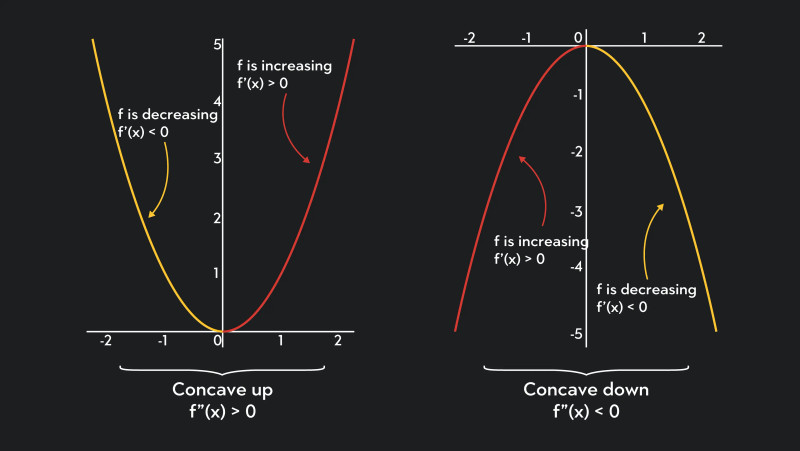
- Concave up looks like a bowl → bottom → minimum.
- Concave down looks like a hill → top → maximum.
This is a faster alternative to the First Derivative Test. Instead of checking sign changes of , you check the sign of at the critical point.
2. The Full Procedure
When a problem says “Use the Second Derivative Test,” here’s the flow:
- Find .
- Find critical points by solving (and checking where it doesn’t exist, if relevant).
- Find .
- Plug each critical point into .
- Classify using the sign of .
Quick example:
Let .
- Solve → gives critical points (you’d solve with quadratic formula).
- Then compute .
- Plug each critical value into and classify by sign.
On a no-calculator section, algebra accuracy matters. A small mistake in flips max to min.
Also remember:
You must have . If that’s not true, you cannot use this test.
3. When the Test Is Inconclusive
If:
- , or
- does not exist
the test gives you no classification.
This does not mean there isn’t a max or min.
Example idea:
For ,
- Critical point at
The test fails. But is clearly a minimum. You can see the flat bottom at the origin in the graph below.
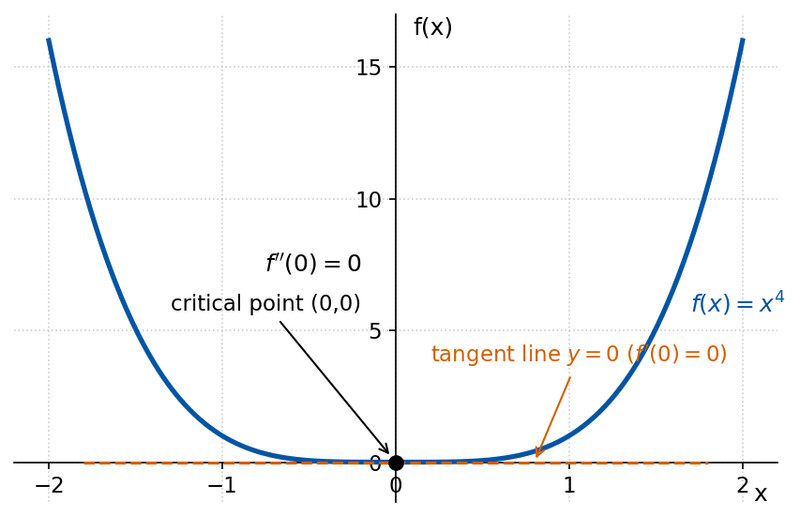
Graph of
When this happens, switch to the First Derivative Test and check if changes sign around the point.
The second derivative only checks concavity at the point. The first derivative checks behavior around it.
4. Local vs Absolute Extrema on an Interval
Here’s a statement the AP exam loves in justification questions:
If a function is continuous on an interval and has exactly one critical point on that interval, and that point is a local extremum, then it is also the absolute extremum on that interval.
Why this works:
- A continuous function can only change direction at critical points.
- If there’s only one, there’s no second peak or valley competing.
On an FRQ, you must actually state:
- The function is continuous on the interval.
- There is exactly one critical point.
- Therefore, the local extremum is absolute.
If you skip continuity, you can lose justification points.
5. Common Mistakes That Cost Points
- Plugging a value into without verifying .
- Mixing up the signs. Positive second derivative means minimum.
- Calling something absolute without mentioning continuity and “only one critical point.”
- Forgetting that endpoints matter when a problem asks for absolute extrema on a closed interval. The Second Derivative Test does not check endpoints.
