Topic 7.4 Notes – Reasoning Using Slope Fields
1. What a Slope Field Shows
A slope field (or direction field) represents a differential equation of the form
At each point , a tiny line segment shows the value of , which is the slope of a solution curve at that point.
Here is a slope field for the differential equation .
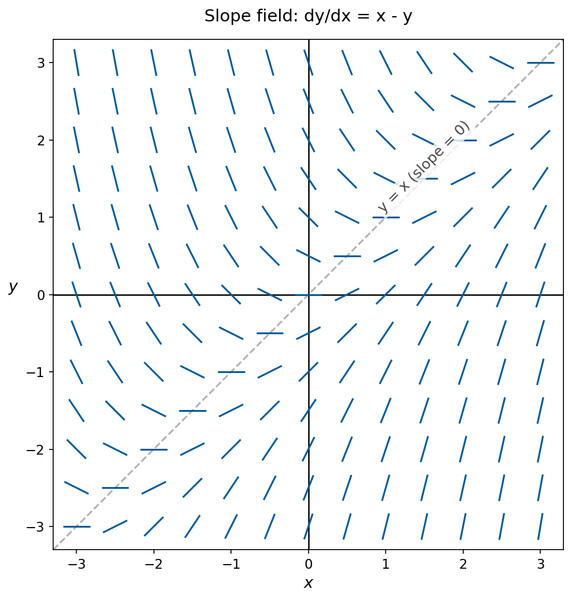
Slope field for
Notice that along the line , the segments are horizontal because there. Below that line the segments tilt upward, and above it they tilt downward.
How to read it:
- Upward slanting segments → positive slope → solution increasing.
- Downward slanting segments → negative slope → solution decreasing.
- Flat (horizontal) segments → slope .
- Very steep segments → large magnitude slope.
The slope field is not a graph of one function. It’s a map of slopes for all possible solutions.
A solution curve is any smooth curve that is tangent to the tiny segments everywhere it passes. If it cuts across them at the wrong angle, it’s not a solution.
2. Solutions Are Functions and Families of Functions
A differential equation gives you a derivative. To get the original function, you integrate.
If
then
That matters. It means there isn’t just one solution. There’s a family of functions.
What that looks like visually
Each value of gives a different curve, but they all follow the same slope pattern. For example, if , then the general solution is .
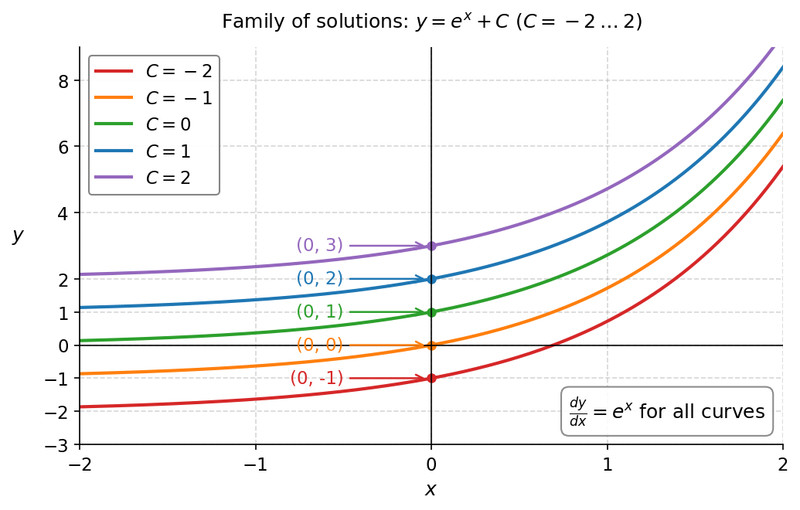
Family of solutions for
Every curve shown satisfies the same differential equation . They are just vertical shifts of one another, coming from different values of .
If you’re given an initial condition, like , that picks exactly one curve from the family. On quizzes and FRQs, this is how they turn a general solution into a particular solution.
Big idea you’re expected to say clearly:
Solutions to differential equations are functions (or families of functions), not single numbers.
3. Estimating Solutions from a Slope Field
You’ll often be asked to estimate something like given , using only the slope field.
Here’s what that means graphically:
- Start at the initial point.
- Follow the direction of the tiny segment there.
- Move slightly to the right (or left).
- Adjust your curve so it stays tangent to each new segment.
- Keep going until you reach the desired -value.
Your curve should be:
- Smooth (no corners),
- Always tangent to the segments,
- Gradually adjusting as slopes change.
This is the visual idea behind Euler’s Method, even if you’re not computing numerically.
On multiple choice, they may show several possible curves through a point. The correct one is the curve that consistently follows the slope pattern.
4. Finding Critical Points Using a Slope Field
A critical point occurs where:
- (horizontal tangent), or
- is undefined (vertical tangent).
Since a slope field shows , you’re looking directly at derivative behavior.
Horizontal segments
Anywhere you see flat segments, the slope is zero.
If a solution passes through that location, it will have a horizontal tangent there. That’s a possible relative max or min.
You still have to check the sign change:
- Slopes change from positive to negative → relative max.
- Slopes change from negative to positive → relative min.
Vertical segments
If segments were perfectly vertical, that would indicate undefined slope. That’s rare in AP-level slope fields but theoretically possible.
Important distinction:
The slope field shows where critical points could occur. A specific solution must actually pass through that spot to have the critical point.
5. How to Read Behavior from a Slope Field
You can determine a lot without solving anything.
Increasing or decreasing
- Mostly positive slopes in a region → solutions increase there.
- Mostly negative slopes → solutions decrease there.
Patterns to recognize
- Slopes depending only on → horizontal “bands” of equal slope.
- Slopes depending only on → vertical alignment of similar slopes.
- A line where all segments are horizontal → often an equilibrium solution (a constant solution).
If a solution starts above or below an equilibrium line, watch whether slopes push it toward or away from that line. That behavior shows up often in modeling questions.
