Topic 2.1 Notes – Defining Average and Instantaneous Rates of Change at a Point
1. Average Rate of Change
Think back to algebra. Slope between two points was always “rise over run.” In calculus language, that becomes average rate of change (AROC) over an interval .
The formula is:
This is called a difference quotient. It measures change in output divided by change in input.
You’ll also see equivalent forms:
- where
- for
All three represent the same idea: overall change over an interval.
What it means graphically
It’s the slope of a secant line connecting two points on the curve. In the graph below, the points and are joined by a straight line.
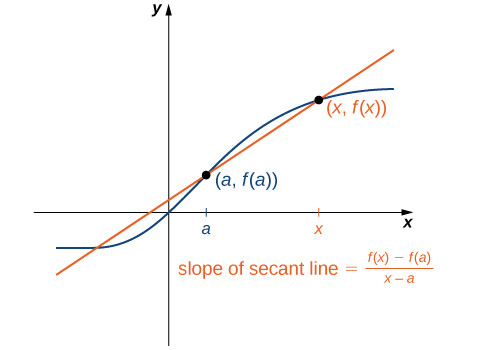
Secant line and average rate of change
That line cuts through the curve. Its slope is , which tells you how fast the function changes on average between those two x-values.
Quick example
If on :
- AROC
Interpretation matters on tests. If is time in seconds and is position in meters, then the units are meters per second.
Common mistakes
- Reversing the order in the numerator but not the denominator.
- Plugging in in , which makes the denominator 0.
- Forgetting units in context questions.
If the problem says “over the interval,” you’re finding average rate of change.
2. Instantaneous Rate of Change and the Derivative at a Point
Now shrink that interval. Imagine sliding point closer and closer to . The secant line starts turning into a tangent line.
The instantaneous rate of change at is defined as:
Equivalent form:
This limit, if it exists, is the derivative at a point.
What it means graphically
It’s the slope of the tangent line at one point. In the image below, the orange line is a secant line through two points on the curve, and the pink line is the tangent line touching the curve at a single point.
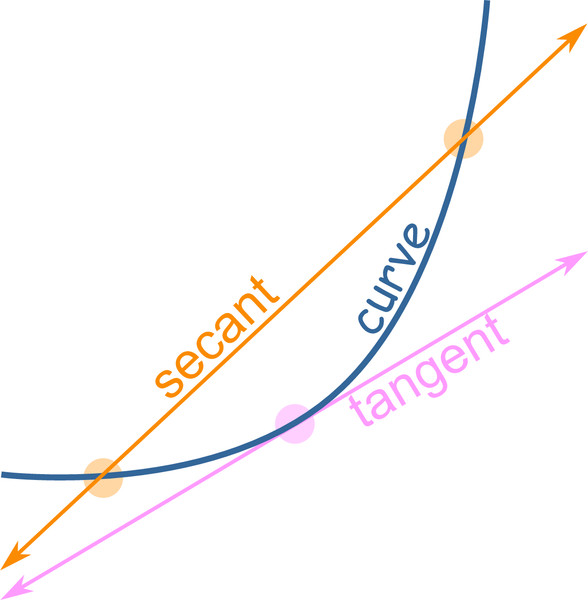
Secant line versus tangent line on a curve
The derivative is what you get when the average rate of change becomes exact at a single instant.
This only works if the limit exists. If there’s:
- a corner,
- a cusp,
- a discontinuity,
then the derivative does not exist there. Unit 1 limits matter here.
When a question says “find the rate of change at ” or “find the slope of the tangent line,” they want .
3. Computing the Derivative from the Definition
You must be able to use the limit definition directly. This shows up on no-calculator multiple choice and sometimes FRQs.
Using the -definition:
- Write .
- Substitute carefully.
- Expand and simplify completely.
- Factor and cancel .
- Take the limit as .
Example: Let . Find .
Expand:
Simplify:
Factor:
Cancel , then take the limit:
Notice you cannot plug in until after canceling. Plugging early creates division by zero.
Most mistakes here are algebra errors. Parentheses matter.
4. Average vs Instantaneous Rate of Change
| Average Rate | Instantaneous Rate |
|---|---|
| Over an interval [a,b] | At a single point x = a |
| Slope of a secant line | Slope of a tangent line |
| Overall change | Exact rate at that moment |
The derivative is what happens when the average rate of change is taken over smaller and smaller intervals until the interval length approaches 0.
5. Common AP Exam Traps
- Treating the difference quotient as just a fraction and forgetting it represents a limit.
- Confusing (a number) with (a function).
- Not checking whether the limit exists.
- Dropping parentheses when substituting .
- Forgetting that units of the derivative are “output units per input unit.”
