Topic 2.10 Notes – Finding the Derivatives of Tangent, Cotangent, Secant, and/or Cosecant Functions
The Derivatives of tan x, cot x, sec x, and csc x
All trig derivatives on the AP exam assume x is in radians. If it were degrees, the formulas would look different.
Here are the four you must know cold:
You already know:
These new four can be derived from sine and cosine using identities and the quotient rule, but on a quiz or no‑calculator multiple choice, there isn’t time for that. You should recognize them instantly.
Two that students mix up every year:
The square only goes with sec when it comes from tangent.
Rewriting Trig Functions Using Identities
Before differentiating, check if rewriting makes it easier.
Key identities:
Sometimes rewriting avoids messy quotient rule work.
For example:
Rewrite first:
Multiply by the reciprocal:
Now the derivative is just . Way easier.
This idea shows up a lot in free-response questions where they want to see if you simplify before differentiating. Recognizing structure is part of the skill here.
Applying the Derivative Rules
These functions rarely appear alone. They usually come wrapped inside something.
Sums and Constant Multiples
If
Differentiate term by term:
Nothing fancy. Just use the rules directly.
Chain Rule with Trig Functions
This is very common on tests.
If
Think outer function first:
- Derivative of is
Then multiply by derivative of inside:
- Derivative of is 5
So:
General pattern to memorize:
If your answer doesn’t include , you forgot the chain rule.
Product Rule
These trig functions love to multiply each other.
If
Use:
So:
On a free-response question, don’t skip steps. Write the product rule structure clearly.
Quotient Rule
If
Use:
But pause first. Could you rewrite as and use the product rule instead? Sometimes that’s cleaner.
Being flexible here saves algebra mistakes.
Powers of Trig Functions
If
Rewrite as:
Use chain rule:
Don’t forget the negative from . Missing that sign is a very common point loss.
Visual Reminder of Relationships
Seeing them together on the unit circle helps organize them in your head. In the diagram below, focus on how each trig function is represented by a segment tied to the angle .
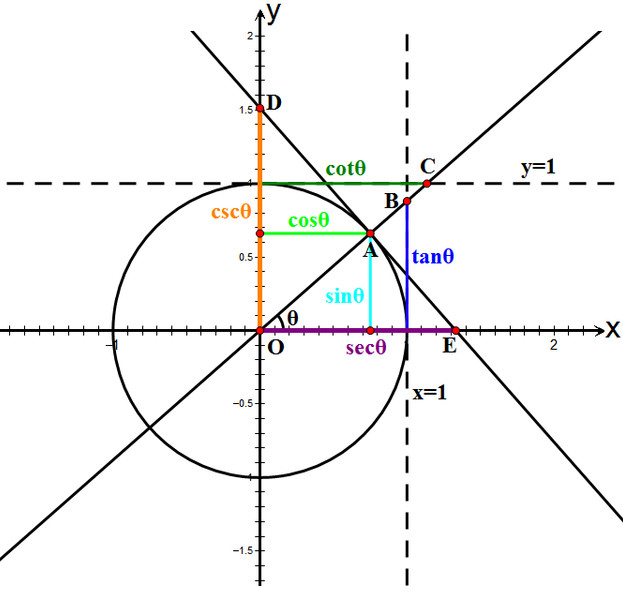
Unit circle definitions of the six trig functions
Notice:
- pairs naturally with
- pairs naturally with
That pairing shows up in their derivatives too.
