Topic 8.4 Notes – Finding the Area Between Curves Expressed as Functions of x
1. Area Between Two Curves as a Definite Integral
Suppose you’re given two functions
and .
If is above on the interval , then the area between them is
Here’s why this works:
- A definite integral adds up infinitely thin vertical slices.
- Each slice has height
- So the integral accumulates the total vertical distance between the curves.
Quick reminder:
A definite integral normally gives signed area. When you’re finding geometric area between curves, your integrand must stay positive, which is why we always do top − bottom.
Here’s what that looks like visually.
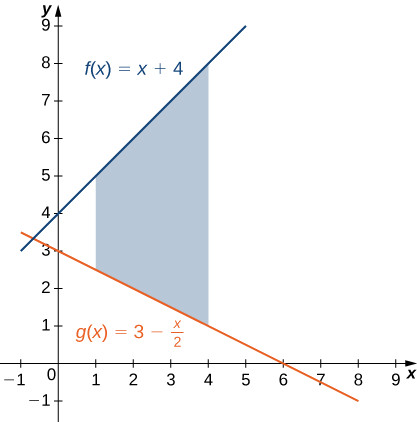
Area between two curves using vertical slices (top − bottom)
In this example, is above over the shaded interval, so each slice has height .
2. The Full Setup Process
This is the part where most mistakes happen. Slow down here.
Step-by-step
- Find intersection points
- Solve .
- These x-values are your limits of integration.
- On FRQs, you may need a calculator to approximate them.
- Figure out which function is on top
- Pick a test x-value between the intersections.
- Compare and .
- The larger output is the top function.
- Write the integral
- Evaluate
- Find an antiderivative.
- Apply the Fundamental Theorem of Calculus.
- Do not include .
- Your final answer should be positive.
If limits are already given, you still must check which function is on top. The problem will not tell you.
On quizzes, a very common trap is students integrating both functions separately and subtracting in the wrong order. Keep it as one integrand so the structure stays clear.
3. When the Top Function Changes
Sometimes the curves cross inside the interval.
That means the “top” function switches.
When that happens:
- Find all intersection points.
- Split the integral at the crossing value.
- On each subinterval, determine the top function.
- Add the areas.
If you don’t split, you’ll accidentally compute net area instead of total area.
On the AP exam, this often appears when one function is curved and the other is linear. They cross once in the middle, and if you ignore it, your answer is too small.
4. Graph and Interpretation Skills
Sometimes you’re given only a graph.
You should be able to:
- Identify intersection points visually.
- Tell which curve is higher on each interval.
- Recognize that the x-axis does not matter unless one of the curves is the x-axis.
Here’s a graph-style example. Notice how the curves intersect once in the middle, at the point labeled between and .
The shaded regions show that the upper function changes at the intersection. From to , one curve is on top. From to , the other curve is on top. That’s why you must split the integral at .
If exact equations aren’t provided, you may:
- Estimate area using geometry, or
- Use a calculator to evaluate the definite integral numerically.
Calculator-active FRQs often expect a decimal answer rounded to three places.
5. Common Mistakes to Avoid
- Reversing top and bottom → gives a negative value.
- Forgetting to solve for intersections when limits aren’t given.
- Failing to split the interval when curves cross.
- Confusing area between curves with net area under one function. These are different setups.
- Sign errors during evaluation when subtracting antiderivatives.
Most lost points come from setup errors, not integration difficulty.
