Topic 2.2 Notes – Defining the Derivative of a Function and Using Derivative Notation
The Derivative as a Limit
You already know average rate of change:
That’s the slope of a secant line between two points. The derivative comes from shrinking that interval down to a single point.
The Definition
Here’s what each piece means:
- → small change in input
- → change in output
- Entire fraction → average rate of change over length
- The limit → instantaneous rate of change
If this limit exists, the function is differentiable at .
Think of it as:
Secant slope → shrink → Tangent slope

Secant lines approaching the tangent line
In the diagrams, the secant line through and a nearby point moves closer and closer to a single line as that second point approaches . That limiting line is the tangent line, and its slope is the derivative.
If the limit fails to exist, the function is not differentiable there. That happens at:
- Sharp corners
- Cusps
- Vertical tangents
- Discontinuities
Those show up a lot in multiple-choice graph questions.
What the Difference Quotient Is Really Doing
The expression
is called the difference quotient.
It measures how much the function changes compared to how much changes. When you simplify it algebraically, you are preparing it so the limit can be taken.
One key idea:
You must eliminate the in the denominator before plugging in . If you plug in too early, you get , which is indeterminate.
Computing a Derivative from the Definition
You are expected to do this algebraically, especially with polynomials.
Let’s try one that’s different from what you’ve seen before:
Find for .
Step 1: Start with the definition
Step 2: Substitute
Step 3: Expand
Simplify numerator:
Cancel like terms:
Factor out :
Cancel :
Now take the limit:
That’s the derivative function.
On a no-calculator section, this process needs to be clean and organized. Algebra mistakes are the biggest point killer here.
Derivative Notation
If , all of these mean the same thing:
They all represent the rate at which changes with respect to .
When evaluated at a point:
- = slope of the tangent line at
You’ll see a lot in related rates later, so get comfortable with it now.
The Derivative and the Tangent Line
The derivative at a point is the slope of the tangent line there.
In the graph below, the blue curve is . The red line touches the curve at the point . The slope of that red line is .
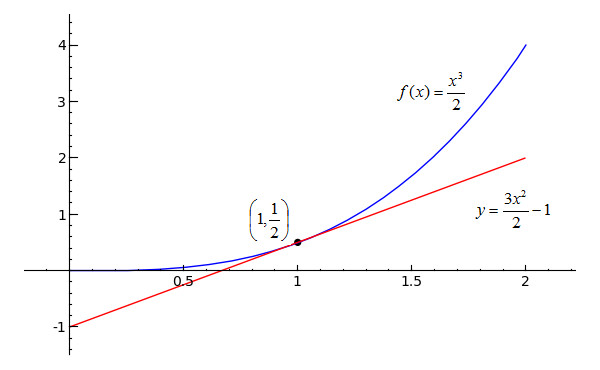
If you’re given a point :
- Find the slope:
- Use point-slope form:
That equation represents the best linear approximation of the function near .
On FRQs, they often want both the slope and the full equation. If you only give the slope, you won’t get full credit.
Multiple Representations of the Derivative
You need to recognize derivatives in four forms.
Analytical
A formula like .
Graphical
Slope of the tangent line.
Positive derivative → increasing.
Negative derivative → decreasing.
Zero derivative → horizontal tangent.
Numerical
Rates of change from a table approaching a limit.
Verbal
“The rate at which the height increases per second.”
Units matter. If is in meters and is in seconds, is meters per second.
AP questions love switching representations. Same idea, different format.
