Topic 5.10 Notes – Introduction to Optimization Problems
What an Optimization Problem Is
An optimization problem asks you to make something as large or as small as possible.
In calculus terms, you are finding an absolute maximum or minimum value of a function, usually within a realistic domain like .
The derivative helps because:
- Critical points occur where or undefined.
- Maximums and minimums happen at critical points or endpoints.
- The derivative tells you where the function increases or decreases.
So optimization is just this idea in disguise:
Build a function from the situation, then use derivatives to find its absolute extreme value.
The Optimization Strategy
These problems feel messy at first because they involve words, not just formulas. The structure is always the same.
- Define variables clearly
- Say what each variable represents.
- Include units (feet, dollars, inches, etc.).
- If dimensions are involved, remember they must be positive.
- Write the objective function
- This is what you’re maximizing or minimizing.
- Area? Surface area? Volume? Cost? Profit?
- Write it symbolically.
- Use the constraint
- There’s always a relationship tying variables together.
- Fixed perimeter, fixed volume, fixed area, revenue relationship, etc.
- Solve this for one variable.
- Substitute
- Replace into the objective function.
- You must end up with one variable only.
- If you still have two variables, you can’t differentiate yet.
- Differentiate and find critical points
- Compute .
- Set .
- Solve carefully.
- Justify maximum or minimum
- Second Derivative Test
- First Derivative Test
- Or compare values if the domain is closed
- Answer the actual question
- Plug back to find missing dimensions if needed.
- Include units.
- State what is being maximized or minimized.
On FRQs, skipping the justification step costs points even if your number is correct.
Common Optimization Setups
These repeat constantly in quizzes and on the AP exam.
Area and Perimeter
Rectangles show up all the time.
- Perimeter constraint like
- Area function
Sometimes:
- One side is against a wall → remove one term
- “Three sides fenced” problems → perimeter expression changes
Surface Area and Volume
Boxes and cylinders are very common.
You must know:
Surface area changes depending on whether a top is included.
For a typical open-top box with a square base of side length and height :
If the box has no lid, the surface area is:
Students often forget to remove the top.
Revenue, Cost, and Profit
In business models:
- Revenue
- Profit
The most common mistake is maximizing revenue when the problem asks for profit.
Also, price usually depends on quantity. Don’t treat price as constant unless stated.
Geometric Relationships
Distance and right triangle relationships show up a lot.
Many optimization problems use the distance formula between two points as the key constraint.
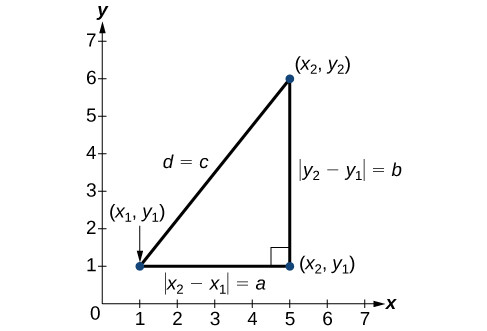
Distance formula from the Pythagorean Theorem
You may need:
Or similar triangles to relate variables.
This is usually the “constraint” part of the problem.
Absolute Maximum vs Local
Optimization problems almost always want an absolute extreme.
If the domain is restricted:
- Length cannot be negative.
- Quantity produced cannot be negative.
- Sometimes an interval is given explicitly.
To justify:
- If , you have a minimum.
- If , you have a maximum.
- If on a closed interval, evaluate endpoints too.
On multiple choice, they often include negative dimensions as trap answers. Eliminate those immediately.
