Topic 2.8 Notes – The Product Rule
The Product Rule
If and are differentiable functions, then
You’ll usually hear it as:
First d second + Second d first
That phrase works because the derivative of a product is not:
If you try multiplying derivatives directly, you lose an entire term. That missing term shows up constantly in wrong answers on quizzes and AP multiple choice.
Why This Rule Exists
When two functions are multiplied, each one is changing. The total rate of change has to account for:
- The first function staying the same while the second changes
- The second function staying the same while the first changes
Both effects happen at once, so we add them.
You don’t need to re‑derive the rule for the AP exam, but understanding this idea helps you remember why there are two terms.
Recognizing When to Use It
Use the Product Rule anytime you clearly see:
- Polynomial × trig
- Polynomial × exponential
- Polynomial × logarithm
- Exponential × trig
- Any two expressions multiplied that aren’t easily simplified first
Examples of expressions that require it:
If you can circle two distinct factors being multiplied, that’s your signal.
When You Don’t Need It
Constant Multiple
That’s just the constant multiple rule.
Easy Polynomial Expansion
If you have:
Expanding first may be faster. On the AP exam, you are not required to expand or simplify unless asked.
Chain Rule Instead
That’s one function raised to a power. That’s Chain Rule, not Product Rule.
Sometimes both rules appear together. For example:
- Chain Rule inside the first factor
- Product Rule overall
Layering rules correctly is a common FRQ skill.
Applying the Product Rule Step by Step
Take:
- Identify factors
, - Differentiate each
- Plug into formula
That’s already a correct AP answer.
You could factor:
but you don’t have to unless told.
Notice something important:
- Both original functions still appear
- There are two terms
If you only have one term, something went wrong.
Visualizing Why
Here’s a quick comparison using a specific example. In the graph below, the black curve is , the blue curve is the correct derivative using the product rule, and the red dashed curve shows what happens if you incorrectly multiply the derivatives.
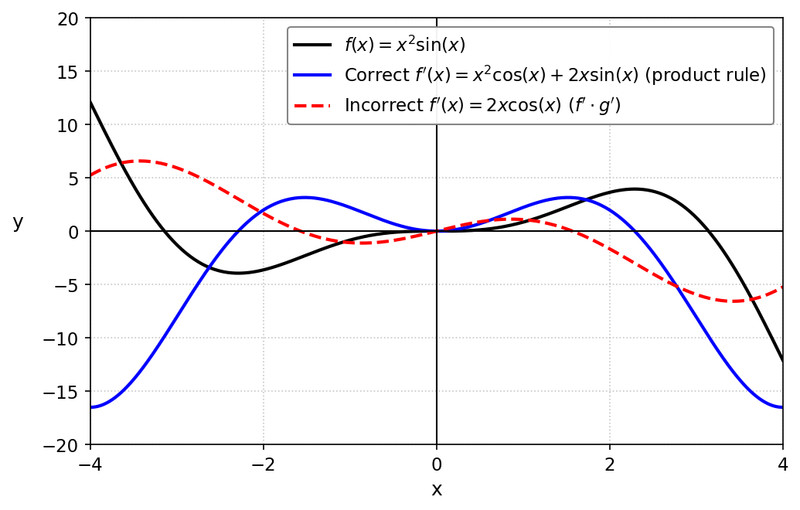
Correct vs. incorrect derivative of
The correct derivative matches where the function increases, decreases, and has horizontal tangents. The red dashed curve does not line up with that behavior. That missing term changes everything.
On multiple choice, this is how they trap people.
Common Mistakes
1. Multiplying derivatives together
Biggest error every year.
2. Forgetting one term
Your answer must have two added pieces.
3. Sign errors with trig
. That negative often gets dropped.
4. Mixing up rule choice
Parentheses with a power usually mean Chain Rule.
Two separate factors mean Product Rule.
What You’re Expected to Do
You should be able to:
- Differentiate products quickly without hesitation
- Combine Product Rule with trig, exponential, and logarithmic derivatives
- Leave answers unsimplified when appropriate
- Recognize layered rule situations
On no‑calculator sections, speed matters. The faster you recognize structure, the fewer algebra mistakes you make.
