Topic 1.10 Notes – Exploring Types of Discontinuities
What Continuity at a Point Means
Everything starts with the definition.
A function is continuous at if and only if all three are true:
- is defined
- exists
Miss even one of these and the function is discontinuous at .
When you justify on an FRQ, you must refer to these conditions. Saying “there’s a hole” is not enough. You need to say which condition fails.
The Three Types of Discontinuities
Every discontinuity you’ll see in AP Calculus AB falls into one of these.
a. Removable Discontinuity (Hole)
What happens
- The limit exists.
- But either the function is not defined at that point, or the function value doesn’t match the limit.
So:
- Condition 2 holds.
- Condition 1 or 3 fails.
What it looks like
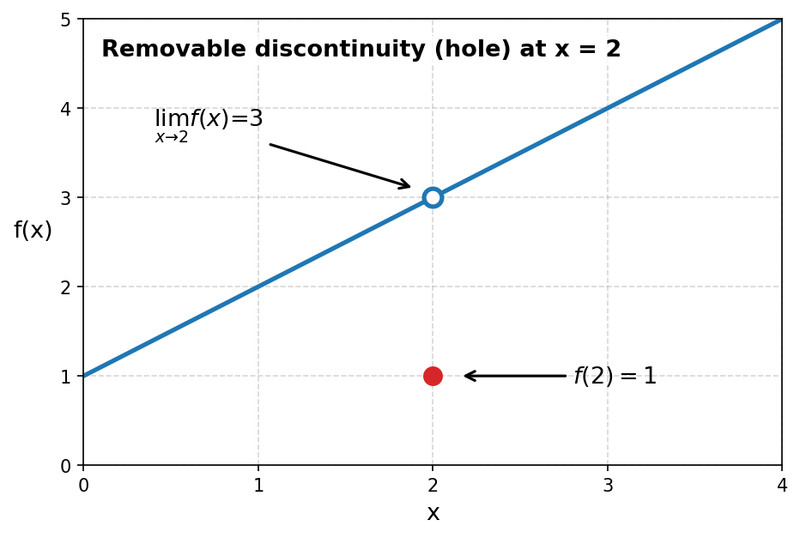
Removable discontinuity at x = 2
The graph approaches the same y-value from both sides. In this example, the limit as is 3, but the filled dot shows . There’s just a missing or misplaced point.
Where it comes from
- Rational functions where a factor cancels.
- Piecewise functions that define one “wrong” value at a single point.
Example idea:
If , factor first:
This simplifies to , but only for .
The original function is undefined at , so there’s a hole.
If you could redefine to match the limit, continuity would be restored. That’s why it’s called removable.
b. Jump Discontinuity
What happens
- The left-hand limit and right-hand limit are not equal.
So:
- Condition 2 fails because the limit does not exist.
What it looks like
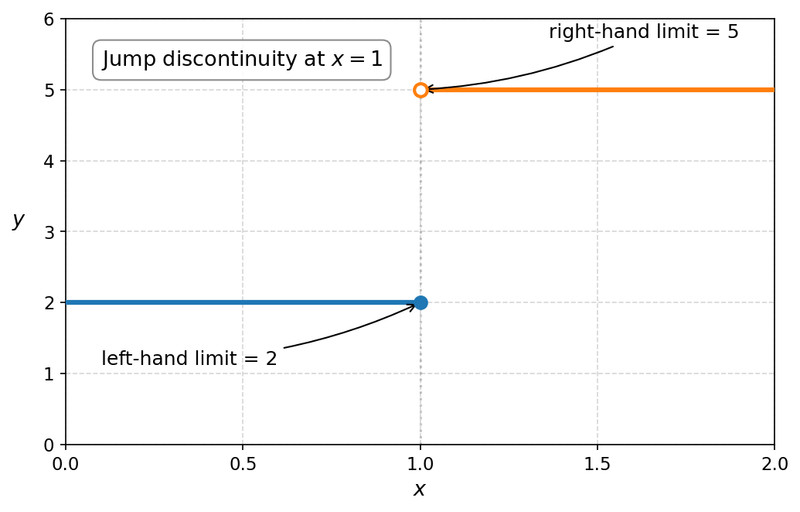
Jump discontinuity at x = 1
As , the graph approaches 2. As , it approaches 5. Both sides approach finite values, but they’re different.
Common source:
- Piecewise functions with different formulas on each side of a point.
Important detail: jumps are finite. The graph doesn’t go to infinity. It just “steps” to a different height.
c. Discontinuity Due to a Vertical Asymptote
What happens
- Function values increase or decrease without bound as .
So:
- Condition 2 fails because the limit is infinite (and infinite limits do not count as existing).
What it looks like
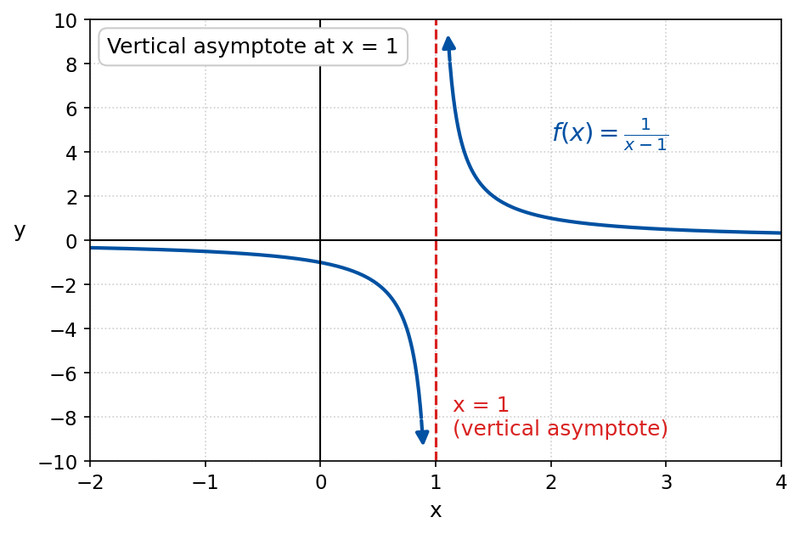
Vertical asymptote at x = 1
Here the function behaves like . As , the graph decreases without bound. As , it increases without bound.
Common source:
- Rational functions where the denominator equals zero and does not cancel.
If the limit is , you have a vertical asymptote discontinuity.
How to Classify a Discontinuity
When given a graph or formula, think in this order:
- Is defined?
- Plug in directly (after simplifying if needed).
- Look for a filled dot on a graph.
- Does the limit exist?
- Compare left-hand and right-hand behavior.
- If algebraic, simplify before evaluating.
- Do they match?
Then conclude:
- All three true → continuous
- Limit exists but not equal to → removable
- One-sided limits unequal → jump
- Limit infinite → vertical asymptote
On written responses, explicitly state which condition fails. That’s what earns full credit.
How This Shows Up on Tests
- You may be asked to “justify using the definition of continuity.” That means referencing the three conditions.
- Graph questions often hide removable discontinuities as open circles.
- Rational expressions almost always require factoring before evaluating limits.
- A common trap is canceling factors and forgetting that the original denominator still restricts the domain.
Also remember: a limit that equals infinity does not mean the limit exists.
