Topic 5.1 Notes – Using the Mean Value Theorem
The Mean Value Theorem
Here’s the formal statement:
If a function is
- continuous on the closed interval , and
- differentiable on the open interval ,
then there exists at least one number in such that
That fraction is the average rate of change on .
The derivative is the instantaneous rate of change at one point.
So the theorem says: at some point inside the interval, the tangent line slope equals the secant line slope.
Here’s what that looks like visually:
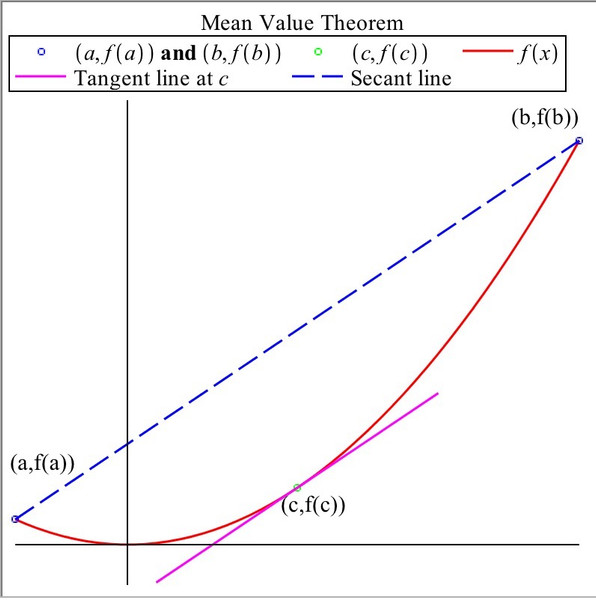
Mean Value Theorem: secant and tangent lines
The dashed blue line represents the secant line between and , and the magenta line is the tangent at with the same slope.
Two key ideas:
- It guarantees existence, not location (unless you solve for it).
- There could be more than one such .
The Two Conditions You Must Check
Every justification problem lives or dies on these hypotheses. If they aren’t satisfied, you cannot use MVT.
1. Continuity on
You need:
- No holes
- No jumps
- No vertical asymptotes
- The function defined at and
Polynomials, exponentials, sine, cosine → continuous everywhere.
Piecewise functions → check endpoints carefully.
2. Differentiability on
Inside the interval, there can’t be:
- Corners
- Cusps
- Vertical tangents
- Discontinuities
Remember: differentiability implies continuity. But continuity alone does not guarantee differentiability.
On a free-response question, you must state both conditions before concluding anything.
Using MVT to Justify a Derivative Value Exists
This is a very common quiz and FRQ setup.
You’ll be asked something like:
“Does there exist a value in such that ?”
Here’s the structure that earns full credit:
State conditions clearly
“Since is continuous on and differentiable on , the Mean Value Theorem applies.”Compute average rate of change
Compare it to the claimed derivative value
- If the result equals 3 → MVT guarantees such a .
- If it doesn’t → MVT cannot justify it.
Important detail students miss: you are comparing the average slope to the specific derivative value they gave you.
If they match exactly, you’re done.
Finding the Actual Value of
Sometimes they want the number.
Example:
Let on .
First, it’s a polynomial → continuous and differentiable everywhere.
Average rate of change:
Now compute derivative:
Set it equal to 2:
Since , that value works.
If you get multiple solutions, only keep the ones inside the open interval.
Rolle’s Theorem as a Special Case
If , then the average rate of change is 0.
So MVT guarantees some where:
That’s called Rolle’s Theorem.
Geometrically, it means if the function starts and ends at the same height, it must have a horizontal tangent somewhere in between.
What MVT Tells You Conceptually
It lets you conclude behavior without knowing the exact point.
- If overall change is positive → derivative is positive somewhere.
- If overall change is negative → derivative is negative somewhere.
- If endpoints match → derivative is zero somewhere.
That’s powerful. You don’t need the full graph. Just the conditions and endpoint values.
