Topic 1.16 Notes – Working with the Intermediate Value Theorem (IVT)
The Intermediate Value Theorem
Here is the formal statement you need to know:
If is continuous on the closed interval , and is any number between and , then there exists at least one number in such that
Translate that into plain language:
- Continuous on → no jumps, holes, or breaks anywhere on that entire interval.
- If the function starts at one y-value and ends at another…
- It must pass through every y-value in between.
In the graph below, the function is continuous from to . The horizontal line sits between and , so the curve has to hit it at some interior point .
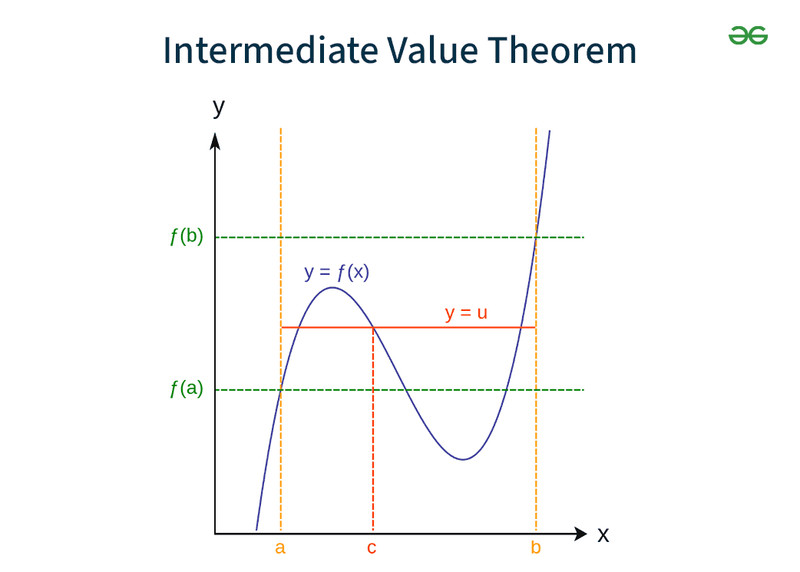
Intermediate Value Theorem illustrated
If you can draw the graph without lifting your pencil between and , IVT is in play.
The Most Tested Case: Proving a Root Exists
On quizzes and the AP exam, the most common use is proving a root exists.
A root means
So now your “target value” is 0.
If:
- is continuous on , and
- and have opposite signs
then there is at least one solution to in .
This is often called the sign change test.
Why it works:
- If one endpoint is positive and the other is negative,
- The function must cross the x-axis somewhere in between.
That crossing is your guaranteed root.
The Two Conditions You Must Check
Students lose points because they skip one of these.
1) Continuity on a Closed Interval
You must verify the function is continuous on .
- Polynomials → always continuous.
- , , → always continuous.
- Rational functions → continuous only where denominator ≠ 0.
- Piecewise functions → check for jumps.
If there is a discontinuity anywhere inside the interval, IVT does not apply.
Also notice it must be a closed interval , not just .
2) The Target Value Is Between the Endpoint Values
You must explicitly show:
Either
or
For roots, this becomes:
- One value positive
- One value negative
No sign change? Then IVT guarantees nothing.
What IVT Guarantees (and What It Doesn’t)
✔️ It Guarantees:
- At least one solution exists.
- The solution is in the open interval .
- The function takes on every intermediate y-value.
❌ It Does NOT Guarantee:
- The exact location of the solution.
- That there is only one solution.
- A solution if there is no sign change.
- Anything if the function is not continuous.
Important detail: even if both endpoints are positive, a root might still exist inside. IVT just cannot confirm it without a sign change.
How to Write a Complete Justification
When asked to justify using IVT, your response should include three ingredients:
- State continuity
“Since is a polynomial, it is continuous on .” - Evaluate the endpoints
Show actual values of and . - State the conclusion clearly
“Since 0 is between and , by the Intermediate Value Theorem, there exists at least one in such that .”
Those exact phrases matter. On FRQs, missing the continuity statement costs points.
Using IVT to Explain Function Behavior
IVT lets you describe behavior without solving.
Examples of reasoning you might see:
- If and , then the function must equal 7 somewhere between 2 and 5.
- If a temperature function changes from −4 to 6 degrees over time and is continuous, it must have been 0 degrees at some moment.
- If a continuous function never changes sign on an interval, it never crosses the x-axis there.
This is why IVT is called an existence theorem. It proves something must happen, even if you cannot find where.
