Topic 5.9 Notes – Connecting a Function, Its First Derivative, and Its Second Derivative
How f, f′, and f'' Are Connected
Everything comes down to sign (positive/negative) and increasing or decreasing behavior.
Core relationships
- If → is increasing
- If → is decreasing
- If → critical point of (possible max/min)
- If → is concave up and is increasing
- If → is concave down and is decreasing
- If → possible inflection point (must check sign change)
Think of it like layers:
- controls up/down movement
- controls bending
The three graphs below show the same function and its first two derivatives lined up side by side.
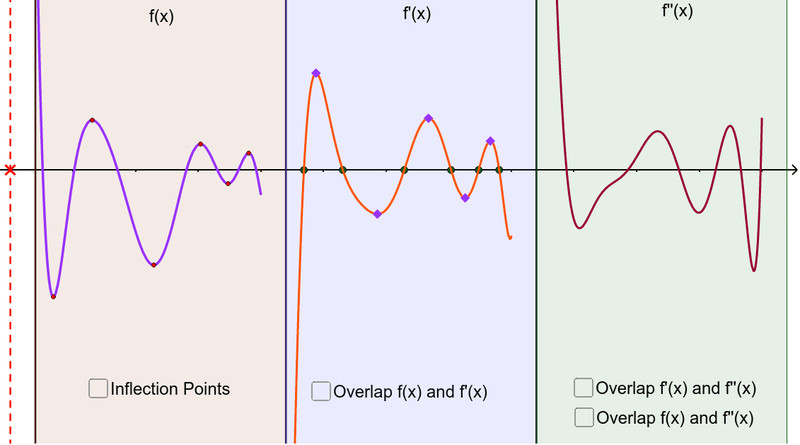
Aligned graphs of , , and
Notice how the x-values of the local maxima and minima of match the zeros of . Then look at where has its own peaks and valleys. Those line up with zeros of . When you study graphs like this, you are matching features across layers.
Increasing, Decreasing, and Relative Extrema
Reading increasing/decreasing from
If you’re given the graph of :
- Above the x-axis → → increasing
- Below the x-axis → → decreasing
That’s it. No slope estimation needed.
Relative maxima and minima
All relative extrema of occur where:
- or undefined
But zero alone isn’t enough. You need a sign change.
- changes positive → negative → relative maximum
- changes negative → positive → relative minimum
Here’s a clean example. This is a graph of , so we are using only the derivative to predict what is doing.
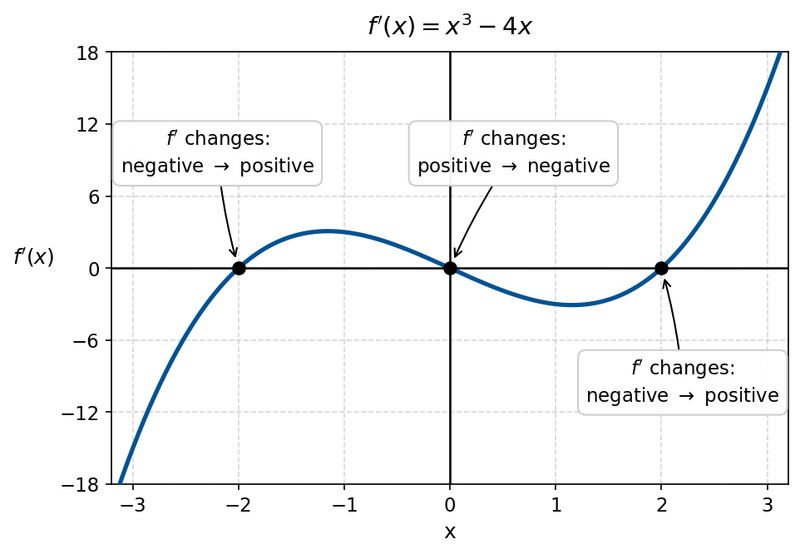
From this graph alone, look at how changes sign at each zero:
- At , changes negative → positive, so has a relative minimum.
- At , changes positive → negative, so has a relative maximum.
- At , changes negative → positive, so has another relative minimum.
On FRQs, the justification must mention the sign change. Just writing “because ” will not earn the point.
Concavity and Points of Inflection
Concavity from
If you’re given the graph of :
- Above x-axis → → concave up
- Below x-axis → → concave down
You can also read concavity from :
- If is increasing → → concave up
- If is decreasing → → concave down
Points of inflection
A point of inflection occurs where:
- changes concavity
- which means changes sign
Major connection:
- Inflection points of are relative extrema of
- They are also x-intercepts of with sign change
If just touches zero and stays the same sign, there is no inflection point. This is a common trap on multiple choice.
The Full Relationship Map
Here’s the whole chain in one place:
- Relative extrema of
↔ x-intercepts of (with sign change) - Points of inflection of
↔ relative extrema of
↔ x-intercepts of (with sign change) - Increasing/decreasing of
↔ sign of - Concavity of
↔ sign of
↔ increasing/decreasing of
When you’re given only one graph on a test, mentally build the others.
If they give you , you should automatically be thinking about:
- where it crosses zero,
- where it’s positive or negative,
- where it’s increasing or decreasing.
That alone tells you almost everything about .
