Topic 4.4 Notes – Introduction to Related Rates
What a Related Rates Problem Is
A related rates problem involves:
- Two or more variables that are changing over time
- An equation connecting those variables
- A known rate like
- An unknown rate like
Every variable depends on the same independent variable, almost always time .
If one quantity depends on another, and that depends on time, the chain rule explains what happens:
That layered dependence is the whole idea. When you differentiate with respect to , every changing variable picks up a .
Quick reminder from Unit 2: this is just implicit differentiation, but now you’re interpreting everything as a rate.
The Core Strategy
Strong students follow the same structure every time.
1) Define Variables Clearly
Assign variables to all changing quantities.
Identify:
- Known rates (example: cm/sec)
- Values at the specific instant
- The unknown rate you’re solving for
Include units. Units often save points on FRQs.
2) Write an Equation Connecting the Variables
Use geometry or a formula from the problem.
Common relationships:
- Circle:
- Sphere:
- Right triangle:
- Rectangle:
If extra variables appear, use another equation to eliminate them before differentiating.
For example, a sliding ladder forms a right triangle.
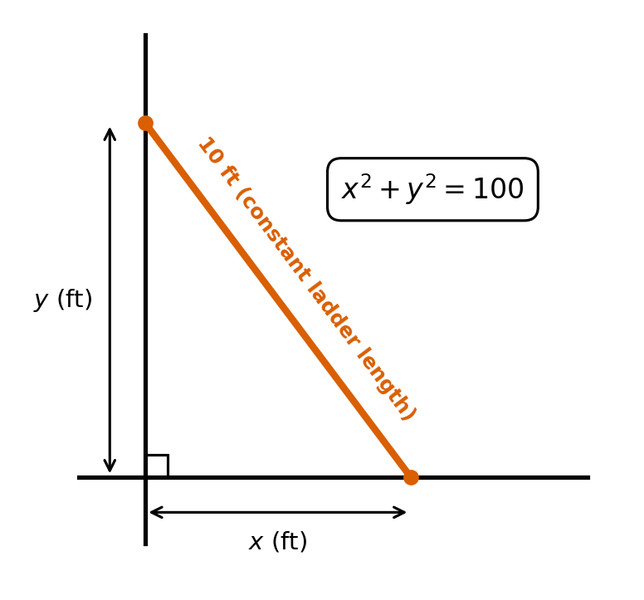
Sliding ladder right triangle model
The 10 ft ladder is the hypotenuse, so .
3) Differentiate With Respect to Time
Differentiate both sides with respect to .
Every variable gets a chain rule factor.
Example:
Differentiate:
Notice how became .
That chain rule factor is what students forget most often.
4) Substitute After Differentiating
Only now plug in:
- Known values of variables
- Known rates
If you need a missing value (like ), go back to the original equation and solve for it first.
Then solve algebraically for the unknown rate.
Always interpret the sign:
- Positive → increasing
- Negative → decreasing
And attach units like ft/sec or cm²/sec.
Differentiation Rules That Show Up
The chain rule is always present.
Example:
Sometimes you also need:
Product Rule
If area depends on two changing sides:
Then:
This shows up a lot with rectangles or expanding surfaces.
Quotient Rule
If a relationship involves division:
Then:
If two variables are multiplying or dividing, expect extra differentiation rules beyond the chain rule.
Common Mistakes That Cost Points
- Plugging in numbers before differentiating
You’ll lose the variable and its rate. - Forgetting chain rule factors
, not just . - Ignoring direction
If something is shrinking, its rate is negative. - Dropping units
AP graders expect them in context problems.
On multiple choice, missing a negative sign is the fastest way to pick the trap answer. On FRQs, missing the chain rule usually loses most of the points for the part.
