Topic 5.11 Notes – Solving Optimization Problems
What an Optimization Problem Is
An optimization problem asks you to maximize or minimize something meaningful in context. That “something” is always modeled by a function.
Quick grounding from earlier topics:
- Critical points occur where or is undefined.
- The First or Second Derivative Test helps classify them.
- On a closed interval, absolute extrema can happen at critical points or endpoints.
In optimization, you are usually looking for an absolute maximum or minimum, not just local behavior. And the number you find must be interpreted in context, not left as a bare critical value.
The Core Structure of Every Optimization Problem
Almost every AP problem of this type fits this structure:
a. Objective Function
This is what you’re trying to optimize.
- Area
- Volume
- Surface area
- Cost
- Revenue or profit
- Distance
You must write it as a function of one variable before differentiating.
If your function still has two variables when you take the derivative, something is missing.
b. Constraint Equation
This limits the situation.
Examples:
- Fixed perimeter
- Fixed volume
- Limited material
- Budget restriction
You use the constraint to eliminate one variable.
For example, if and represent dimensions and you know
you can solve for one variable, such as
and substitute into the objective function.
That substitution step is where students lose points most often.
c. Feasible Domain
Not every mathematical solution makes sense physically.
- Lengths, radii, time → must be positive.
- Sometimes the problem gives an actual interval.
If the domain is closed, check endpoints. If it’s open (like ), you focus on critical points.
d. Critical Points and Endpoints
Now calculus comes in.
- Differentiate the one-variable objective function.
- Solve .
- Classify using derivative tests.
- Compare with endpoints if required.
You are looking for the absolute extreme value.
The Optimization Process in Action
Here’s the full sequence laid out visually. This is the mental checklist you want on test day.
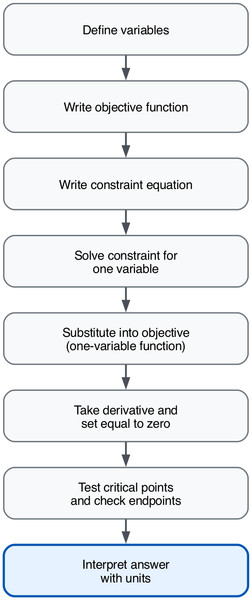
Optimization problem-solving flowchart
Under pressure, think through that sequence mentally.
One small example (different from your textbook ones):
Suppose a rectangle has area and you want to minimize its perimeter.
- Let width be , length be .
- Constraint: .
- Perimeter (objective):
- Differentiate:
- Set equal to zero:
Solving gives , so . That produces a square, which gives the minimum perimeter.
Notice we optimized perimeter, not area. Students often mix up which function they’re supposed to differentiate.
Interpreting the Answer
This is where points are earned or lost.
If the question asks:
- “What dimensions maximize the area?” → give the dimensions.
- “What is the maximum area?” → give the function value.
- “When is profit maximized?” → give the input value (units produced) and possibly the profit amount.
Your final statement should:
- Use a complete sentence.
- Include units.
- Refer to the actual context.
For example:
“The maximum profit is 12,400 dollars when 350 units are produced.”
On FRQs, leaving off units or failing to state what the number represents can cost the final point even if the calculus is perfect.
Patterns You Should Recognize Fast
Certain setups repeat constantly:
- Fixed perimeter → maximize area usually leads to a square.
- Fixed volume cylinder → minimize surface area often leads to a height related to the radius in a simple ratio.
- Profit problems use .
If you recognize the structure early, you’ll move faster and make fewer algebra mistakes.
